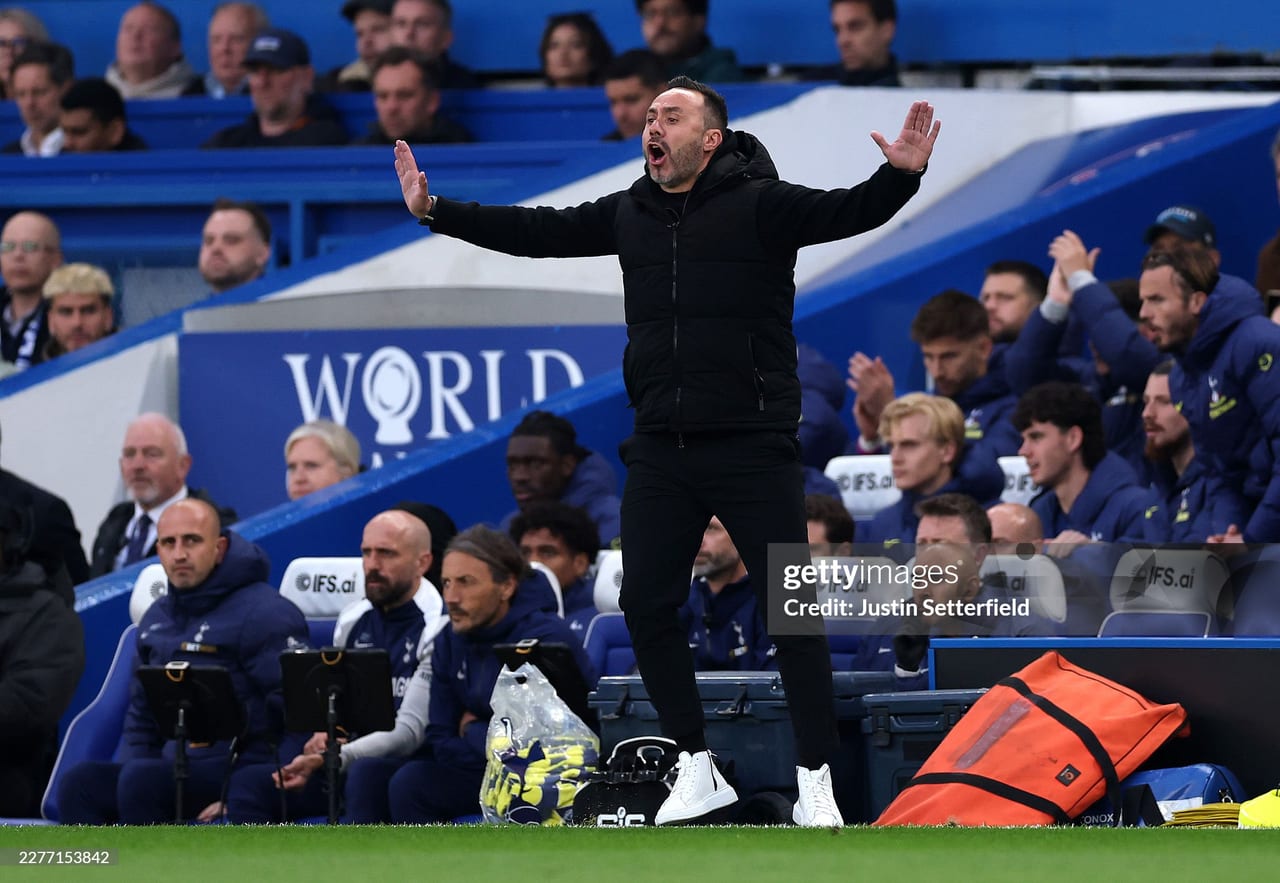
For long stretches of Tuesday night, this did not feel like a normal London derby. It felt like two footballing ideologies trying to emotionally survive themselves.
Chelsea FC entered Stamford Bridge needing a result to keep their European ambitions alive. Tottenham Hotspur arrived carrying something far heavier: fear.
Fear of relegation. Fear of collapse. Fear of a season spiraling into humiliation.
That difference ultimately decided everything.
Chelsea controlled the spaces Tottenham wanted to use
Roberto De Zerbi’s Tottenham attempted to build through his trademark risk-heavy positional framework. Spurs lined up in a fluid 4-2-3-1 but constantly morphed into a deep 4-2-2-2 structure during buildup, baiting Chelsea’s press deep inside their own half.
The idea was simple in theory.
Invite pressure centrally, drag Chelsea’s midfield forward, then exploit the vertical gaps left behind through rapid third-man combinations into the wide areas.
But Enzo Maresca prepared for exactly that.
Chelsea did not obsess over dominating possession. Instead, they dominated territory and passing lanes. Their 3-2-2-3 buildup shape created overwhelming numerical superiority in central midfield, with Moisés Caicedo anchoring the base while Enzo Fernández pushed aggressively into the left inside channel.
That created a constant four-versus-two scenario against Tottenham’s double pivot of Rodrigo Bentancur and Pape Matar Sarr.
Spurs were not just outnumbered. They were structurally trapped.
Chelsea’s press worked almost passively at first. Tottenham’s centre-backs were allowed to circulate possession harmlessly across the back line, but the second a vertical pass entered midfield, Chelsea exploded into aggressive pressure.
Caicedo, Cole Palmer, and Enzo Fernández locked onto Tottenham’s central options with ruthless precision.
The effect was devastating.
Instead of manipulating Chelsea’s press, Tottenham repeatedly accelerated directly into it.
Enzo Fernández punished Tottenham’s emotional impatience
Chelsea’s opener in the 18th minute did more than give the hosts the lead. It psychologically distorted Tottenham’s entire tactical structure.
Fernández’s stunning long-range strike forced Spurs into emotional football far earlier than De Zerbi would have wanted.
Before the goal, Tottenham still attempted patient buildup patterns despite Chelsea’s pressure. After it, their circulation became visibly frantic. Vertical passes were rushed. Distances between midfield and defence stretched dramatically. The calm positional manipulation De Zerbi demands disappeared under the emotional weight of the occasion.
Chelsea immediately sensed it.
Rather than pushing recklessly for a second goal, Maresca’s side doubled down on controlling central access points. Palmer drifted intelligently between Tottenham’s midfield and defensive lines, while Pedro Neto and Alejandro Garnacho maintained maximum width to isolate Spurs’ fullbacks.
Chelsea were not dominating through endless possession sequences. They were dominating through spatial suffocation.
Tottenham’s midfield simply stopped functioning as a connector between defence and attack.
Chelsea’s second goal explained Tottenham’s entire night
The second goal in the 67th minute was not just a defensive mistake. It was Tottenham’s tactical identity collapsing in real time.
Andrey Santos’ finish arrived from a Pedro Neto cross, but the real story was the structural chaos that created the move in the first place.
Tottenham’s aggressive buildup principles had already begun physically collapsing by the hour mark. The distances between their defensive line and midfield were becoming enormous, sometimes stretching beyond 30 yards. Their press lost synchronization. Their recovery runs slowed. Their compactness vanished.
Chelsea immediately attacked those gaps.
As Neto received possession wide, Tottenham’s defensive shape completely lost balance. One defender stepped toward the ball, another retreated toward the six-yard box, while the midfield failed to recover into the central corridor.
The result looked almost comedic from a structural perspective.
Santos arrived into the penalty area virtually untracked because Tottenham had overloaded their own defensive attention toward the wide delivery. Chelsea manipulated Spurs’ panic perfectly.
It was the football equivalent of everybody trying to fix the same problem simultaneously while creating three new ones.
So the answer to how Chelsea’s second goal happened, the answer is brutally simple:
Tottenham became so obsessed with surviving the immediate danger that they forgot to defend the actual scoring zone.
That sequence summarized the entire match.
Tottenham abandoned control and embraced chaos
Ironically, Tottenham looked most dangerous once they completely abandoned their original tactical plan.
After Chelsea’s second goal, Tottenham abandoned controlled buildup and shifted toward direct transition football and early wide deliveries.
Long balls replaced patient circulation. Wide crosses replaced controlled progression. The midfield was largely bypassed entirely.
It should not have worked.
Yet Chelsea briefly lost emotional control after Richarlison’s 73rd-minute goal, which arrived following a sharp combination involving Pape Matar Sarr.
Suddenly Stamford Bridge became nervous.
Chelsea dropped deeper. Their defensive line retreated. Palmer abandoned his advanced playmaking role to help stabilize midfield possession, while late substitutions from Maresca sacrificed pressing aggression for defensive security.
The final stages descended into pure emotional warfare.
Tottenham threw numbers into the penalty area with little positional restraint. Micky van de Ven stepped aggressively into midfield zones to launch aerial deliveries, while Chelsea accumulated yellow cards attempting to disrupt the rhythm of the game through tactical fouls and physical interruptions.
For the final ten minutes, structure disappeared entirely.
This became survival football.
Chelsea won the midfield war before they won the match
The clearest tactical truth from Stamford Bridge was Chelsea’s complete superiority in central areas.
Their midfield structure consistently overwhelmed Tottenham numerically and positionally, with Caicedo anchoring Chelsea’s buildup while Fernández and Palmer manipulated the spaces between Tottenham’s midfield and defensive line.
Spurs simply never solved the overload problem.
Bentancur and Sarr were forced into impossible defensive coverage responsibilities, constantly shifting horizontally to close passing lanes while simultaneously trying to support buildup progression.
The physical exhaustion eventually became visible.
Chelsea’s control did not come from endless possession dominance. It came from deciding where the game would be played and which players would be allowed to influence it.
That is a far more sophisticated form of control.
Tottenham’s relegation fear distorted their football
The emotional backdrop mattered enormously.
This was not just another tactical battle.
Tottenham were carrying the psychological pressure of a relegation fight into one of the most structurally demanding tactical systems in modern football.
De Zerbi’s buildup principles require calmness, trust, and precise positional timing. Tottenham instead played with visible anxiety after falling behind.
That anxiety transformed calculated risks into reckless ones.
The irony is painful.
Tottenham’s tactical system is designed to manipulate pressure. Against Chelsea, pressure manipulated Tottenham instead.
The final truth
This match was ultimately decided by Chelsea’s superior midfield structure and positional discipline, which dismantled Tottenham’s risky buildup patterns and forced the defensive chaos that defined the night.
Chelsea looked like a team controlling the geometry of the pitch.
Tottenham looked like a team trying to emotionally outrun their own season.