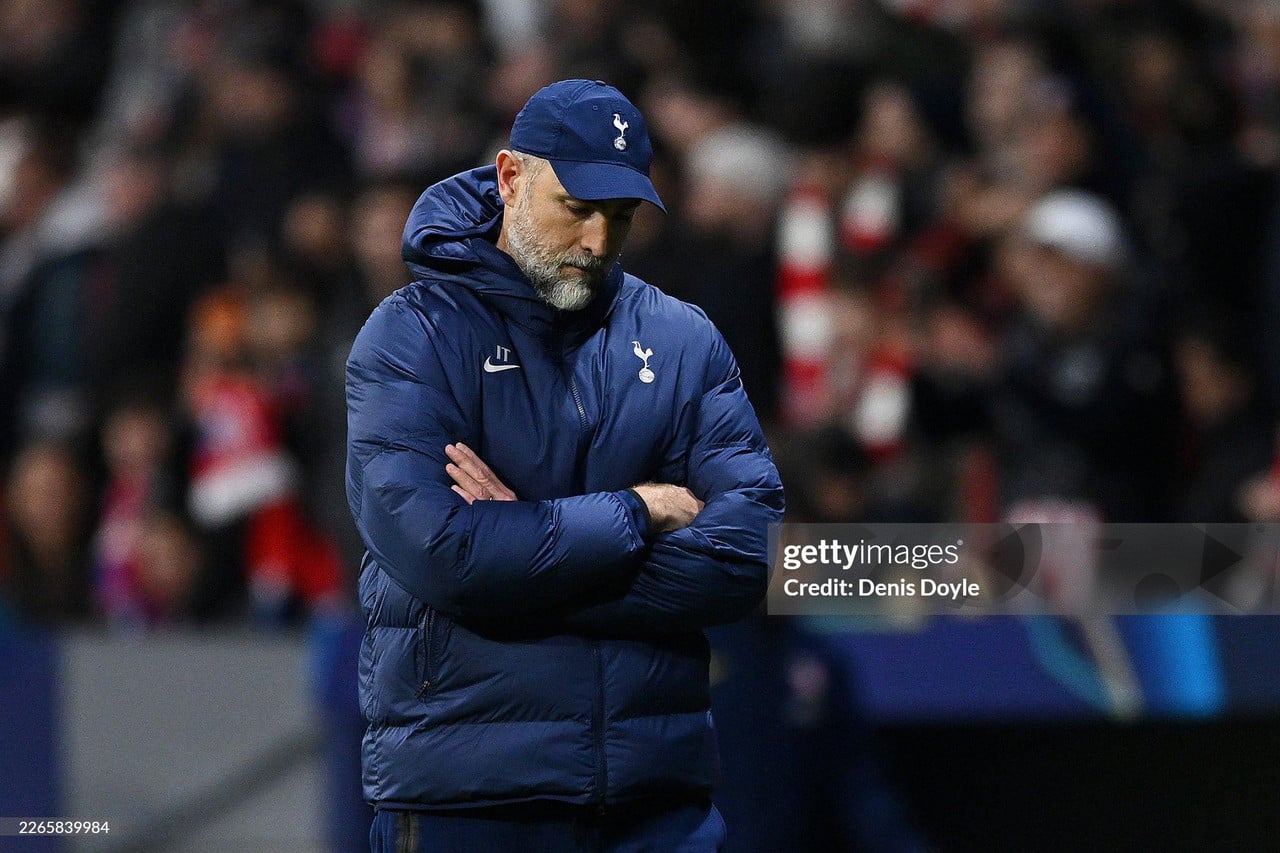
To say that Tottenham Hotspur have a problem would be a seismic understatement.
The club sacked Ange Postecoglou weeks after winning their first piece of silverware in 17 years, only to sack his successor, Thomas Frank, months later.
Frank had unknowingly led the Lilywhites into a relegation fight and, as Leeds, West Ham and Nottingham Forest gradually closed the gap, the Spurs board pulled the plug on the former Brentford boss.
In a bid to turn their season around with fresh ideas and innovation, Spurs turned to Igor Tudor, a manager known best for playing a three-at-the-back wingback system, uncanny in its similarities to the tactics used, unsuccessfully, by his predecessor.
With only Conor Gallagher joining Spurs in the January window, weeks before Frank’s dismissal, the situation was… odd.
The same players and tactics were expected to yield different results at the most crucial stage of the campaign.
Unsurprisingly, Tottenham’s fortunes have not changed on the pitch, while tensions and emotion has risen drastically off it.
Now, just two points above the drop zone in the Premier League, Spurs’ latest embarrassment, a 5-2 thrashing at Atletico Madrid, is a low that Tudor cannot come back from.
It is abundantly evident that the players have lacked what little faith they may have initially had in the Croatian, with a lack of hunger, fight and cutting edge culpable for their demise in the Spanish capital.
The transfer window is fixed shut until long after the season ends, when Spurs’ future in the top flight of English football will already have been decided. Something needs to change, and fast.
It cannot be the players, so Tudor must go.
Let one thing be clear, however, the former Juventus boss is not solely responsible for his new employers’ woes, far from it.
But whatever the specifics and causes of Spurs’ issues, of which there are many, do not matter here and now.
Whether you are discontent with the board, unhappy with certain players or dissatisfied with the general direction of the club’s trajectory, there is not enough time in their nine remaining Premier League games to make meaningful changes to those areas.
Spurs need somebody to make an immediate difference, not a lasting one. Tudor’s appointment on a deal until the end of the season is proof that the club agree, but now they must recognise that their judgement was wrong, and roll the dice again - but the stakes are far higher this time.
Get it wrong again, and midweek visits to Madrid could soon be replaced with Saturdays in Stoke, all while their north London rivals hurtle towards a first Premier League title in 22 years.
The exact solution is not an obvious one, but what Spurs need is clear: belief. With players seemingly giving up mid-game, sometimes even mid-run, it is easy to see how things have unravelled so quickly.
In fact, asked after the game whether he believes he deserves to continue as Spurs boss, Tudor responded, emotionless, “No comment,” in a scene more reminiscent of a trial than a Champions League press conference.
Tudor cannot be confident that he deserves to continue after a mere four games at the helm, so how can he expect any player to get behind his ideas? He cannot.
If Spurs are to retain their Premier League status, it will not be pretty. Holding onto hopes of easy-on-the-eye, free-flowing football is pointless and will only lead the Lilywhites closer to the edge of a perilous cliff face.
Tactics remain important, but should be rendered subordinate to the rapid change in mood needed at the Tottenham Hotspur Stadium.
One of the biggest hurdles facing any prospective new boss to improve morale among the squad is to regalvernise the fanbase. Tudor has cut a lonesome figure for himself in record time, while his predecessor’s media comments alienated him from much of the fanbase.
Somebody who knows the club and gets what it means to the fans is essential. The worry for Spurs is that candidates who fit that admittedly limited criteria are of even shorter supply.
A perhaps obvious candidate would be Ryan Mason. A two-time interim boss at the Tottenham Hotspur Stadium, Mason left the Lilywhites in June 2025 to become Championship side West Bromwich Albion’s head coach.
Just seven months later, in January, Mason was sacked, with the Baggies 18th at the time, just seven points from the drop zone. Though since his dismissal, West Brom have plummeted to new lows, currently sitting 22nd, two points from safety.
Though his credentials as a manager in his own right are sub-optimal, Mason has always enjoyed a strong relationship with Spurs supporters and, as a two-time interim boss of the club, will already have a rapport with some players, a bond which could prove crucial so late into the campaign.
Mauricio Pochettino cuts an interesting figure in Spurs’ managerial debate. One of the most-loved managers in the club’s history, the Argentine was in attendance at the Riyadh Air Metropolitano on Tuesday, an invited witness to his former side’s slaughter.
If reports are to be believed, Pochettino is a front-runner for the permanent Spurs job in the summer, when Tudor’s interim contract will end, if it is not done prematurely, but there is a fundamental issue with any talk of an early arrival for the 2021/22 Ligue 1 winner.
He is currently the manager of the United States and, with a home World Cup just three months away, the US are unlikely to consider his departure, or allowing him to split his responsibilities to occupy both roles, at present.
An outsider who meets the criteria, Harry Redknapp, has not managed professionally since a brief stint at Birmingham City in 2017, but even he looks an unlikely option, with the 79-year-old due to appear in ITV’s ‘I’m A Celebrity South Africa’ in April.
Whoever Spurs decide to move forward with, it cannot be Tudor; that much is clear. There is too much at stake to persist with the same failed ideas and expect to reap new rewards.