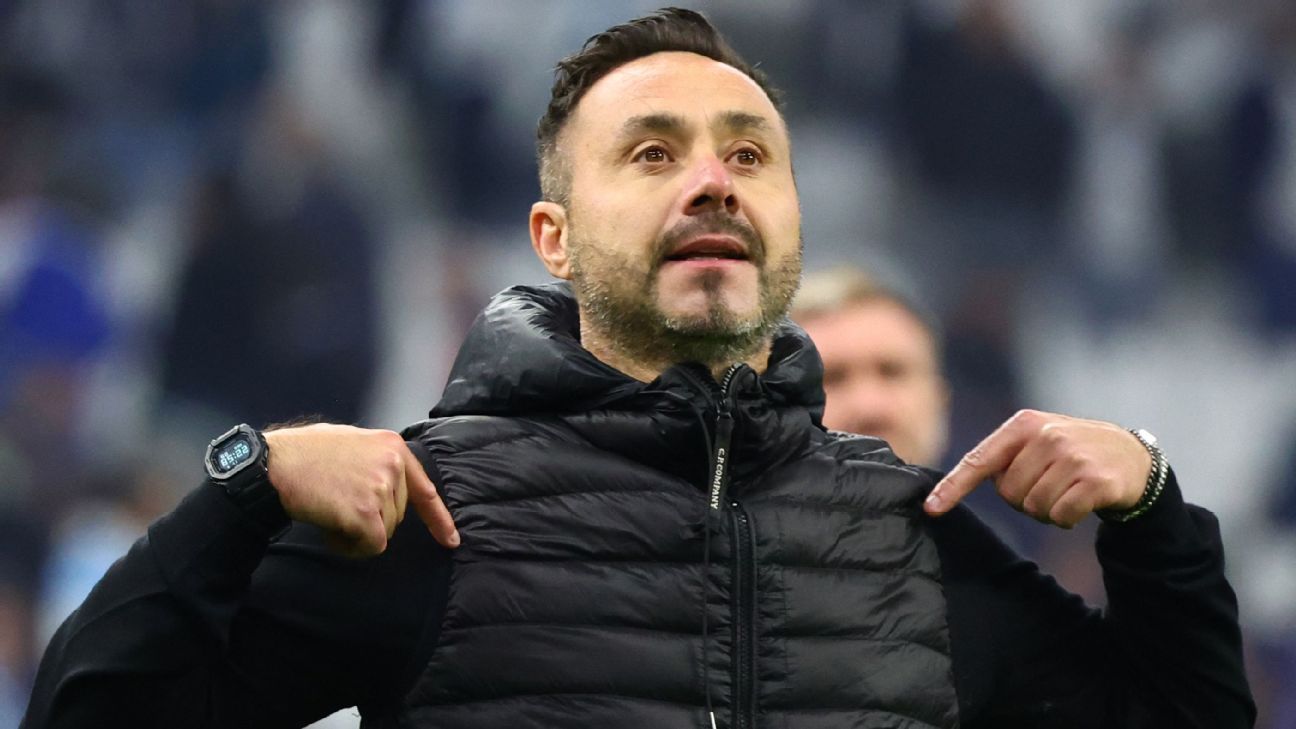
The biggest news in club football right now is at Tottenham Hotspur, who have appointed another manager with Roberto De Zerbi signing a five-year deal to replace Igor Tudor after the interim coach lasted just six weeks in the role.
De Zerbi, who has been out of work since exiting Ligue 1 side Marseille in February, has a seismic task ahead of him in north London. His new club are facing a battle to avoid Premier League relegation for a second straight season, sitting just one point above the bottom three with seven matchdays remaining.
"I am delighted to be joining this fantastic football club, which is one of the biggest and most prestigious in the world," De Zerbi said in a club statement. "I am here because I believe in that ambition, and have signed a long-term contract to give everything to deliver it."
- Tudor's disastrous 6 weeks left Spurs even closer to drop. What happened?
- No plan, no fight: Spurs hurtling toward relegation after loss to Forest
- How did Tottenham go from Europa League champs to relegation battle?
De Zerbi is Tottenham's third manager of the 2025-26 season, following Thomas Frank (fired in February) and the outgoing Igor Tudor, who was relieved of his duties on March 29 without winning any of his five league games. But why did Tottenham land on the fiery former Brighton & Hove Albion manager, and what can he do with this squad from a tactical perspective in order to win their fight and remain in the Premier League?
Why have Tottenham hired De Zerbi?
Sources have told ESPN that De Zerbi was the club's preferred choice for a long-term appointment this summer; they even tried to hire him after Thomas Frank's sacking in February. De Zerbi parted company with Marseille on the same day Frank was sacked by Spurs, but sources familiar with the discussions told ESPN that the Italian's reluctance to jump straight into another job forced the club to look at alternatives, eventually hiring Tudor.
De Zerbi, 46, was also part of the conversation when Tottenham opted to appoint Frank last year. Back then, the club identified 10 criteria for a new head coach, which included a track record in developing young players, communicating effectively with the media and an attractive style of football. Despite Frank's failure in the role, those criteria largely remain in place. In a rare interview with media including ESPN on Feb. 20, sporting director Johan Lange expanded on the point about style.
"We are very ambitious to create a team that can play dominant football and that can control the matches with the ball for a few reasons," said Lange. "If you look across almost every league in the world, that is how you can say the top teams normally are successful -- that is being able to dominate possession, create chances, be aggressive without the ball and so that is of course the football.
De Zerbi's Brighton fits that profile, but the reality is that style can come later. More immediately, he has seven games to help Spurs avoid the catastrophe of relegation to the Championship.
Sources with knowledge of the process say the club were also keen to avoid the instability of another interim appointment, believing there to be no other highly credible coach available right now. The view was also taken that a group of players low on confidence and coached in dramatically different ways by Frank and Tudor would benefit from the stability of knowing the new head coach was not just passing through, having signed a long-term contract through 2031.
Further benefits come in the certainty De Zerbi's appointment should yield in the transfer market. Spurs cannot guarantee what level of football they can offer prospective signings next summer, but with De Zerbi in place, the club can identify and begin laying the groundwork on the targets they need to help him implement his style of football. Equally, De Zerbi can make detailed assessments of the existing squad and begin clarifying who he wants to work with next season.
Sources told ESPN there is an acknowledgment internally that a major overhaul of the playing staff is needed, plus a more aggressive approach to the club's wage structure that's long been comparatively conservative by traditional 'Big Six' standards. However, one note of caution came on Monday in Spurs' latest financials for the year ending June 30, 2025: a loss of £94.7 million and a net debt of £831.2 million.
Spurs also worked hard to change De Zerbi's mind over taking the role this season, sources told ESPN. One source has suggested there is a substantial bonus written into his new contract which is triggered if relegation is successfully avoided. The five-year deal -- again, a length designed to provide as much stability as possible -- has no relegation clause in a strong show of faith from both sides.
De Zerbi is indeed an effective communicator, but also a controversial one. He has a track record of falling out with players and executives, disagreements with the latter hinging on him demanding a greater say in transfer strategy and more aggression in the market.
Sources have told ESPN that the more volatile elements of De Zerbi's character were acknowledged and considered, but at the same time, bringing in a manager with such a defined vision of what he wants and how he wants to play can give clarity to the team's direction, which has felt decidedly rudderless of late. Put simply, De Zerbi's force of personality could fill a void that many staff believe exists at the club in terms of their future strategy.
Sources say both the club and De Zerbi are sensitive to his past comments on Mason Greenwood, amid three Spurs fans groups voicing their opposition to his appointment. Greenwood initially faced three charges -- one count of attempted rape, one count of controlling and coercive behaviour and one count of assault occasioning actual bodily harm -- in October 2022. The case was later discontinued after key witnesses withdrew and "new material came to light."
Greenwood joined Marseille in 2024, and De Zerbi later praised him as "a good guy" who had paid a "heavy price." Sources have told ESPN that those words were discussed as part of the hiring process, but Spurs felt sufficiently confident to proceed. -- James Olley
Is De Zerbi the right man to keep Spurs up?
During two seasons with Brighton, from 2022-24, De Zerbi made a profound tactical impact on the Premier League. The Italian instructed his players to do something quite curious that made them stand out from the rest of the division.
Watch any Brighton game from 2023 and you'll see something you don't really see anywhere else: Very frequently, when in possession midway up the pitch, the Seagulls' center backs not only came to a complete standstill with the ball, but they placed their studs on top of it too. This was De Zerbi's attempt to wave a red flag at a charging bull; he wanted opponents to react to that by pressing his players and trying to recover the ball. That became known as "baiting the press," and once it happened Brighton would play a neat triangle around the opponents -- and suddenly find themselves galloping into the space that opened up.
For a heavily possession-focused coach -- and make no mistake, with De Zerbi, it's all about having the ball -- this was a crucial tool in opening up teams that tried to sit in, defend deeper and protect the center of the pitch... and it worked.
Brighton finished sixth in 2022-23, the best league placement in club history, and led them into a European campaign for the first time. Only Liverpool, Arsenal and Manchester City scored more goals than the Seagulls' 72. Alexis Mac Allister, Moisés Caicedo, Leandro Trossard and Kaoru Mitoma all broke out under De Zerbi's guidance.
The Italian prioritises technically skilled players in every position -- even goalkeeper -- as he demands his team continually play short from the back. When it works, it looks amazing: slick combination moves bypass opponents' pressing and open up the whole pitch to attack in transition.
Defensively, De Zerbi-led teams are aggressive in trying to win the ball back high up. De Zerbi asks his striker to set the press and for his teammates to follow him in. One of the benefits of having lots of possession -- his teams typically average more than 55% possession across a season, while individual games can spike into the high 60s or low 70s -- is that you can conserve energy while on the ball, then expend it closing down when you lose it.
All of this, naturally, sounds wonderful on paper, and there's clear evidence that his methods have led to good, even great things at Sassuolo, Brighton and Marseille in the last decade. But the big problem here is how much of it can be applied to Tottenham in their current predicament. By the time they next play, at Sunderland on April 12, Spurs could be in the bottom three if relegation rivals West Ham United win they home game against bottom club Wolverhampton Wanderers two days earlier.
Will the Tottenham defensive unit be comfortable with a sudden switch to playing out under pressure and baiting the press? Can an effective pressing system of their own be instilled in such a short space of time? And, most crucially, do Spurs have the right midfielders to even play heavy possession football?
One thing must be made very clear: In this iteration of the Premier League, where teams have spent big money to get bigger, stronger and more athletic, playing bad possession football is a recipe for disaster. Loose passes are pounced upon and punished in an instant. The vast majority of teams in the league have abandoned the idea of playing total football because they're simply not good enough to do it -- or the risks are too great.
Will De Zerbi stay true to his ideology despite the truly desperate situation he now finds himself in, or will he compromise on his principles in the short-term? If the answer is the latter...will that even work? -- Sam Tighe