Auckland F.C 0-2 Tottenham Hotspur: goals and highlights — International Club Friendly — as it happened
Picture
Remote Image

Description
Source

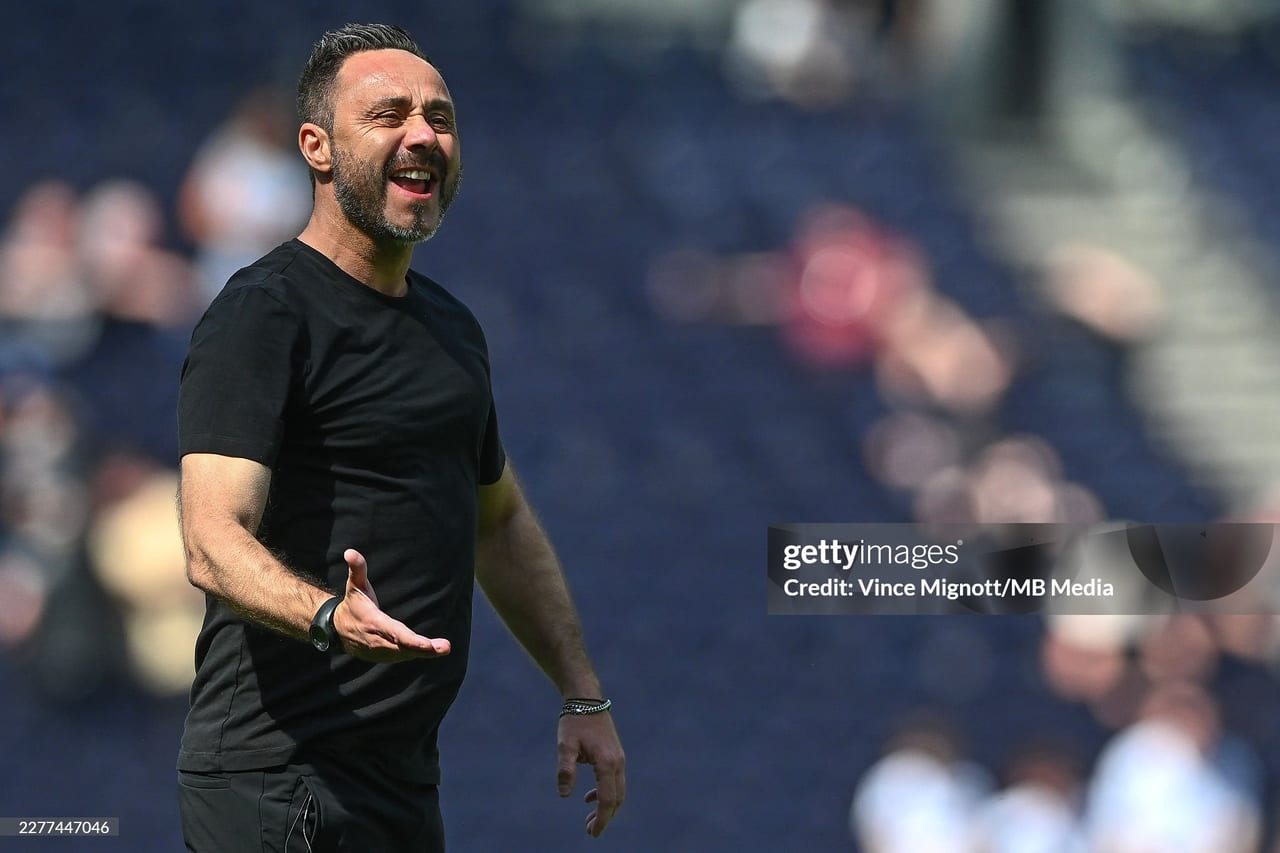
It was just under two months since the 2019 Champions League final. Tottenham Hotspur had lost 2-0 to Liverpool that night in Madrid, but the miracle work from Mauricio Pochettino & Co. was crafted long before.
Spurs had not signed a player all season long and had to contend with Harry Kane missing months due to injury. With the help of Lucas Moura, Heung-min Son and Fernando Llorente amongst others, they reached their first European final since 1984 and finished fourth in the Premier League.
A month later came a first statement signing in years as Tanguy Ndombele smashed the club's transfer record with his £60 million move. The Frenchman was a player Pochettino had wanted to revitalise a midfield that had lost Mousa Dembele and Victor Wanyama.
It appeared as though, following years of Pochettino coaching shrewd purchases into Premier League talent, the Tottenham board were finally ready to deliver the investment he had been crying out for.
Still, another month went by and that significant rebuild left Pochettino wanting. Teenager Jack Clarke had been signed, and later Ryan Sessegnon and Giovani Lo Celso. This quartet was not enough for a radical revamp and, ultimately in their individual cases, largely unsuccessful.
Just a few weeks before the 2019/20 season got underway, then manager Pochettino admitted to not being involved in transfer dealings.
"I am only coaching … trying to get the best from [the current players]," he said in an Audi Cup press conference.
"Sell, buy players, sign contract, not sign contract - I think it is not in my hands, it's in the club's hands and Daniel Levy.
"The club needs to change my title and description. Of course I am the boss deciding the strategic play, but in another area, I don't know. Today, I feel like I am the coach."
Embed from Getty Images
Later, in October, executive chairman Levy would seemingly shift the blame back on the Argentine, stating in a meeting with the club's Supporters Trust that Pochettino "didn't want to sign someone for the sake of it. He felt there were sufficient players in the squad, and that those coming back from injury would be like new signings."
Levy demonstrated less than four weeks later where the true power was at Spurs, and it was not in the dugout. Pochettino was sacked, replaced by Jose Mourinho - one of Levy's dream appointments - for reportedly almost double the salary.
For 25 years of the Levy era, managers came and went, transfer strategy was hit and miss but throughout it was clear that he had significant control on and off the pitch, with Pochettino, the club's most successful manager of the Premier League period, struggling to assert his authority after five years at the helm.
Except now, just shy of seven years later, not only is Pochettino long gone but Levy also. Someone who appeared nigh untouchable during his time in north London, the 64-year-old was ousted as ENIC Group and the family of owner Joe Lewis took control to move Spurs into a more modern way of running things.
It is 2026 and Roberto De Zerbi is less than four months into his job at Tottenham and already looks to have had more say in transfer business than Pochettino ever did.
De Zerbi's spending spree
It is only July and already Tottenham Hotspur are in the midst of a transfer window unlike any in recent times. £237 million spent makes it Spurs' second highest transfer expenditure in their history.
But unlike the 2023/24 season where the £275 million was spread across nine players, and counterbalanced with the big money sale of Kane and offloading the wages of Hugo Lloris, Davinson Sanchez and Harry Winks, this current window's total has been accumulated from just three signings - Jan Paul van Hecke, Matheus Fernandes and Sandro Tonali.
With the latter two, the Lilywhites broke their transfer record twice within the space of a week, and the Italy international became the first time the club will pay £100 million for a player. Add to that some smart free acquisitions in Andrew Robertson, Marcos Senesi and Martin Dubravka.
Ball playing defenders and low-lying midfielders adept at progressing the ball - these are De Zerbi signings. Unlike Pochettino's big window the summer before he was sacked, all of these players have Premier League experience. And most are in or nearing their prime ages or provide valuable leadership credentials.
And, to reiterate, it is only July. Spurs are not famous for doing this kind of business this early.
Moreover, this shift is also coming to sales, with Football London reporting that Tottenham have 'made it clear that there will be a new policy with exits at the club' where 'players [are] sold for better value and at the right time.'
Embed from Getty Images
Circumstances between De Zerbi and Pochettino differ, of course. The Italian was a highly-rated free agent who was given the unenviable task of keeping Tottenham in the Premier League when form and momentum pointed towards the Championship.
Risks were made on De Zerbi's end in choosing to join: What if it did not work out? What would happen to his reputation? Would it scupper his chances of getting another top job?
As West Ham United dwindled and the Lilywhites did just enough and little more to stay in the league, Tottenham then had to cough up their concessions.
The primary one being allowing De Zerbi more of a say over recruitment to create a team in his image. In turn, Tottenham have crossed an expenditure Rubicon that many believed they would never dare tread near.
Power to the person
Watching on from across the Atlantic, sporting in his enlightened university tutor look, Pochettino could rightfully feel aggrieved, having led the team of coaches that turned Spurs into a regular Champions League outfit and to that final at Wanda Metropolitano.
The Argentine has always been magnanimous about the Lilywhites and Levy himself since being shown the door, but his frustrations were there to witness at the time.
"I am not open to start a new chapter with no plan," he said in that same Audi Cup room, seemingly vocalising what he had been fighting against since joining in 2014. "With no clear idea, with not being transparent."
It was evident in the years after Pochettino left that Tottenham fell short in all three.
It is often seen a rarity in the modern game to give such power to managers, with Arsene Wenger and Sir Alex Ferguson the recurring examples of the old order of bosses who had their fingers in every facet of their respective clubs.
But look at the elite level of English football and you will see that this ilk of figurehead is more common than expected.
Embed from Getty Images
Pep Guardiola and Jurgen Klopp are the clearest instances of this, moulding Manchester City and Liverpool around their tactical identities and personalities.
Mikel Arteta is the only boss in the Premier League with the title of manager, given to him by ex-Arsenal and current Tottenham CEO Vinai Venkatesham because the Spaniard was 'doing much more than being our head coach.'
Then, there is Unai Emery, who has been referred to as 'kingmaker' at Aston Villa for the power he wields.
Of course, clubs like Chelsea and Nottingham Forest showcase other structures based around their boardrooms, while famously Brentford and Brighton have been built around data and recruitment.
Under the ENIC ownership, Spurs have always been a myriad of these models but they have never quite provided a linear identity.
Pochettino's job title did change from head coach to manager to 2016, but that did not give him ultimate say in recruitment or vision for the club. As he said, they may as well have changed it back. Something they have never truly done is go all in on a manager.
Big club style
On The Overlap podcast, former head coach Ange Postecoglou claimed he was wanting to sign 'Premier League ready players' to help the team improve from their fifth placed finish in his debut campaign.
"I was looking at Pedro Neto, [Bryan] Mbeumo, [Antoine] Semenyo … Marc Guehi. I said if we're going to go from fifth to there [challenging for titles], that's what the other big clubs would do in that moment."
Both Pochettino and Postecoglou have admitted the club's situation in their respective tenures - constructing the new stadium, no European football - hampered the ability to spend, but De Zerbi's opening of the purse strings does cast a starker shadow on the lack of ambition afforded to them despite their success.
Embed from Getty Images
Especially given Spurs were arguably one West Ham goal away - at Crystal Palace - from going down.
Even Antonio Conte could feel dissatisfied. Having brought Spurs back into the top four with his own mini miracle job in 2021/22, his parting words in the explosive press conference in Southampton show Tottenham were not keen to let the head coach near the reins of genuine authority.
"The fault is only for the club, or for every manager that stay here?," he said about Spurs' lack of consistent silverware.
"I have seen the managers that Tottenham had on the bench. You [Tottenham] risk to disrupt the figure of the manager and to protect the other situation in every moment."
Spurs would continue in this fashion into Postecoglou's spell. The Australian's 17th-placed league finish was reacted to in similar fashion to previous difficult moments - sacking the manager.
Even last season, when there was no Europa League to console them and a realistic chance of relegation, Thomas Frank to Igor Tudor showed that the change of face strategy was still not working. De Zerbi's appointment cajoled the club into embracing the more dictatorial method.
Managing power
Fat salaries can be enough to tempt many a man to even the most seismic of jobs. Football coaches, however, want ultimate control of their squad and thus the direction of the club as a whole, given both operate in tandem.
De Zerbi's previous job in England, down the A23 in Brighton & Hove, saw him ultimately lose the battle in trying to attain that control. He would eventually leave after two years because of disagreements with chairman Tony Bloom, with The Athletic reporting 'irreconcilable differences' in the pair's transfer hopes.
Bloom was keen to continue the analytics-based policy that had not only served the club so well but him personally, with his background in sports betting and poker. Meanwhile, De Zerbi was not content with milling about in midtable, urging bolder moves.
"He [De Zerbi] comes to me and says, 'Why are you talking about top 10, why don't you talk about top six?'," Brighton's chief executive Paul Barber recalled.
"It's the first time in my club career that I am almost encouraged by the head coach to push expectations publicly."
Embed from Getty Images
De Zerbi himself would verify this in an interview with The Telegraph in 2025, echoing Pochettino's desires for having greater power over the team at large and recruitment.
"We reached a point where, after qualifying for the Europa League, I didn't understand what the next step forward was.
"And you can offer to double my salary, but if I can't see a dream or goal to achieve, I can't give my all as I would like.
"I would lose motivation and a purpose I always had in football."
Now, having dragged Spurs from the brink of catastrophe, De Zerbi has the perfect melting pot - a wealthy club that is totally in debt to him.
Upon beating Everton on the final day of 2025/26, his attention immediately turned towards cashing in the credit he had earned.
"My target now is finished, to stay up. My [next] target is to start pre-season with the team in my dream, in my head."
Time will tell whether Spurs' De Zerbi-centred future will work out. Of all the success Guardiola, Klopp, Arteta and Emery have had, there are still hazards. First, simply, is this the right person to go all in on, and then what comes after they are gone?
The latter question is particularly pertinent to Tottenham. Given backing a manager in this way is the last roll of the dice that the hierarchy have not yet landed on, the absence of any big picture planning may well be exposed again should the De Zerbi project turn sour.
Perhaps there is no going back from this, however. Questions that circled about the true financial might of Spurs in the transfer market have now been answered, and not investing in a similar, big money fashion will be harder to justify in future windows.
In other words, the die is cast.

Some transfers are about opportunity. Others are about necessity.
Jan Paul van Hecke's move to Tottenham feels like something different. It feels like a manager getting exactly the player he wanted.
The deal is not officially completed yet, but all signs point in one direction. Tottenham have agreed a £52 million fee with Brighton, personal terms have long been settled, and the player reportedly only wanted one destination.
That destination was Roberto De Zerbi's Tottenham.
On the surface, it is easy to understand why Spurs are interested. Van Hecke is coming off an excellent season, started 36 Premier League matches, helped Brighton qualify for Europe again and is currently representing the Netherlands at the World Cup.
But this move makes even more sense when viewed through the eyes of De Zerbi.
A reunion that always felt possible
Managers often talk about trust. Some players earn that trust quickly. Others never quite manage it. Van Hecke belongs firmly in the first category.
When De Zerbi arrived at Brighton a few years ago, Van Hecke was still trying to establish himself. By the time De Zerbi left, the Dutch defender had become one of the most important players in the squad.
Reports have gone as far as describing De Zerbi as a father figure to van Hecke. Whether that description is completely accurate or not, it is clear there is a strong relationship there.
That relationship matters. Managers rarely spend significant money on players unless they know exactly what they are getting. De Zerbi knows van Hecke's strengths, weaknesses, personality and mentality better than almost anyone. There are no surprises here.
More than just a centre-back
It is easy to look at Van Hecke and think Tottenham are simply signing another centre-back. He is much more than that. Modern football places huge demands on centre-backs. They are expected to defend, build attacks and stay calm under pressure.
Those qualities are exactly why De Zerbi likes him. Last season, van Hecke completed more than 2,000 passes in the Premier League with an impressive 89 percent success rate. That is not the profile of a defender who simply clears danger and moves on.
He wants the ball. More importantly, he knows what to do with it. Anyone who watched Brighton regularly will have noticed how comfortable he looked stepping forward with possession. He rarely seemed rushed and often played a key role in helping his team progress up the pitch.
That fits perfectly with the football De Zerbi wants his teams to play.
Solving a Tottenham problem
For all of Tottenham's struggles in recent years, defensive consistency has probably been the biggest issue. Injuries, suspensions and constant changes at the back have prevented the club from building any real stability.
Cristian Romero remains one of the best defenders in the Premier League on his day. The problem is that availability has often been an issue. He played only 23 league matches last season. The year before, it was 18.
That uncertainty has forced Tottenham into difficult situations too many times.
Van Hecke offers something different. He started 36 of Brighton's 38 league games last season. Managers love talent but they love reliability even more. If Tottenham are preparing for a future where Romero eventually leaves, van Hecke looks like a sensible place to start.
A player entering his prime
One of the more interesting aspects of this transfer is the timing. At 26 years old, van Hecke is no longer a developing prospect. He is also not approaching the end of his career. This is usually the stage where defenders play their best football.
His performances for Brighton over the past year suggest he is ready for a bigger challenge. The fact he is currently starting for the Netherlands alongside Virgil van Dijk at the World Cup says a lot about how far he has come.
A few years ago, that would have been difficult to imagine. Now it feels completely normal.
Why this deal makes sense
Some supporters will inevitably look at the £52 million fee and wonder whether Tottenham are paying too much. That is fair. It is a significant amount of money. But transfer fees are often about context.
Tottenham are not buying potential. They are not buying a player who needs years of development. They are buying a proven Premier League defender who already understands De Zerbi's methods and can step straight into the team.
That reduces risk considerably. The reality is that finding defenders who can defend well, stay fit, play under pressure and contribute in possession is becoming increasingly difficult. Van Hecke ticks every one of those boxes.
Exactly what De Zerbi wanted
Sky Sports recently summed up the situation perfectly.
"This is total commitment in De Zerbi. To put it simply, it's the player De Zerbi asked for."
That probably tells the story better than anything else. This transfer is not about chasing the biggest name on the market. It is about bringing in a player who fits the manager's vision.
Van Hecke may not generate the same excitement as a superstar forward or a glamorous attacking midfielder. But there is every chance he becomes one of Tottenham's most important players over the next few years.
Because sometimes the smartest signings are not the loudest ones. And this feels very much like one of those.

If you have watched Tottenham over the last few seasons, this news probably feels inevitable.
Pedro Porro has become one of the most important players in the squad, and Spurs have now made sure he will remain in North London for years to come.
The club confirmed on Monday that the Spanish defender has signed a new contract until June 2031, with the option of an extra year that could keep him at Tottenham until 2032.
For supporters, it is exactly the sort of news they wanted to see at the start of the summer. Porro arrived from Sporting CP in January 2023 with plenty of excitement around him, but even then few would have expected him to become such a key figure so quickly.
Over the last three and a half years, he has developed into one of the first names on the teamsheet. Whether Tottenham needs a goal, a moment of quality or simply someone willing to keep pushing the team forward, Porro usually finds a way to make an impact.
After signing the new deal, the Spaniard kept his message simple.
"Hi Spurs fans. I'm so happy to sign a new contract. Can't wait to see you next season. Come on you Spurs!"
Reward for one of Tottenham's most important players
That excitement is shared by plenty of people around the club.
Last season was another reminder of how important he has become. Porro made 47 appearances and proved to be an absolute rock, playing the most minutes in the squad to help navigate a challenging campaign.
His numbers since joining the club tell the same story. In 152 appearances, he has scored 13 goals and provided 26 assists. Those are impressive figures for any defender and help explain why supporters have taken such a liking to him.
Sporting director Johan Lange praised the progress Porro has made since arriving and spoke about the influence he has had both on and off the pitch. The club clearly sees him as a player who can help lead the next stage of the project.
Head coach Roberto De Zerbi was equally complimentary, describing him as a player whose energy, intelligence and mentality make a difference every week.
Spurs move quickly amid outside interest
The extension also arrives at an important time.
Reports linking Porro with clubs such as Real Madrid and Manchester City have become increasingly common over recent months. When players perform as consistently as he has, attention from elsewhere is unavoidable.
Instead of allowing those rumours to grow, Tottenham have moved quickly and secured the future of one of their biggest assets. More than anything, this feels like a reward for a player who has steadily improved every season since arriving at the club.
Tottenham supporters have watched him grow from an exciting signing into one of the leaders of the team. Now they know he will be sticking around for a while longer.
And judging by the reaction from fans, that is a decision everyone seems pretty happy with.

A season that, upon its conclusion, brought an overwhelming feeling of relief. Now this was not the glory-tinged relief that Spurs had last season, where they ended a 17 year wait for silverware. It was a relief of an alien kind, with the club having avoided relegation from the Premier League on the final day of the season.
The campaign began with substantial change. Thomas Frank took over from Ange Postecoglou on the touchline, while in the boardroom, Executive Chairman Daniel Levy was relieved of his duties after 25 years.
On the pitch, it started with a UEFA Super Cup loss on penalties to PSG. Games thereafter were okay enough points-wise, but performances had precious little vitality.
The Dane was in charge until February 2026 oversaw continuously tepid displays and, soon enough, worsening results.
Rather than competing on all fronts, as was his appointment's intention, he left the Lilywhites in February, five points above the bottom three and out of both domestic cup competitions early.Embed from Getty Images
Ex-Juventus hardman Igor Tudor was tasked with course correcting a weary squad to the end of the season, but ended up making the situation worse as relegation threatened West Ham and Nottingham Forest gathered momentum.
Tudor’s era was cut short after just seven games. For reasons only explainable as it being Tottenham Hotspur, his only point in Premier League was earned away at Anfield and his only victory was the Champions League return tie against Atletico Madrid.
The highly-rated and controversial Roberto De Zerbi then took on the task of dragging Spurs out of the unthinkable.
Almost through sheer force of will, the Italian did manage to resurrect fortunes enough to keep Tottenham in the top flight, finishing just two clear of the Hammers on 41 points.
Embed from Getty Images
The only bright spot for Spurs this season was that the ignominy could have been far worse. Relegation to the Championship as the world’s ninth richest club would have been catastrophic from a financial and spiritual perspective.
There is no smoke without fire, and Tottenham fans will hope that their 2025/26 campaign acts as a reckoning for the hierarchy to ensure they never bear witness to such a season again.
To recap in as rosy a way as we can, VAVEL’s Tottenham writers have selected six awards to highlight the better performers and moments during a dismal year in North London.
Player of the Season - Joao Palhinha
When João Palhinha arrived at Tottenham Hotspur on loan from Bayern Munich, there was plenty of excitement around the move. Spurs had been looking for a midfielder who could bring some much-needed steel to the team, and by the end of the season Palhinha had become one of the first names on the team sheet.
Tottenham endured a difficult and often frustrating campaign, with defensive problems and inconsistent performances making life difficult throughout the year. However, one player consistently stood out whenever the team needed someone to steady the ship.
It did not take long for Palhinha to become one of Tottenham's most important players. His ability to win tackles, break up opposition attacks and protect the defence gave the team a level of security that had been missing for some time.
Embed from Getty Images
While his main job was doing the dirty work in midfield, he also delivered in crucial moments. A dramatic stoppage-time equaliser against Wolves and an important winner against Everton showed he could contribute at the other end of the pitch when it mattered most.
Across 39 appearances in all competitions, the Portuguese midfielder was one of the few players who consistently performed at a high level. His leadership, commitment and relentless work rate made him a favourite among the Tottenham faithful.
In a season that often tested Tottenham, Palhinha was the player supporters could always count on. For that reason, there is no doubt that he deserves the Player of the Season award.
Words by Dhruv Kapoor
Young Player of the Season - Archie Gray
Blooding in young players to the first team environment can usually take time. Physically they are still developing, mentally the spotlight could be daunting.
Archie Gray’s Tottenham career has not been that smooth, orderly transition. However, the England international has continuously displayed the kind of fortitude and level-headedness associated with senior footballers.
After playing majority of 2024/25 as a makeshift centre-back, Gray was afforded more opportunities in his more favoured midfield position, but was still required to fill in as and when.
Embed from Getty Images
This campaign did not end with a trophy like his first, but there were some silver linings.
His first senior goal against Crystal Palace earned a vital three points in a 1-0 win. It was followed by his first home goal against Newcastle in Frank’s final outing as Spurs manager.
Towards the tail end, De Zerbi chose to lineup with more experienced options. Nevertheless, Gray’s courage amid a tumultuous few seasons at the club has always shone through and has given him the resilience and platform to become a cornerstone of Spurs squads to come.
Words by Brandon Williams
Signing of the Season - Mohammed Kudus
Signed for £55 million from London and eventually relegation rivals West Ham, Kudus immediately became a beacon on the right flank for Tottenham.
So intrinsic was he to Thomas Frank’s plans that the Ghanaian was often the sole avenue for keeping the ball in the final third and generating chances, resulting in three goals, five assists and 23 chances created.
Although Spurs’ struggles ran much deeper and form had already started to slip, Kudus’ injury at the turn of the calendar year was the tipping point for Frank’s tenure.
Embed from Getty Images
Remarkably, Kudus completed 51 take ons this season - the fifth highest in the Premier League this season, despite the fact he played only 19 matches while every other player in the top ten had a minimum of 30 outings. It puts him level with Rayan Cherki and above the likes of Morgan Rogers and Bukayo Saka.
The 25-year-old has already shown what a smart piece of business his acquisition could be for the future. If he can perform well for the Lilywhites in their most desperately sluggish state, then a better unit around him will likely see him find greater heights.
Words by Brandon Williams
Most improved player - Mathys Tel
The first six months of Mathys Tel’s season were non-existent. He struggled for minutes under Thomas Frank and was left out of the UEFA Champions League squad. In January, the rumour mill was swinging and there was a chance that the Frenchman may have left the club.
But there was no denying there was glimpses of hope, and those glimpses were seen at the end of the season, as Tel became a key player under Roberto De Zerbi, and used the lack of available wingers to his advantage, with Wilson Odobert, Dejan Kulusevski, Mohammed Kudus and Xavi Simons all out injured.
In November, Tel scored against Manchester United off the bench, but despite showing promise, he didn’t start a game until January after that strike against the Red Devils. Against Bournemouth in early 2026, in what was his second start in a row, the winger scored as Spurs lost 3-2.
Despite his cameos of good moments, Frank was persistent in using other options instead of Tel, and even shoehorned Lucas Bergvall into a winger position instead of accommodating the former Bayern Munich man.
It was under De Zerbi where Tel got his first regular, consistent minutes as part of the starting XI. He was a driving factor in Spurs’ survival and looked the only dangerous threat going forward for large parts of the campaign.
Embed from Getty Images
His assist at Villa Park and stunning strike against Leeds United were vital in surviving relegation and the truth be told, without those, Spurs would have gone down.
Under De Zerbi’s guidance, and with regular minutes, there is no reason why Tel cannot explode under the Italian. He has had a promising campaign with limited minutes to show for it, but one thing that is for certain, he has not disappointed when called upon.
Words by Harrison Nathan
Surprise Package - Antonin Kinsky
Antonin Kinsky was not a newcomer this season. He already had twelve Spurs appearances under his belt by the time he took to the field against Atletico Madrid, replacing a Guglielmo Vicario in patchy form.
A disastrous 17-minutes saw him make two errors that led to goals, with Igor Tudor opting to substitute him without so much as a glance of sympathy in his direction as he walked off.
You would be forgiven for thinking the Czech’s Tottenham career ended then and there, but Vicario’s later injury problems saw him reinstated to the team under De Zerbi.
What transpired was one of the most remarkable individual stories of the Premier League season.
Embed from Getty Images
The 23-year-old made a string of excellent performances, notably making eye-catching stops against Wolves and Leeds United and ultimately playing a crucial role in literally saving Spurs from the drop.
His touch to keep out Sean Longstaff in the latter fixtures in particular going down as one of the finest pieces of goalkeeping in the Premier League season.
Moreover, Kinsky performed well when playing out from the back under De Zerbi’s new remit. Doubly admirable given that was what caused him problems in Madrid.
"Yeah, I would say I'm stronger by that one experience," he told Sky Sports about his redemption. "There is always so much things to improve, so it just shows you the things that you can get better at or mentally to adjust a little bit the approach towards the game."
Words by Brandon Williams
Match of the Season - Aston Villa 1-2 Tottenham, May 2026
The win at Molineux eight days prior was a relief for Tottenham – their first win in the Premier League in the entirety of 2026 was a huge weight off the players’ shoulders. However, things were not going to get any easier as they continued to fight relegation.
Handed an extra life by West Ham losing 3-0 at Brentford the day before, they travelled to Villa Park to face the UEFA Europa League semi-finalists, Aston Villa, in a crunch tie. An additional advantage that Spurs were given was the fact that Unai Emery heavily rotated.
And they used it to its fullest, as they picked up a resounding victory that would change the trajectory of their season.
Embed from Getty Images
It instilled a belief for the first time that they would get out of the mess at the foot of the Premier League table, and for the first time in what felt like an eternity, there was light at the end of the tunnel for Roberto De Zerbi’s men.
Eventual Player of the Match winner Conor Gallagher handed the Lilywhites an early lead as he rifled a half-volley into the bottom corner, and it was a coming-of-age performance from the Englishman, who, for the first time since his January move from Atletico Madrid, showed glimpses of his old self that many raved about when he was at Chelsea.
Richarlison, who played a major role in Premier League with eleven goals throughout the campaign, doubled the lead in the first half, as the 3,000+ travelling Tottenham fans were sent into pandemonium tucked into the corner of the stands in the Midlands.
Spurs never looked uncomfortable on that special Sunday night in Birmingham, and, despite Emi Buendia’s stoppage time header, nothing could spoil the party in the away end as the fans began to believe their season would be saved, and torture of the Championship would be avoided.
Words by Harrison Nathan

Tottenham Hotspur are close to completing the signing of Andy Robertson on a free transfer, with the Liverpool left-back expected to join once his contract expires this summer.
There is news that the Scotland captain has reportedly agreed terms over a move to North London, after turning down late interest from Juventus to stay in the Premier League. Nothing is officially signed yet, but all signs point towards Robertson becoming one of Tottenham’s first major arrivals of the window.
It is also a move that says a lot about where the Spurs are right now. This is not a team aiming to compete for the top four anymore. They are rebuilding after finishing 17th in the Premier League after a deeply disappointing season, with Roberto De Zerbi now responsible for fixing both the squad and the mindset.
A signing that comes from clear need
This is not one of those surprise opportunistic deals. Tottenham have been actively reshaping their squad this summer and have been keeping an eye on Robertson for a while.
In fact, they already tried to bring him in during the January window, but they failed because Liverpool did not want to let him go at that moment. But after a few months, the situation has completely changed.
Spurs need experience. They need players who have actually been through pressure situations and know how to deal with them. That has been missing in this squad, especially in defensive areas.
Left-back has been a problem position. Destiny Udogie has shown real quality at times, especially when moving into midfield to help Spurs control the ball. But injuries have broken his rhythm, and over the season Spurs have not had a reliable option there.
That is where Robertson comes in.
Why Robertson still matters, even at 32
At Liverpool this season, Robertson’s role has clearly changed. He is not an automatic starter anymore.
With Milos Kerkez arriving and taking more responsibility, Robertson ended up playing more of a rotation role, finishing the season with limited Premier League minutes. It was the first real sign that Liverpool were moving towards a new cycle.
But even with reduced minutes, he still looks like a player who can contribute at the top level. Just not every three days anymore.
What stands out more now is not his explosive running or constant overlap numbers from his peak years, but his experience and decision-making. He knows when to go, when to hold, and how to manage big moments in matches.
That is something Spurs have lacked, especially when games start to get messy.
There is also the leadership factor. Robertson is Scotland captain, has played in Champions League finals, won league titles, and spent nearly a decade in one of the most intense systems in European football. That kind of background does not disappear even if the legs slow slightly.
How he fits into De Zerbi’s system
Roberto De Zerbi’s system at Tottenham is expected to be quite flexible, often shifting between a 4-2-3-1 and a more structured 3-2-5 shape when Spurs have the ball.
In simple terms, full-backs are not just defenders. They are key attacking outlets and also important in how Spurs build play from the back.
Robertson fits that in a slightly different way compared to Udogie.
Udogie tends to drift inside into midfield areas, almost acting like an extra midfielder at times. He helps Spurs play through pressure centrally.
Robertson is different. He is more direct. He stays wide, pushes high, and looks to deliver crosses quickly once he gets into attacking positions.
That difference actually gives Spurs something they have been missing. When teams sit deep against them, Spurs sometimes struggle to stretch the pitch properly. Robertson’s natural instinct to stay wide and whip in early crosses gives them another way of attacking compact defences.
It is simple, but it is effective.
Pressing, energy, and what still holds up
One thing Robertson definitely still has is intensity.
He spent years under Jurgen Klopp in a system that demanded constant pressing, constant running, and constant awareness in transition moments. That experience fits quite neatly with what De Zerbi wants, even if the structure is slightly different.
Spurs under De Zerbi are expected to press high and aggressively, especially in wide areas. Robertson is comfortable stepping up the pitch, engaging wingers early, and squeezing space.
The main question now is not about his understanding of the role, but about physical consistency. At 32, he is not going to cover the same ground he once did every single game.
That is why this move looks more like rotation planning than a guaranteed starting role.
Sharing responsibility with Udogie
This is probably the most practical part of the signing.
Tottenham cannot rely on Udogie to play every game, especially with his injury record this season. That is just not realistic in a long campaign.
Robertson gives them a different option without a major drop in quality. He is experienced enough to step in immediately, but also adaptable enough to share minutes depending on the opponent.
It also gives De Zerbi flexibility. Some games might need Udogie’s inverted midfield movement. Others might need Robertson’s width and crossing. Having both allows Spurs to adjust without changing the entire system.
A sensible move in a rebuilding phase
This is not a signing that screams long-term planning, and it probably was not meant to.
It feels more like a practical decision for where Tottenham are right now. A team coming off a poor season, trying to stabilise, and bring in players who understand what top-level football actually demands.
Robertson is not arriving as a superstar signing. He is arriving as someone who knows the league, knows the pressure, and still has enough quality to make a difference.
And for Spurs at this stage, that might be exactly the point.

Tottenham are close to agreeing a deal with Argentine centre-back Marcos Senesi following his departure from Bournemouth.
The 29-year-old announced his departure before the Cherries' 1-1 draw with Manchester City at the Vitality, which ensured European qualification for the first time in their history.
Personal terms for the three-time Argentina international are yet to be finalised with Spurs, but the deal is advancing.
Why did Senesi leave Bournemouth?
The defender turned down a third contract offer from Bournemouth in December and began talks with clubs overseas.
Senesi, who featured in all but one league game this season, now looks set to stay in the Premier League despite previous interest from Barcelona and Atletico Madrid.
Liverpool and Manchester United also expressed interest in the defender earlier this month.
The centre back, who helped Bournemouth finish a club-best sixth in the top flight, made 128 appearances over his four-year spell in Dorset, having joined the club from Feyenoord in 2022.
He could feature for Argentina at the World Cup this summer having been included in Lionel Scaloni's provisional squad, with the final squad set to be announced on Saturday.
Bournemouth's search for a replacement
Bournemouth, who will be managed by Marco Rose next season, are actively looking for a Senesi replacement this summer.
As per reports, Sporting's Ousmane Diomande has been identified as a potential replacement for Senesi, with several top clubs interested in the defender.
Tottenham's summer business
Spurs secured survival on the final day of the season by beating Everton 1-0 at the Tottenham Hotspur Stadium, finishing 17th for the second consecutive season.
Roberto De Zerbi's side are also set to sign Scottish left-back Andrew Robertson following his exit from Liverpool.
Details remain to be finalised on the deal with Tottenham, but an agreement is in place in principle.

Roberto De Zerbi was a much relieved man after his side narrowly escaped relegation following a 1-0 victory over Everton.
Tottenham came into the game needing at least a draw to stay in England's top-flight, however, a first half opener from João Palhinha, followed by a brilliant stoppage time save from Antonin Kinsky was enough to secure all three points.
"I'm happy, I enjoyed today, the beginning of the day until now.
"Football is nice because if you give your best, maybe today, maybe tomorrow, after tomorrow, you receive back everything from football. It's incredible.
"My players played a fantastic game, as a spirit, as a behaviour, as an attitude, but also as a quality of the play, especially in the first half, they played very well and I'm proud.
"We deserve this day. We deserve this game. We deserve this win. We deserve everything of today. I think we deserve to stay up, because we made 11 points in seven games and we deserved more."
Focus shifts to building a 'new' team
De Zerbi also made it clear that his new target is to begin next season with his "dream" team so that Tottenham can avoid a similar situation.
He said: "From tonight we have to start to organise and to build a new team. I don't think we have not to change too many players.
"We have 10, 11, 12 players good enough to stay, good enough, like players, like people. Then we have to complete the squad with the first level of players. The first level of players, because we suffered too much.
"I suffered a lot, but I think the fans, the club, the board, the players, they suffered too much. We are Tottenham and we can't suffer like this until the last second of the last game to stay up.
"I will be stronger. I don't want to decide alone because football is a group - sporting director, scouting, CEO - but my target now is finished, to stay up.
"My target is to start the pre-season with the team I have in my dream, my head."
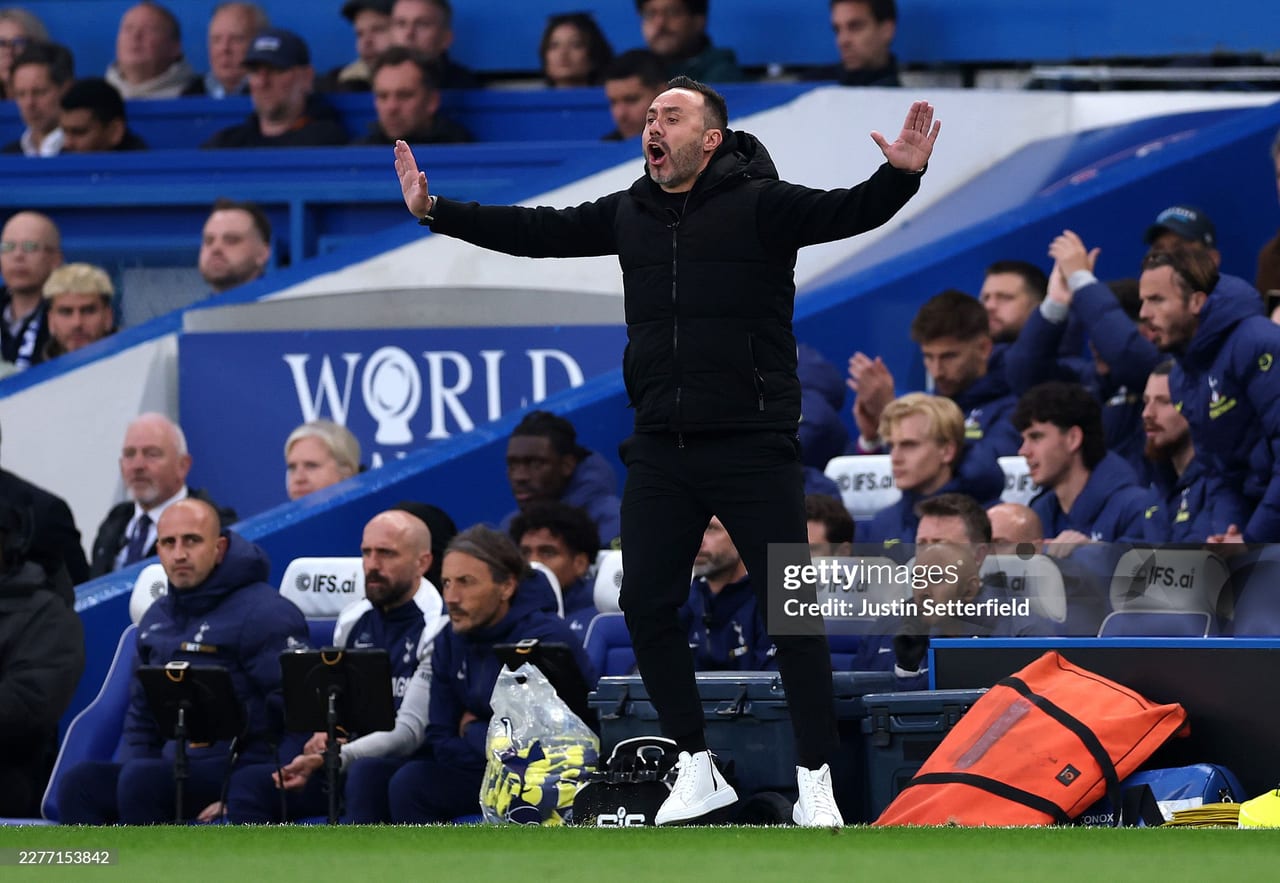
For long stretches of Tuesday night, this did not feel like a normal London derby. It felt like two footballing ideologies trying to emotionally survive themselves.
Chelsea FC entered Stamford Bridge needing a result to keep their European ambitions alive. Tottenham Hotspur arrived carrying something far heavier: fear.
Fear of relegation. Fear of collapse. Fear of a season spiraling into humiliation.
That difference ultimately decided everything.
Chelsea controlled the spaces Tottenham wanted to use
Roberto De Zerbi’s Tottenham attempted to build through his trademark risk-heavy positional framework. Spurs lined up in a fluid 4-2-3-1 but constantly morphed into a deep 4-2-2-2 structure during buildup, baiting Chelsea’s press deep inside their own half.
The idea was simple in theory.
Invite pressure centrally, drag Chelsea’s midfield forward, then exploit the vertical gaps left behind through rapid third-man combinations into the wide areas.
But Enzo Maresca prepared for exactly that.
Chelsea did not obsess over dominating possession. Instead, they dominated territory and passing lanes. Their 3-2-2-3 buildup shape created overwhelming numerical superiority in central midfield, with Moisés Caicedo anchoring the base while Enzo Fernández pushed aggressively into the left inside channel.
That created a constant four-versus-two scenario against Tottenham’s double pivot of Rodrigo Bentancur and Pape Matar Sarr.
Spurs were not just outnumbered. They were structurally trapped.
Chelsea’s press worked almost passively at first. Tottenham’s centre-backs were allowed to circulate possession harmlessly across the back line, but the second a vertical pass entered midfield, Chelsea exploded into aggressive pressure.
Caicedo, Cole Palmer, and Enzo Fernández locked onto Tottenham’s central options with ruthless precision.
The effect was devastating.
Instead of manipulating Chelsea’s press, Tottenham repeatedly accelerated directly into it.
Enzo Fernández punished Tottenham’s emotional impatience
Chelsea’s opener in the 18th minute did more than give the hosts the lead. It psychologically distorted Tottenham’s entire tactical structure.
Fernández’s stunning long-range strike forced Spurs into emotional football far earlier than De Zerbi would have wanted.
Before the goal, Tottenham still attempted patient buildup patterns despite Chelsea’s pressure. After it, their circulation became visibly frantic. Vertical passes were rushed. Distances between midfield and defence stretched dramatically. The calm positional manipulation De Zerbi demands disappeared under the emotional weight of the occasion.
Chelsea immediately sensed it.
Rather than pushing recklessly for a second goal, Maresca’s side doubled down on controlling central access points. Palmer drifted intelligently between Tottenham’s midfield and defensive lines, while Pedro Neto and Alejandro Garnacho maintained maximum width to isolate Spurs’ fullbacks.
Chelsea were not dominating through endless possession sequences. They were dominating through spatial suffocation.
Tottenham’s midfield simply stopped functioning as a connector between defence and attack.
Chelsea’s second goal explained Tottenham’s entire night
The second goal in the 67th minute was not just a defensive mistake. It was Tottenham’s tactical identity collapsing in real time.
Andrey Santos’ finish arrived from a Pedro Neto cross, but the real story was the structural chaos that created the move in the first place.
Tottenham’s aggressive buildup principles had already begun physically collapsing by the hour mark. The distances between their defensive line and midfield were becoming enormous, sometimes stretching beyond 30 yards. Their press lost synchronization. Their recovery runs slowed. Their compactness vanished.
Chelsea immediately attacked those gaps.
As Neto received possession wide, Tottenham’s defensive shape completely lost balance. One defender stepped toward the ball, another retreated toward the six-yard box, while the midfield failed to recover into the central corridor.
The result looked almost comedic from a structural perspective.
Santos arrived into the penalty area virtually untracked because Tottenham had overloaded their own defensive attention toward the wide delivery. Chelsea manipulated Spurs’ panic perfectly.
It was the football equivalent of everybody trying to fix the same problem simultaneously while creating three new ones.
So the answer to how Chelsea’s second goal happened, the answer is brutally simple:
Tottenham became so obsessed with surviving the immediate danger that they forgot to defend the actual scoring zone.
That sequence summarized the entire match.
Tottenham abandoned control and embraced chaos
Ironically, Tottenham looked most dangerous once they completely abandoned their original tactical plan.
After Chelsea’s second goal, Tottenham abandoned controlled buildup and shifted toward direct transition football and early wide deliveries.
Long balls replaced patient circulation. Wide crosses replaced controlled progression. The midfield was largely bypassed entirely.
It should not have worked.
Yet Chelsea briefly lost emotional control after Richarlison’s 73rd-minute goal, which arrived following a sharp combination involving Pape Matar Sarr.
Suddenly Stamford Bridge became nervous.
Chelsea dropped deeper. Their defensive line retreated. Palmer abandoned his advanced playmaking role to help stabilize midfield possession, while late substitutions from Maresca sacrificed pressing aggression for defensive security.
The final stages descended into pure emotional warfare.
Tottenham threw numbers into the penalty area with little positional restraint. Micky van de Ven stepped aggressively into midfield zones to launch aerial deliveries, while Chelsea accumulated yellow cards attempting to disrupt the rhythm of the game through tactical fouls and physical interruptions.
For the final ten minutes, structure disappeared entirely.
This became survival football.
Chelsea won the midfield war before they won the match
The clearest tactical truth from Stamford Bridge was Chelsea’s complete superiority in central areas.
Their midfield structure consistently overwhelmed Tottenham numerically and positionally, with Caicedo anchoring Chelsea’s buildup while Fernández and Palmer manipulated the spaces between Tottenham’s midfield and defensive line.
Spurs simply never solved the overload problem.
Bentancur and Sarr were forced into impossible defensive coverage responsibilities, constantly shifting horizontally to close passing lanes while simultaneously trying to support buildup progression.
The physical exhaustion eventually became visible.
Chelsea’s control did not come from endless possession dominance. It came from deciding where the game would be played and which players would be allowed to influence it.
That is a far more sophisticated form of control.
Tottenham’s relegation fear distorted their football
The emotional backdrop mattered enormously.
This was not just another tactical battle.
Tottenham were carrying the psychological pressure of a relegation fight into one of the most structurally demanding tactical systems in modern football.
De Zerbi’s buildup principles require calmness, trust, and precise positional timing. Tottenham instead played with visible anxiety after falling behind.
That anxiety transformed calculated risks into reckless ones.
The irony is painful.
Tottenham’s tactical system is designed to manipulate pressure. Against Chelsea, pressure manipulated Tottenham instead.
The final truth
This match was ultimately decided by Chelsea’s superior midfield structure and positional discipline, which dismantled Tottenham’s risky buildup patterns and forced the defensive chaos that defined the night.
Chelsea looked like a team controlling the geometry of the pitch.
Tottenham looked like a team trying to emotionally outrun their own season.