The Independent

Why Tottenham could face ‘significant’ financial hit even if they avoid relegation

Submitted by daniel on
Picture
Remote Image
Why Spurs could face financial hit even if they avoid relegation - The Independent
Description

Tottenham Hotspur have been warned they face a "significant" financial hit even if they avoid relegation to the Championship.

The north London club is currently in a battle to stay in the top flight after a 10-match Premier League winless run saw them slide down the table.

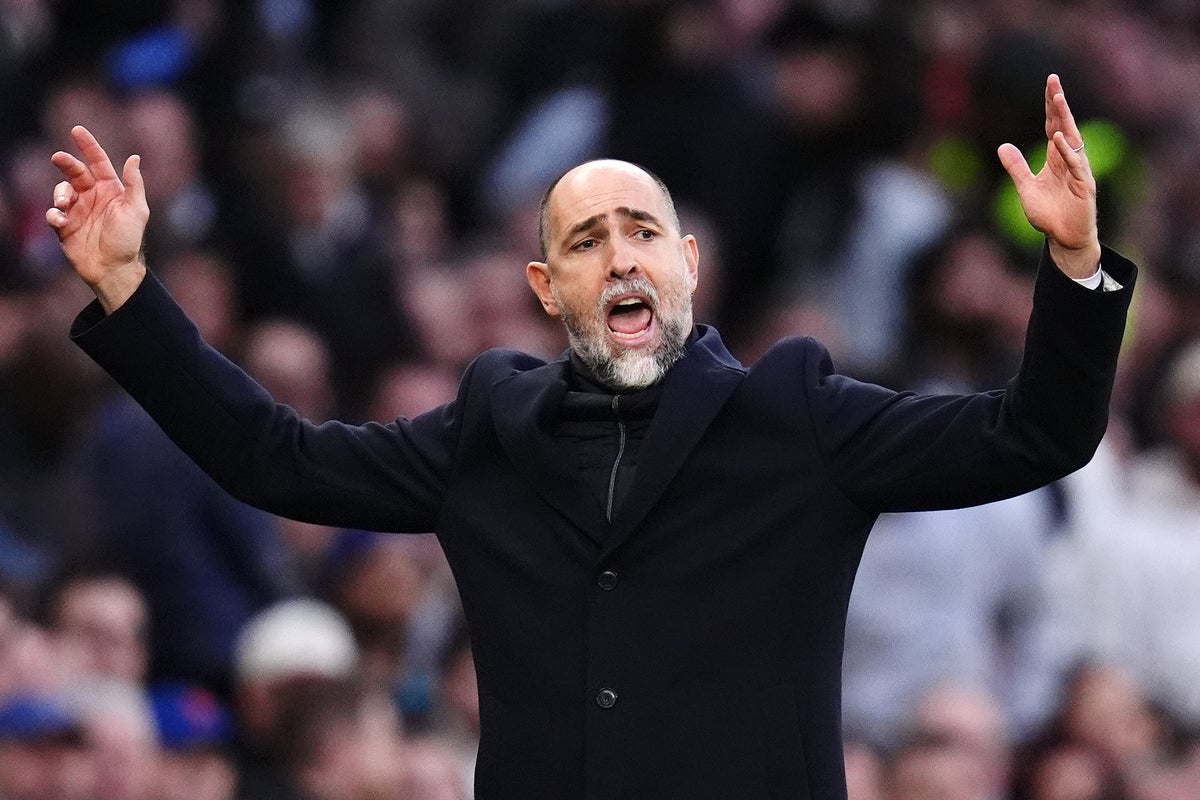
Manager Thomas Frank was sacked last month and replaced with interim boss Igor Tudor, who conceded it was an "emergency situation."

It has also been estimated Tottenham could lose £250 million if they go down.

However, leading sports lawyer Geoff Cunningham of Clarion Solicitors has painted a bleak picture for the 2025-26 campaign regardless of their division, given Spurs are likely to miss out on Europe for only a third time in 21 seasons.

Cunningham said: “I imagine they will have certain commercial revenue that will increase based upon them being in a European competition.

“If they’re not in Europe, it’s not just lost revenue from being in the competition, but it’s also lost revenue of commercial rights they sell for being in that competition and also the ticket revenue and the hospitality revenue.

“Every time there’s a home game and they sell 60,000 tickets plus corporate hospitality, that’s a fair amount of revenue generated from every game.

“It’s going to be significant (loss) and there’s no way of really avoiding that. It’s just simple maths. If there’s less games and there’s less TV revenue from European competition, you are going to lose more money.”

Cunningham was more optimistic about how Spurs could handle relegation given they have the ninth biggest revenue in world football.

“I think the kind of reported £250million relegation cost is probably likely to be quite accurate,” Cunningham said.

“The Premier League revenue difference will probably be compared with where they’ve been used to finishing and if you also account European football, I think it would be quite likely to be £100m or more.

“There’s a number of ways they can plug the gap or part of the gap quite quickly with certain financial facilities, but I don’t think they’ll do that. I think they’re a club with pretty good financial stability and I think they will naturally cut their cloth accordingly.

“Player contracts will reduce significantly and they will manage themselves pretty well.

“They are likely to be able to survive in the Championship at a very good level and likely compete, like Burnley do, with promotion quite quickly after relegation.”

Why Tottenham could face ‘significant’ financial hit even if they avoid relegation

Submitted by daniel on
Picture
Remote Image
Why Spurs could face financial hit even if they avoid relegation - The Independent
Description

Tottenham Hotspur have been warned they face a "significant" financial hit even if they avoid relegation to the Championship.

The north London club is currently in a battle to stay in the top flight after a 10-match Premier League winless run saw them slide down the table.

Manager Thomas Frank was sacked last month and replaced with interim boss Igor Tudor, who conceded it was an "emergency situation."

It has also been estimated Tottenham could lose £250 million if they go down.

However, leading sports lawyer Geoff Cunningham of Clarion Solicitors has painted a bleak picture for the 2025-26 campaign regardless of their division, given Spurs are likely to miss out on Europe for only a third time in 21 seasons.

Cunningham said: “I imagine they will have certain commercial revenue that will increase based upon them being in a European competition.

“If they’re not in Europe, it’s not just lost revenue from being in the competition, but it’s also lost revenue of commercial rights they sell for being in that competition and also the ticket revenue and the hospitality revenue.

“Every time there’s a home game and they sell 60,000 tickets plus corporate hospitality, that’s a fair amount of revenue generated from every game.

“It’s going to be significant (loss) and there’s no way of really avoiding that. It’s just simple maths. If there’s less games and there’s less TV revenue from European competition, you are going to lose more money.”

Cunningham was more optimistic about how Spurs could handle relegation given they have the ninth biggest revenue in world football.

“I think the kind of reported £250million relegation cost is probably likely to be quite accurate,” Cunningham said.

“The Premier League revenue difference will probably be compared with where they’ve been used to finishing and if you also account European football, I think it would be quite likely to be £100m or more.

“There’s a number of ways they can plug the gap or part of the gap quite quickly with certain financial facilities, but I don’t think they’ll do that. I think they’re a club with pretty good financial stability and I think they will naturally cut their cloth accordingly.

“Player contracts will reduce significantly and they will manage themselves pretty well.

“They are likely to be able to survive in the Championship at a very good level and likely compete, like Burnley do, with promotion quite quickly after relegation.”

Ossie Ardiles urges Tottenham squad to stick together to avoid relegation

Submitted by daniel on
Picture
Remote Image
Ossie Ardiles urges Tottenham squad to stick together to avoid relegation - The Independent
Description

Thank you for registering

Please refresh the page or navigate to another page on the site to be automatically logged inPlease refresh your browser to be logged in

Thank you for registering

Please refresh the page or navigate to another page on the site to be automatically logged inPlease refresh your browser to be logged in

Tottenham legend reveals what the club must do to escape ‘big, big trouble’

Submitted by daniel on
Picture
Remote Image
Tottenham legend reveals what the club must do to escape ‘big, big trouble’ - The Independent
Description

Tottenham Hotspur legend Ossie Ardiles has urged unity to help his former club escape "big, big trouble" in the Premier League.

Spurs' top-flight status faces its gravest threat in three decades, now just four points above the relegation zone following Sunday's 2-1 defeat at Fulham.

A dismal run of two wins in 19 matches, including a record-equalling 10-game winless streak, has sent the fanbase into a frenzy, questioning if the injury-hit squad can halt the slide.

Ahead of Thursday’s visit of Crystal Palace, two-time FA Cup winner Ardiles told the Press Association: "Our job, everybody at the club, my job and the job of everybody in Tottenham is to go behind the team.

"We are OK right now but we could be in big, big trouble. "So, everybody has to be together to achieve what we want to achieve. Survive this season and then we’ll see what happens next."

Ardiles discussed Tottenham’s precarious situation during a milestone event for his former team-mate Micky Hazard, who, alongside his sister Michelle, co-founded the mental health charity Legend On The Bench.

The Hazards unveiled the 100th park bench by Legend On The Bench last Thursday at Water Gardens in Harlow, with several Spurs greats, including Ardiles, in attendance.

Former England goalkeeper Pat Jennings and ex-Tottenham captain Gary Mabbutt were also present for the landmark occasion for the charity, established after Hazard’s nephew Jay committed suicide in 2019.

"Yes, it is a wonderful, wonderful achievement. I was with him when he started to do this and he started very small, but it is amazing how it has grown," Ardiles reflected.

"Micky is the driving force. I come, take pictures and talk a lot of rubbish, but the proper job and the hard work is all down to him.

"His goal was quite small but it grew and grew and he works harder and harder. Now we are where we are right now. It’s an incredible achievement."

Tottenham ban three fans over Nazi salutes during Champions League tie

Submitted by daniel on
Picture
Remote Image
Tottenham ban three fans over Nazi salutes during Champions League tie against Frankfurt - The Independent
Description

Tottenham Hotspur has confirmed it has imposed indefinite bans on three supporters for making Nazi salutes during a Champions League fixture in Germany.

The offensive gestures were performed during Spurs’ 2-0 victory against Eintracht Frankfurt in late January.

Uefa sanctioned the London club for the behaviour, imposing a €30,000 (£26,212) fine and a suspended ban on selling away tickets for one match.

Tottenham had previously labelled the conduct as "utterly abhorrent conduct" and vowed to punish those responsible.

“The club has been informed of sanctions handed down to us by Uefa following the utterly abhorrent conduct of a small number of individuals at our recent Champions League away match in Frankfurt,” a statement read.

“The club has cooperated fully with Uefa’s investigation, as well as with German police on the night and, subsequently, the Met Police.

“We can confirm that all three individuals found to be making Nazi salutes towards Eintracht Frankfurt fans have been identified and have received indefinite bans under the club’s Sanctions and Banning Policy.

“The club stands firmly against all forms of discrimination and has therefore taken the strongest possible action. The disgusting behaviour of a minority of so-called fans on the night is in no way reflective of the values of our club and its supporters.”

Spurs received a further fine of €2,250 (£1,966) for the “throwing of objects” by fans at the match on 28 January.

The Uefa Control, Ethics and Disciplinary Board (CEDB) has brought the charges against Spurs, who are in a precarious position domestically after a record-equalling 10-match run without a win in the Premier League.

A statement read: “The CEDB has decided: To fine Tottenham Hotspur €30,000 and to ban Tottenham Hotspur from selling tickets to its away supporters for the next one (1) Uefa competition match, for the racist and/or discriminatory behaviour of its supporters.

“Said ban from selling tickets to its away supporters is suspended for a probationary period of one (1) year, starting from the date of the present decision.”

Tottenham’s next Champions League fixture is a last-16 tie away to Atletico Madrid on 10 March.

Tottenham are haunted by risk of historic humiliation but one game could save them

Submitted by daniel on
Picture
Remote Image
Tottenham are haunted by risk of historic humiliation but one game could save them - The Independent
Description

For all that Igor Tudor has tried to get the Tottenham squad to look forward, and look at themselves “in the mirror”, there are figures around the club who can’t get certain images from Sunday out of their heads.

The players naturally looked beaten. The hierarchy, however, were said by those present to appear “haunted”.

Obviously, the biggest home defeat to Arsenal since 1978 was bad enough, but this was obviously more.

It was the realisation that the change of manager wasn’t going to change that much, certainly as regards the negative atmosphere around the club. It was the realisation that there was evidently no quick fix. It was that Tudor has a huge job on his hands, and maybe the most difficult in the history of the club.

Above all, it was the illustration that they are right in it, that relegation is now a live possibility.

Fulham vs Tottenham Hotspur may well be the biggest game this weekend, in how it will tell us the most – much more than a north London derby – about what Tudor can actually do with this team.

If Spurs win, the mood will immediately lift. They’ll finally have breathing space, and just the positive feeling that would come from a first win of the year. A draw would at least show some progress, even if it’s not quite what they need.

Any kind of defeat, however, and it really is alarms blaring.

The tension will be suffocating. The pressure immense.

And for all that people are rightly saying that a Spurs relegation would be the biggest of the Premier League – and probably the biggest in English football since Manchester United in 1973-74 – more relevant might be how the reasons for that reflect frankly astonishing underperformance. If they really do go down, it will be one of the most remarkable feats of reverse alchemy in football history; a shocking waste.

People point to Leeds United in 2003-04, but the manner in which they had financially overextended themselves made their decline inevitable.

Tottenham have had the opposite problem. This should have been the opposite of inevitable. It should have been impossible.

They’re the ninth-wealthiest club in the world on revenue. The ownership now actively want to spend, and raise a relatively high wage bill even higher.

This comes in an era in which most of the sport has never been more geared towards those who are already wealthy. As has been stated on these pages many times in the past, it’s not like 1974 when there was relative parity in the old First Division. There’s a 90 per cent correlation between wage bill and league finish, and the gaps have never been greater.

So, in a skewed modern parallel of how United were relegated a mere six years after becoming European champions, Spurs could get relegated a mere five years after joining the Super League.

That, in its own way, says a lot about the modern game.

But of course it’s more than that.

It’s 10 years this week since they could have gone top of the league, in “the Leicester City season”.

It’s seven years since they were in the actual Champions League final, for what was supposed to have been a launch moment for the club.

That should instead now be the great regret, the ghost of what might have been.

The moment is now just a peak from which they have fallen a very long way.

A greater frustration – especially for the supporters – is that there’s been no sudden drop, no hinge date from which you can trace everything. Instead, the fans have long been complaining that the very ownership approach made this more and more likely.

Questions have persisted as to what the aim of the hierarchy is. Representatives of the Lewis family would, of course, insist it is about eventually making the club a success.

Fans would counter that by pointing to limited investment over 25 years, and question whether this has just been about having a football asset there, or something you can eventually flip in a sale.

The view among some other Premier League owners and executives is that they need a sale, for a refresh. There is too much “baggage”.

As one senior figure argues, any club can succeed in spite of the ownership, but their outlook still dictates so much. It tends to show when they are fully immersed in victory, usually in structure and appointments.

It can also go both ways. To once again draw a contrast with the other side of north London, the Kroenke ownership are said to have really come alive once Mikel Arteta’s Arsenal started winning.

The discussion is nevertheless complicated by the fact that the Lewis family imbued Daniel Levy with so much power for so long.

Ironically, it was the former chairman’s departure – something long desired by much of the fanbase – that has brought this greater collapse.

That isn’t necessarily to defend or criticise Levy. His abrupt departure nevertheless prevented a transition of responsibility, so now everything has plummeted through the cracks.

The lack of football expertise has been exposed. The lack of a football idea has been exposed. The mismatched nature of the squad has been exposed, one long conditioned by the Levy-led decision to keep the player wage bill to such a low percentage of revenue when they could have afforded much more. It’s now also a squad with considerable “scar tissue” – to quote one insider – despite last season’s Europa League success. Speculation now mounts about “cliques” in the dressing room.

Some sources would point out how Spurs employed potentially transformative figures in their recent past, such as Michael Edwards, only for them to leave.

All of which leaves Tudor in this unenviable situation, trying to make sense of something that sees confusion at all levels.

This is what is said to have “haunted” the hierarchy on Sunday, the manner in which every issue has suddenly combined to significantly escalate; the lack of time; the pressure.

It isn’t terminal, of course. There is still talent in the squad. Tudor is said to feel that the squad can also fit his formation.

One win could change everything, settle everyone down, set things right.

Nevertheless, it shouldn’t be overlooked that this is an incredible situation to be in. One of the wealthiest clubs in the world, a hierarchy once arrogant enough to think they should be in a breakaway league, are dependent on a Hail Mary appointment and the intangible of good feeling in order to escape a historic nightmare.

Naturally, discussion is already building about what relegation would bring. Spurs have a lot of very high fixed costs and partners, amid a situation where they wouldn’t have the same TV money, sponsors would change, and match-day income would dive. At the same time, some investors would see relegation as a huge opportunity to do a deal on the cheap. Spurs are seen as “set up on the business side”, which perhaps makes some difference from the rest of the club.

More interesting, if they get out of this, might be how they turn this situation around. Some football figures see it as a grand opportunity in that regard, due to the myriad advantages Spurs have.

That only sums up the situation.

To manage that, though, they need that one win to change everything back.
Is Fulham vs Tottenham on TV? Channel, kick-off time and how to watch Premier League clash

Submitted by daniel on
Picture
Remote Image
Is Fulham vs Tottenham on TV? Channel, kick-off time and how to watch Premier League clash - The Independent
Description

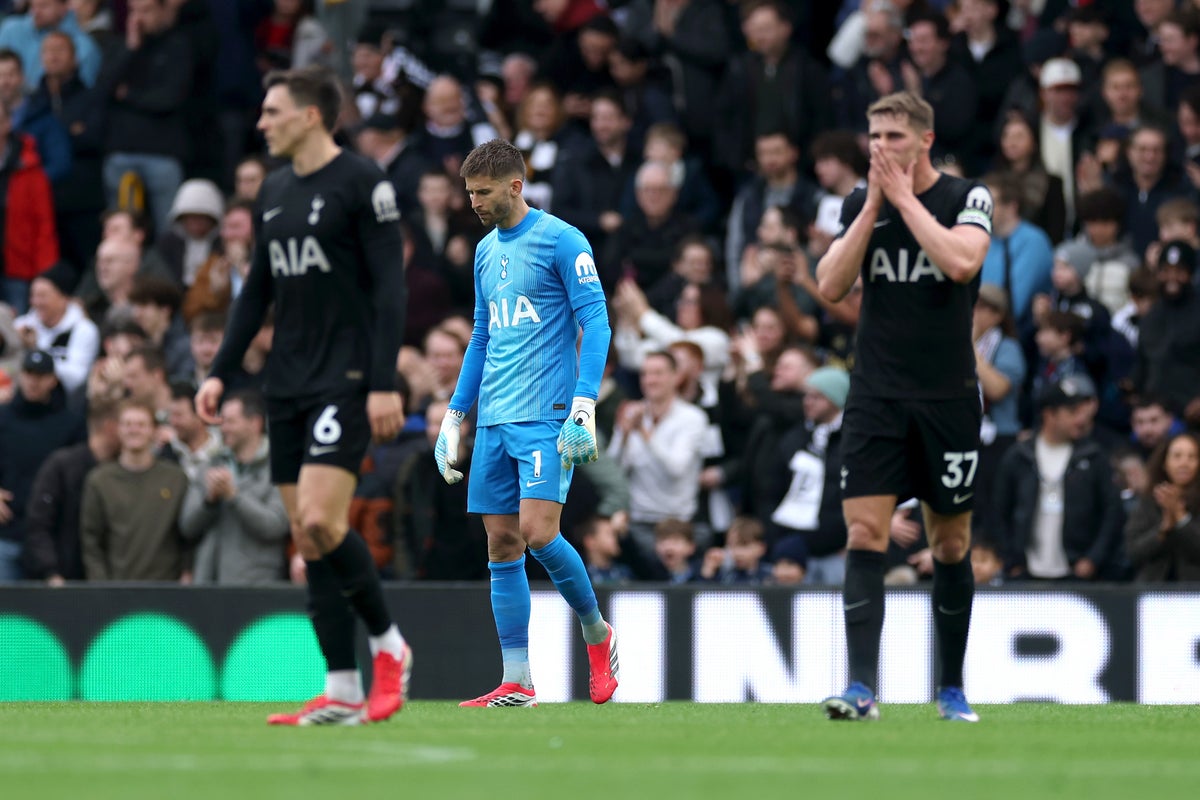
Tottenham are still searching for a first Premier League win of 2026 as they make the trip across London to Fulham.

Nine matches have come and gone since the turn of the year for Spurs without three points, with Igor Tudor’s interim tenure beginning with a derby-day drubbing by Arsenal.

With the club far from out of the relegation fight, Tudor and his squad will be looking to stop the rot but face a Fulham side buoyed by an impressive win at Sunderland last weekend.

That victory snapped a three-match losing run for a team that no team in the division has fewer draws than.

Here’s everything you need to know.

Tottenham’s trip to Fulham is due to kick off at 2pm GMT on Sunday 1 March at Craven Cottage.

Viewers in the United Kingdom can watch the match live on Sky Sports +, with coverage on the channel from 12.30pm GMT. A live stream will be available via Sky Go and NOW.

Samuel Chukwueze and Sasa Lukic may both be available to improve the options available to Marco Silva, and Antonee Robinson has also been back in training. Kevin will be sidelined for several weeks after suffering an injury against Sunderland.

Kevin Danso and Pedro Porro are both back in contention for Tottenham, and could bolster a backline that struggled against Arsenal with Igor Tudor favouring a five-at-the-back formation. Dominic Solanke may return to the starting side but Cristian Romero remains suspended.

Fulham XI: Leno; Tete, Andersen, Bassey, Sessegnon; Berge, Cairney; Wilson, Smith Rowe, Iwobi; Jimenez.

Tottenham’s Champions League draw and path to final revealed

Submitted by daniel on
Picture
Remote Image
Tottenham’s Champions League draw and path to final revealed - The Independent
Description

Tottenham will play Atletico Madrid in the Champions League last-16 as they seek solace in European football amid their perilous Premier League position.

Despite being dragged into a relegation scrap at home, Spurs impressed during the league phase and finished fourth in the table behind only Arsenal, Bayern Munich and Liverpool.

They won five of their eight matches, and only lost once - with that defeat coming against Paris Saint-Germain at the Parc de Princes.

Spurs won the Europa League last season despite their poor Premier League form - although the odds on them repeating the trick look incredibly slim.

However, they will play Atletico Madrid in the last-16, setting up just a second ever meeting with the Spanish side after the 1963 Uefa Cup Winners’ Cup final, as Spurs became the first English side to win a European title.

The two legs will take place on Tuesday 10 March, in the Spanish capital, and Wednesday 18 March at the Tottenham Hotspur Stadium.

Should they progress past Atletico, Tottenham will face either Newcastle or Barcelona in the quarter-finals. As Tottenham are fourth seeds, they are guaranteed to be at home in the second leg until the semi-finals.

If Tottenham reach the semi-finals for the first time since 2019, when they lost to Liverpool in the Madrid final, they know they would play one of four teams:

They are Bodo/Glimt, Sporting CP, Bayer Leverkusen and Arsenal.

Tottenham will be at home in the second leg, unless they play top seeds Arsenal.

Paris Saint-Germain vs Chelsea

Galatasaray vs Liverpool

Real Madrid vs Manchester City

Atalanta vs Bayern Munich

Newcastle vs Barcelona

Atletico Madrid vs Tottenham

Bodo Glimt vs Sporting CP

Bayer Leverkusen vs Arsenal

The last-16 ties will take place in mid-March. Here are the remaining round dates:

Round of 16: 10/11 & 17/18 March 2026

Quarter-finals: 7/8 & 14/15 April 2026

Semi-finals: 28/29 April & 5/6 May 2026

Final: 30 May 2026 (Budapest)

Tottenham are haunted by risk of historic humiliation but one game could save them

Submitted by daniel on
Picture
Remote Image
Tottenham are facing a historic humiliation but one game could save them - The Independent
Description

For all that Igor Tudor has tried to get the Tottenham Hotspur squad to look forward, and look at themselves “in the mirror”, there are figures around the club who can’t get certain images from Sunday out of their heads.

The players naturally looked beaten. The hierarchy, however, were said by those present to appear “haunted”.

Obviously, a biggest home defeat to Arsenal since 1978 was bad enough, but this was obviously more.

It was the realisation that the change of manager wasn’t going to change that much, certainly as regards the negative atmosphere around the club. It was that there was evidently no quick fix. It was that Tudor has a huge job on his hands, and maybe the most difficult in the history of the club.

Above all, it was the illustration that they are right in it, that relegation is now a live possibility.

Fulham-Tottenham Hotspur may well be the biggest game this weekend, in how it will tell us the most - much more than a north London derby - about what Tudor can actually do with this team.

If Spurs win, the mood will immediately lift. They’ll finally have breathing space, and just the positive feeling that would come from a first win of the year. A draw would at least show some progress, even if it’s not quite what they need.

Any kind of defeat, however, and it really is alarms blaring.

The tension will be suffocating. The pressure immense.

And for all that people are rightly saying that a Spurs relegation would be the biggest of the Premier League - and probably the biggest in English football since Manchester United in 1973-74 - more relevant might be how the very reasons for that reflect frankly astonishing underperformance. If they really do go down, it will be one of the most remarkable feats of reverse alchemy in football history; a shocking waste.

People point to Leeds United 2003-04, but the manner in which they had financially overextended themselves made their decline inevitable.

Tottenham have had the opposite problem. This should have been the opposite of inevitable. It should have been impossible.

They’re the ninth wealthiest club in the world on revenue. The ownership now actively want to spend, and raise a relatively high wage bill even higher.

That comes in an era where most of the sport has never been more geared towards those who are already wealthy. As has been stated on these pages many times in the past, it’s not like 1974 when there was relative parity in the old First Division. There’s a 90 percent correlation between wage bill and finish, and the gaps have never been greater.

So, in a skewed modern parallel of how United were relegated a mere six years after becoming European champions, Spurs could get relegated a mere five years after joining the Super League.

That in its own way says a lot about the modern game.

But of course it’s more than that.

It’s 10 years this week since they could have gone top of the league, in “the Leicester City season”.

It’s seven years since they were in the actual Champions League final, for what was supposed to have been a launch moment for the club.

That should instead now be the great regret, the ghost of what might have been.

The moment is now just a peak from which they have fallen a very long way.

A greater frustration - especially for the supporters - is that there’s been no sudden drop, no hinge date from which you can trace everything. The fans have instead long been complaining about how the very ownership approach just made this more and more likely.

Questions have long persisted over what the actual aim of the hierarchy is. Representatives of the Lewis family would of course insist it is about eventually making the club a success.

Fans would counter that by pointing to limited investment over 25 years, and question whether this has just been about having a football asset there, or something you can eventually flip in a sale.

The view among some other Premier League owners and executives is that they ultimately need a sale, for a refresh. There is too much “baggage”.

As one senior figure argues, any club can succeed in spite of the ownership, but their outlook still dictates so much. It tends to show when they are fully immersed in victory, usually in structure and appointments.

It can also go both ways. To once again draw a contrast with the other side of north London, the Kroenke ownership are said to have really come alive once Mikel Arteta’s Arsenal started winning.

The discussion is nevertheless complicated by the fact that the Lewis family imbued Daniel Levy with so much power for so long.

It is ironic that it was the former chairman’s departure - something long desired by much of the fanbase - which has brought this greater collapse.

That isn’t necessarily to defend or criticise Levy. His abrupt departure nevertheless prevented a transition of responsibility, so now everything has plummeted through the cracks.

The lack of football expertise has been exposed. The lack of a football idea has been exposed. The mismatched nature of the squad has been exposed, one long conditioned by the Levy-led decision to keep the player wage bill such a low percentage of revenue when they could have afforded much more. It’s now also a squad with considerable “scar tissue” - to quote one insider - despite last season’s Europa League. Speculation now mounts about “cliques” in the dressing room.

Some sources would similarly point to how Spurs did have potentially transformative figures employed in their recent past, such as Michael Edwards, only for them to leave.

All of which leaves Tudor in this unenviable situation, trying to make sense of something that sees confusion at all levels.

This is what is said to have “haunted” the hierarchy on Sunday, the manner in which every issue has suddenly combined to significantly escalate; the lack of time; the pressure.

It isn’t terminal, of course. There is still talent in the squad. Tudor is said to feel that squad can also fit his formation.

One win could just change everything, settle everyone down, set things right.

It nevertheless shouldn’t be overlooked that this alone is an incredible situation to be in. One of the wealthiest clubs in the world, a hierarchy once arrogant enough to think they should be in a breakaway league, are dependent on a Hail Mary appointment and the intangible of good feeling in order to escape a historic nightmare.

Naturally, discussion is already building about what relegation would actually mean. Spurs have a lot of very high fixed costs and partners, amid a situation where they wouldn’t have the same TV money, sponsors would change, and match-day income dives. At the same time, some investors would see relegation as a huge opportunity to do a deal on the cheap. Spurs are seen as “set up on the business side”, which perhaps makes some difference from the rest of the club.

More interesting, if they get out of this, might be how they turn this around. Some football figures see it as a grand opportunity in that regard, too, due to the number of advantages Spurs have.

That only sums up the situation.

To manage that, though, they need that one win to change everything back.
This is the most competitive Premier League in years – and that’s very bad news for Spurs

Submitted by daniel on
Picture
Remote Image
This is the most competitive Premier League in years – and that’s very bad news for Spurs - The Independent
Description

The article below is an excerpt from the free Monday edition of the Miguel Delaney: Inside Football newsletter. To get my latest analysis, reporting and insights delivered straight to your inbox, sign up by entering your email address in the box above.

Members of Inside Football and Independent Premium subscribers get an extra bonus edition every Friday. Become a member at just £3 for three months here.

As Igor Tudor walked into the Tottenham Hotspur dressing room after that defeat to Arsenal, he carried the air of a man realising just how big this challenge is. His message to the players was much the same as the one he relayed to the media: it’s time to look in the mirror. Because right now, that squad is staring at something that had still seemed impossible for so long. They’re in a relegation battle. Spurs, one of the Super League founders and currently among the wealthiest clubs in the world, could go down.

Some Tottenham fans reading this will no doubt be screaming that they’ve been warning of this for months, that the club has long been in real danger of sleepwalking into relegation. In attempting to take a non-supporter view, though, it was hard not to think the squad simply had too much quality. The wage bill was too high, suggesting there was just enough individual class.

Except the reality is that the situation has now gone far beyond that. This is no longer about quality. As Tudor rightly intuited, this is about psychology, about emotion, about the swirl engulfing the club.

There is also another element, running parallel to Tottenham’s form, further squeezing the club.

There is now considerable evidence to suggest this is the most competitive Premier League in a decade, since Leicester City’s title season of 2015–16. And we’re beyond simply a more difficult league, as discussed in Inside Football recently. There’s more to it – something the Premier League should actually be delighted about. Its unique selling point is back, and has never been more evident.

And that could yet create more havoc.

Taking the most immediate metric – and one that Spurs inadvertently contributed to – the 36 points between first place and the relegation zone is the lowest at this stage, after matchweek 27, since 2015–16. Back then, it was 32. Now, it would be 35, had Arsenal’s away match against Wolves not been brought forward due to the Carabao Cup final.

The nature of that 2-2 draw was rightly seen as a mini-crisis for Arsenal, to the point that Mikel Arteta spent a long time discussing it even after the 4-1 win over Spurs. But it can also be true that a draw away to the bottom team isn’t necessarily the defining result in the way it would have been in previous seasons.

Wolves are, after all, the 29th wealthiest club in the world. They might have only won one game so far this season, but they haven’t lost badly. Their worst defeat was 4-0 on the opening day, against Manchester City, before the managerial switch that stabilised the side. As referenced earlier in this newsletter, and in a stat that has conspicuously barely changed, that game is one of only six Premier League matches this season to involve defeats of a four-goal margin or higher.

This is astonishingly low for this late in the campaign, with 11 matchweeks left. By comparison, even “the Leicester season” saw 20 such results, and the number was as high as 32 in 2023–24.

This shows the gaps between teams aren’t as wide but it has another effect too. The top teams – especially those chasing the title – can’t take their foot off the gas. They can’t simply make four substitutions to rest players when cruising. They have to stay fully switched on, as witnessed in Arsenal’s draw with Wolves and in so many of Man City’s recent matches.

That only deepens the physical and mental fatigue caused by a congested calendar. And it’s impossible not to see how this contributes to another telling statistic. City’s nervy win over Newcastle United was their third in a row, which put Pep Guardiola’s side on the longest winning streak in the Premier League. Only Liverpool are currently even on two wins in a row.

The low stakes of these streaks have been a feature of the season. Stumbling Aston Villa – whose late equaliser against Leeds United might still prove crucial in the race to secure a Champions League place – have the longest streak at just eight. After that, it’s City on six, and Arsenal and Liverpool on five each.

This only proves how difficult it is to generate momentum. Teams can’t put winning runs together in the same way as previous years. There’s a high degree of fallibility, which makes for greater unpredictability – anyone can beat anyone.

The reasons for this are fairly clear, and almost mirror what happened after 2015–16. Then, much of the focus was on how wealthy clubs responded by appointing the biggest managers in the game, when Pep Guardiola and Antonio Conte joined Jose Mourinho, Jurgen Klopp, and Mauricio Pochettino. But they were also doing something more significant.

They were involved in discussions that drove even more Champions League prize money to the wealthiest clubs, as the “Super League” group exploited the vacuum at Uefa and Fifa following the 2015 fall of Sepp Blatter. This directly paved the way for the Super League and influenced the new Champions League. The wealthy clubs got what they long wanted – but it might be too much.

They may genuinely have bitten off more than they can chew – at least for now. The expanded Champions League has become an unintended balancing factor in European football. The greater number of games mitigates the effect of wealth, due to fatigue.

In the Premier League, there’s been a further counterbalance from the massive influx of money over the past 13 years. Even clubs at the bottom have sophisticated coaching staffs and squads that could steamroll most of Europe. Wolves are difficult to break down. West Ham United have gained new respectability. Nottingham Forest have a solid mid-table squad.

There’s even an argument that Burnley are performing better than Spurs. All of which is bad news for the one-time Super League club, even if they were always considered a junior partner.

The sheer competitiveness of the Premier League could see them fall, sleepwalking into relegation as Middlesbrough did in 1997, West Ham in 2003, Newcastle in 2009, or Leicester in 2023 – but potentially on a much greater scale. The second half of that Arsenal defeat was alarming in that regard.

Sunday’s trip to Fulham may now be the biggest fixture of the weekend, revealing what Tottenham can actually achieve under Tudor.

The message from the rest of the league, however, is clear: you’ve never had to be sharper.

To receive the free, Monday newsletter simply enter your email address in the box at the top of this page.

You can also head to our newsletter preference centre to sign up for the email. Once there, all you need to do is press the ‘+’ button and enter your email address.