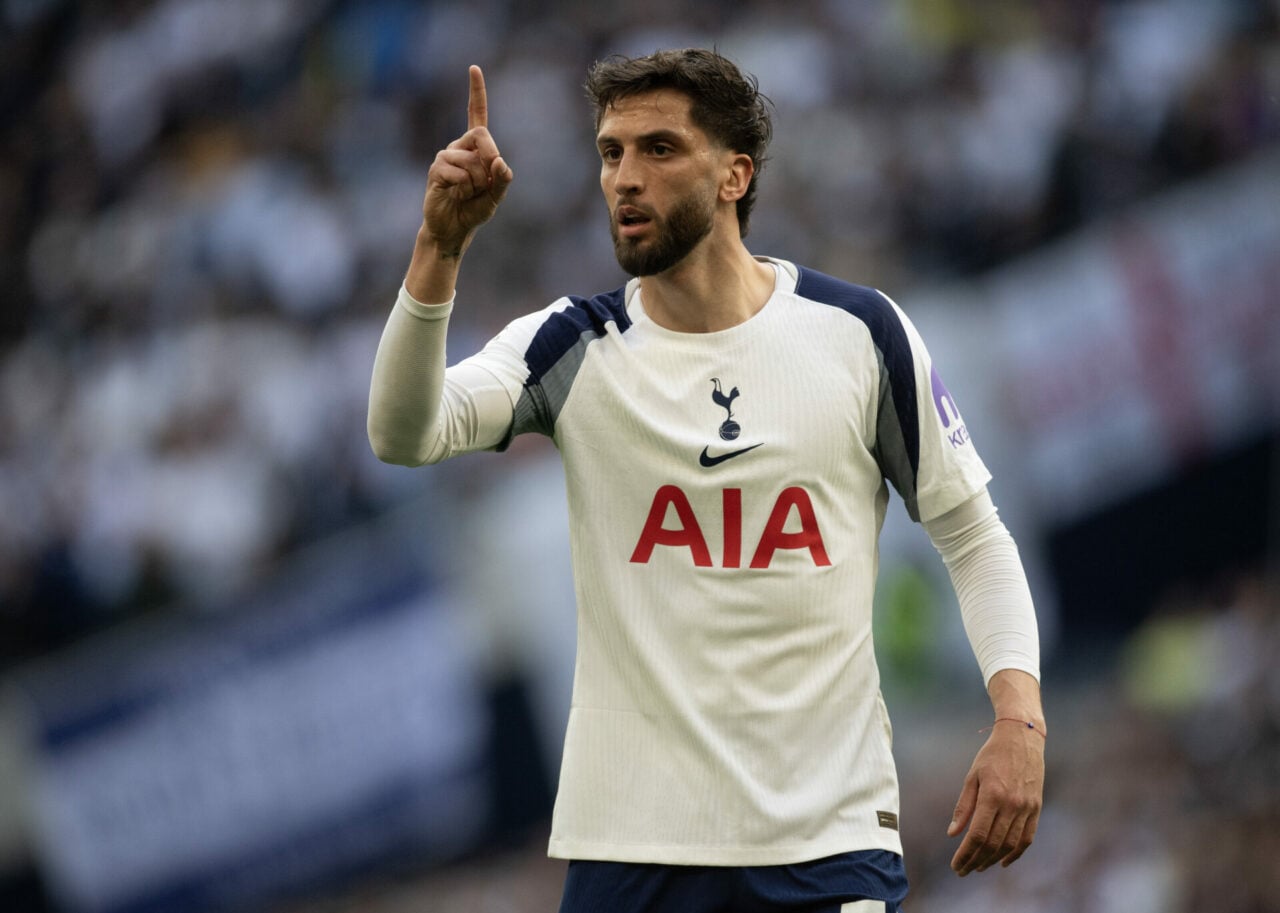
Tottenham have been crying out for midfield composure all season, and it has now arrived in the form of a player many had written off – Rodrigo Bentancur.
Bentancur, who has quietly engineered three of the most composed midfield performances Tottenham Hotspur have produced all season, was helped off the pitch at Villa Park on Sunday evening, clutching what looked, in those sickening seconds, like it could be another serious injury.
Spurs had just claimed a precious 2-1 win, making it two in two in the Premier League. For the Uruguayan, who has clawed his way back from hamstring surgery to become the unexpected heartbeat of Roberto De Zerbi’s nascent project, the timing felt cosmically unfair.
Because what Bentancur has produced across these last three games against Brighton, Wolves and Aston Villa is, quietly, one of the more remarkable individual turnarounds of this Premier League season.
Fortunately, Roberto De Zerbi has since claimed that Bentancur was ‘just tired’, thus boosting his chances of playing against Leeds on Monday.
Rodrigo Bentancur returns as Tottenham’s much-needed architect
Bentancur had been out since early January with a serious hamstring injury that required surgery, leaving Spurs rudderless in the middle of the park during the most desperate stretch of their campaign.
As we reported here on Spurs Web, his personal fitness coach Daniel Fernandez revealed that Bentancur’s recovery was progressing faster than initially expected, with the midfielder completing three training sessions a day and already 15 days ahead of the original prognosis.
MORE SPURS STORIES
His return for the Brighton match on 18 April was as much an act of necessity as celebration. De Zerbi, parachuted in to rescue a sinking ship, had one game under his belt, a 1-0 loss at Sunderland, and had already seen enough.
The experiment of pairing Archie Gray and Conor Gallagher in the double pivot had shown its limits, with Granit Xhaka bossing that midfield with contemptuous ease. Something had to change.
De Zerbi turned to Bentancur and Yves Bissouma for the 2-2 draw with Brighton. All of a sudden, Spurs were more composed where it mattered. In a somewhat symmetrical manner, this was the exact midfield pairing that Ange Postecoglou turned to in the Europa League final three games of 2025, which of course, Spurs won.
The difference this time, was immediate and unmistakable.
The numbers tell a story for Spurs
According to stats from SofaScore, Bentancur managed a pass accuracy of 85.7 per cent from his 51 touches against Brighton. He contributed in several other aspects of his game too, putting in four tackles, making 12 defensive contributions and winning five of six ground duels.
As we noted on Spurs Web after the Brighton draw, the influence of the two players, and the care they showed on the ball, no doubt prevented Spurs from conceding too many chances. Brighton had just two big chances all game.
The Wolves performance, a week later, was arguably even more complete. Bentancur took a total of 79 touches across the 90 minutes, while his heat map showed he popped up everywhere in the middle third of the pitch, including both channels.
He completed 54 of his 61 passes, boasting an impressive 89 per cent success rate, and more than played his part in a rare shutout, registering three tackles, three clearances, three interceptions and six recoveries at Molineux. Imposing in duels, he won four of seven on the ground and all three in the air.
Our player ratings from Molineux noted that he was composed in midfield, and he dictated play with neat one-touch passing and close control. That is not a peripheral contribution. That is a midfielder running a game.
And then came Villa Park. His afternoon there before his substitution was, statistically, his finest yet. Bentancur completed 98 per cent of his passes and had 56 touches, was dispossessed zero times, made two tackles, two interceptions and three recoveries, and won four of six ground duels.
Across the three matches, Bentancur has averaged well over 60 touches per game, maintained pass accuracy consistently above 85 per cent, and contributed a combined seven interceptions, eight tackles and seventeen recoveries. That is not a cameo role. That is an anchor.
Rodrigo Bentancur, the press and the presser
One of the most persistently misunderstood facets of Rodrigo Bentancur’s game is his relationship with pressing. He will never be Declan Rice, hunting and hounding with all elbows and lunging tackles. That is not his vocabulary. But his reading of the press – knowing when to engage, when to hold his shape, and when to trigger the trap, is something altogether more sophisticated.
Tottenham are pressing higher, winning the ball back more often in advanced areas and playing with greater intensity than they did under the club’s previous managers this season. Bentancur is central to why that shift has been possible.
His positioning in the press dictates the entire structure. When he steps, the line steps. When he holds, the shape stays compact. It is the kind of intelligence that does not generate viral clips but that coaches understand instinctively. His importance showed as the team did drop off slightly after his forced substitution.
While Bissouma, Palinha and Gallagher are at their best harrying after opponents, tackling and progressing with the ball, the Uruguayan is more comfortable using his intelligence to keep possession. Frequently, this has been mistaken for passivity.
Mistaken for passivity. That is precisely the right phrase — and we will return to it.
The ball carrier the system needed
De Zerbi’s entire footballing philosophy rests on a simple principle: possession is only valuable if it moves in directions that hurt the opponent. Static, horizontal possession is just possession theatre. The Italian demands forward intent, press resistance under duress, and midfielders who can play through the first wave of pressure to find the second line.
Rodrigo Bentancur, in these three matches, has done exactly that. His ability to receive under pressure and turn, a hallmark of his game at its best, has allowed Spurs to transition from defensive recovery into attack without resorting to the long ball. His pass selection has been intelligent: clipped balls into the channels, half-space passes that unlock Conor Gallagher and Randal Kolo Muani in forward positions, and the occasional perfectly weighted switch that stretched Brighton’s defensive block.
As our half-time ratings piece from Wolves observed: the Uruguayan was sharp in midfield, using the ball well and mixing one-touch passing with neat dribbles in tight spaces, and also venturing forward to support attacks. He is not being bypassed, barged off the ball, or rushed into mistakes. He is, in a word, press-resistant.
A Spurs captain without the armband
Leadership in football is one of those concepts invoked constantly and defined poorly. Too often it is reduced to chest-beating and shirt-grabbing in the tunnel. Real leadership, the kind that costs something, looks different. This is the exact leadership that has been spoken about on television, radio, and podcasts that Tottenham have desperately been missing.
After being substituted against Brighton in the 67th minute, Bentancur did not trudge to the dugout, wrap himself in a bib and stare at his phone. He was seen on the touchline, animated, pushing his teammates forward, coaching and encouraging those still on the pitch through the tense closing stages. Here was a player who had just returned from months of rehabilitation and immediately cared more about the team’s collective fate than his own game time. In a season where Spurs have at times looked like a collection of individuals waiting for someone else to care, that moment said everything.
He is, admittedly, not the Premier League’s most accomplished metronome, but his ability to keep a cool head when under the cosh is invaluable to Spurs and De Zerbi. You cannot teach that. You cannot buy it in a transfer window. And in a relegation battle — where fear and chaos are as dangerous as any opposition tactic — a player who exudes calmness and demands standards from those around him is worth considerably more than his technical numbers suggest.
The Conte years and the Postecoglou chapter
To understand what Bentancur is capable of, you need to reach back to January 2022, when he arrived from Juventus and immediately looked like the most natural fit for Antonio Conte’s system of any player at the club.
He made a huge impact after joining in the second half of the 2021/22 campaign, making 18 appearances and starting 16 of Spurs’ final 17 matches as they secured fourth place and a return to the UEFA Champions League, partnering Pierre-Emile Hojbjerg and winning nine of the final 13 league games. He moved up another gear in 2022/23, until injury cruelly cut it short.
That season, before his knee injury in February, he was the most complete central midfielder Spurs had played in years (arguably, since the talismanic Moussa Dembele): dynamic enough to break into attacking positions, disciplined enough to hold his shape, and technically accomplished enough to control rhythm against elite Premier League opposition.
As our Spurs Web profile on Bentancur details, he demonstrated in that 2022-23 campaign that his ceiling, when fit and properly managed, is considerably higher than his recent reputation suggested.
Then came the injuries. The knee. The hamstring. The long months of rehabilitation and return. By the time Ange Postecoglou arrived, Bentancur was rebuilding himself, and his form was understandably inconsistent.
Yet even in fits and starts, he and Bissouma were the duo who more often than not got the nod under Postecoglou in the No. 6 spots. They started the Europa League final triumph over Manchester United, as well as both semi-finals. He was not a passenger in that triumph. He was one of its architects.
The Thomas Frank question and the real answer
Here is where honesty requires some uncomfortable clarity. Many Spurs supporters spent the first half of this season directing sustained frustration at Bentancur. As our Spurs Web opinion pieces from that period reflect, the passing was too lateral, the tempo too slow, the impact too minimal for a player starting virtually every Premier League game. The criticism was not entirely without foundation.
But here is the context those critics were missing.
Thomas Frank, whatever his personal qualities as a coach, operated a system at Tottenham built on defensive caution and risk minimisation. It was a style that constrained rather than liberated its most technically gifted players.
Frank’s Tottenham was not designed to press high, build in triangles, or ask midfielders to receive in tight spaces and play through the press. It was built to survive, to defend deep, and to counter when possible. In that system, a midfielder of Bentancur’s intelligence and craft had nowhere to operate. He was a concert pianist being asked to play with mittens on.
Before his injury setback, he had played regularly under Thomas Frank, starting 25 of the first 30 matches of the campaign. That was despite his stock not being particularly high, with the 28-year-old often criticised for Spurs’ lack of adventure and guile in deeper positions.
The problem was never Bentancur. The problem was Frank’s cowardice — his unwillingness to trust his players in possession, to build from the back with intent, or to give a midfielder of genuine quality the licence to control a game in the way De Zerbi now demands.
As we flagged on Spurs Web ahead of the Brighton match, the transformation under a manager who finally fits Bentancur’s profile was always likely to be significant. The overall effects are already obvious. Tottenham are winning the ball back more effectively and showing more teeth across the pitch.
The remontada and what comes next for Rodrigo Bentancur at Tottenham
Football has a Spanish word for it: remontada. The great comeback. Usually applied to teams recovering impossible deficits in knockout ties. But there is a personal remontada happening here, quiet and steady across three consecutive performances in the most high-stakes weeks of Tottenham’s season.
His re-emergence after his injury could be the difference between Spurs staying in the top-flight and going down, that is how good he has been. That is not hyperbole. It is the honest assessment of what these three weeks have produced.
The worry, of course, is Sunday evening’s substitution at Villa Park. The circumstances of his exit, helped off before the hour mark in a match that meant everything, cast a shadow over what was otherwise a day of genuine relief and celebration. Tottenham’s wretched luck continued against Wolves as Dominic Solanke was forced off with a hamstring issue and Xavi Simons suffered an ACL tear.
The injury list at N17 this season has been grotesque in its length and timing, and the possibility of losing Bentancur now, at this precise moment, when he is irreplaceable, is the kind of thought that Spurs supporters cannot dwell on for too long. Hopefully, De Zerbi is correct and it is just fatigue.
His personal remontada can still be complete. This team’s survival story can still have the right ending. But it needs him fit, available, and free to run the game in the way that only he, among Spurs’ current midfielders, truly knows how.
Get well soon, Lolo. We’re not done yet.