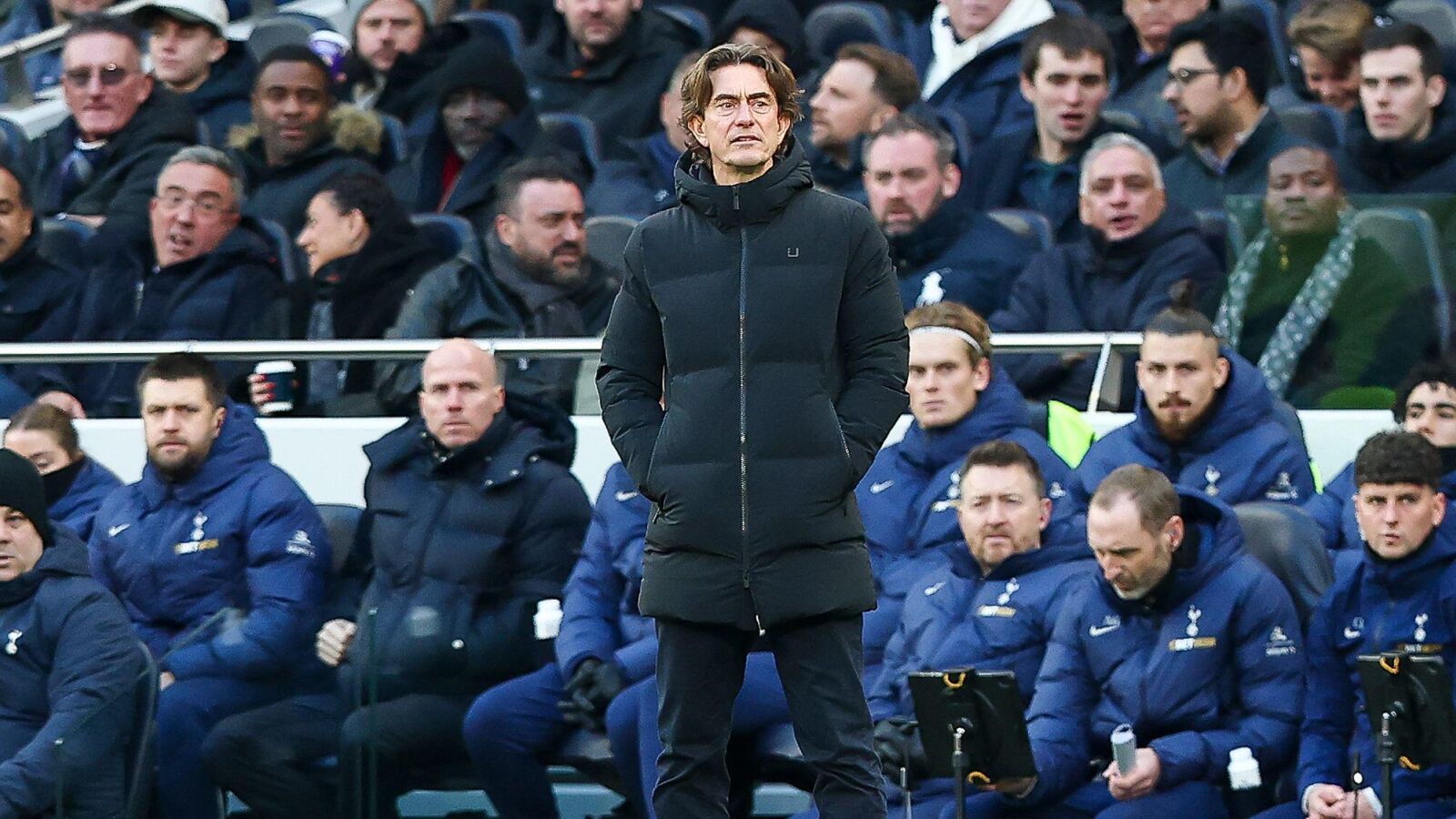
A philosophical question emerged during the latest misery Spurs inflicted upon their fans in what is already looking like a dreary waste of everyone’s time.
At Brentford in the week, Spurs started slowly, remained tethered in second gear, never got going at all, and finished the game as slowly as they started it. They got a point out of it because Brentford decided to start 2026 in much the same way.
Obviously, that was quite bad from Spurs. But in a way isn’t it even worse to spend 45 minutes pointedly not doing that – to spend the whole first half on the front foot, pressing high up the pitch, looking to attack and put an opponent under pressure – only to then fall back on the whole unwatchably dreary schtick and have to settle for another drab and uninspiring point to show for it?
We really do think it might be worse. There’s something enormously apt about it feeling like Frank is under even more pressure after a three-match unbeaten run than he was before it. It’s almost impressive to make collecting actual real-life Premier League points this soul-destroying.
The first half was perhaps Spurs’ best first half of any home Premier League game this season. That is a tremendously low bar, arguably in fact underground, but still. They really were okay in that first 45.
Not good, obviously. Spurs have entirely forgotten what good looks like over recent months. They still played like a team of strangers when tasked with piecing together a coherent attack, but there was at least a sense of them all being on the same page in at least wanting to give that a try.
Mathys Tel was bright but wayward. Richarlison ran around a lot. Wilson Odobert tried his best. There was a willingness, at least. There was intent.
They deserved their lead, even if that lead came, as the occasional goals Spurs still score these days now apparently must, from a deep corner launched beyond the far post. It was peak Frankball: a deep corner met by one centre-back, played to the other centre-back and turned in by Ben Davies.
Spurs’ leading goalscorer in 2026, ladies and gentlemen. A man who played in the last league game between these two almost nine years ago, alongside Vincent Janssen and Michel Vorm.
You can’t help but enjoy that moment for him. Today’s goal we mean, not playing in a 0-0 draw at the Stadium of Light alongside Vincent Janssen and Michel Vorm in 2017. The Spurs crowd – spectators who get comfortably the Premier League’s worst value for money, enjoyed that, at least, with chants of ‘Davies again, ole, ole’ and ‘He scores when he wants’ breaking out.
At half-time it was for once easy to feel relatively, cautiously positive about Spurs. And then Frank got hold of them. And then the second half happened. And it was absolutely rotten.
Everything encouraging about the first half was abandoned entirely. The plan throughout the second half was to desperately protect that 1-0 lead at all costs and if a goal happened to arrive by magic on the break then, well, okay that’s fine, we suppose. But on no account were Spurs going to actively seek further goals, not when already 1-0 up against a newly promoted side.
Even when that newly promoted side is proving as adept as Sunderland, it’s still just miserably small-time.
Sunderland, of course, having barely got into the game at all in the first half, were enormously encouraged by this change in the script and duly dominated the second half. They are not, frankly, a team that particularly requires such encouragement.
The alarms rang loudly and repeatedly before Brian Brobbey eventually lashed home a superb and richly deserved equaliser after neat interplay with Enzo Le Fee.
It’s no coincidence that it was those two to the fore, either. Both had been spectators in the first half, before becoming the game’s main characters throughout the second. Le Fee had himself struck the post with a header moments before creating the equaliser for Brobbey.
The goal came eight minutes after Frank had replaced Wilson Odobert with Lucas Bergvall and Archie Gray with Joao Palhinha. No bad players there, but changes that nevertheless send a message to the opposition. A slight nudge towards the defensive from a team already retreating into themselves.
A little further encouragement that their own back door needed that little bit less attention.
Perhaps the most damning thing of all was how little the equalising goal changed Spurs’ approach. Holding on to three points simply became holding on to one. There was no great renewed urgency to go and win the game again, with Sunderland holding the momentum and looking the likelier to nick it late on.
That’s the thing with Frank’s obsession with eliminating risk. It so easily becomes the biggest risk of all. Spurs have been here before during Jose Mourinho’s destroy and exit when encouraging 1-0 leads turning into dispiriting 1-1 draws was the norm. There can be no argument that putting all your chips on 1-0 can possibly represent the safest bet. That’s true of anyone, but especially Spurs.
Once you’ve switched off entirely as an attacking team, it’s maddeningly difficult to flick that switch back on again. By the time Spurs did, it was already injury time, leaving them only a few desperate minutes to try and win another corner from which to maybe get the winner. The best they managed was a throw, and Bergvall dropped it.
A moment to sum up an afternoon to sum up a season. We remain entirely unconvinced anyone involved benefits from allowing this to continue.