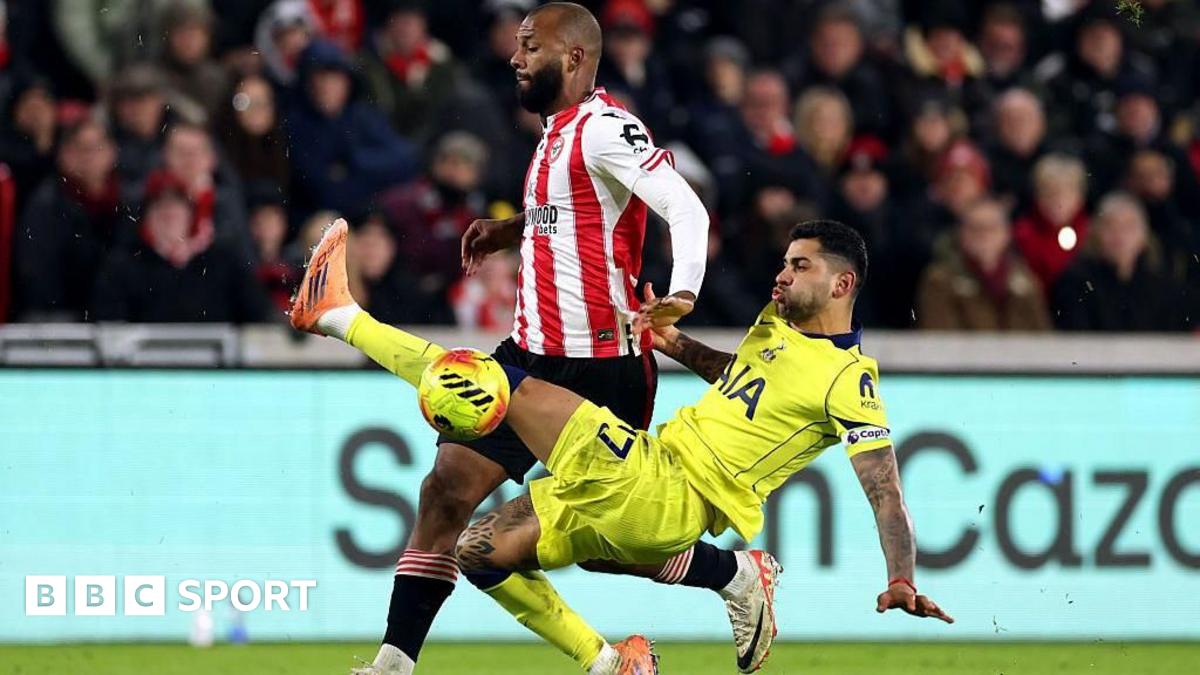
Keith Andrews was far from happy after Tottenham defender Cristian Romero escaped a red card in the 0-0 draw on New Year's Day.
The Brentford manager was adamant Romero should have been sent off for bringing down Igor Thiago when the striker was running through on goal.
Romero did not even concede a free-kick let alone be shown a card.
Andrew said in his post-match news conference that it was "a blatant red card" because "Thiago was stopped from getting to the ball".
You can see Andrews' point. Romero made a wild swing at the ball to try to intercept a pass. In doing so, Thiago was brought down.
When play has continued the video assistant referee (VAR), Alex Chilowicz, has two things to consider. Firstly, was the foul itself a clear and obvious error and then was it definitely a denial of an obvious goal-scoring opportunity (DOGSO).
The VAR cannot intervene purely on the free-kick, it has to be both a foul and a red card.
Romero brought his left leg across the Brentford player, creating a barrier and halting his progress.
It is hard to argue against a foul so why did the on-field officials not give it?
From their perspective it could have looked like Romero hooked the ball because he came away in possession. But this was a result of momentum rather than an executed challenge.
That leaves the VAR to consider DOGSO.
When assessing DOGSO referees are told to imagine the scenario without the defender at the point of the foul.
The ball was in front of Thiago, there was no other defender in close proximity and play was a few yards outside the area.
Thiago would surely have collected the ball, run forward a few yards and taken a shot.
That Romero came away with the ball has probably given the VAR some doubts that Thiago would take control. It gave the perception that play would not have continued forward.
However, this happens after the foul and the ball only stopped because Romero landed on it. A DOGSO red card appears to be the more logical outcome.
While the ball did touch Romero's arm it was accidental and would not be considered handball.
It could have been Romero's third red card in under a month.
Andrews was annoyed that Romero was not sent off when the two teams met on 6 December. Again the Argentine defender had made a challenge on Thiago.
It was a scissors-style tackle which Andrews felt was a "very easy one" for the officials.
The Premier League's Key Match Incidents Panel voted 3-2 that Romero should have been sent off by referee Rob Jones. But it was a 4-1 vote that the VAR, Tim Wood, was right not to intervene and advise a red card.
Romero was sent off for two yellow cards against Liverpool on 20 December.
On one side of the argument is that players go to ground too easily trying to get decisions. The other is that if you do not go down you won't get a foul.
Hugo Ekitike broke through into the area under pressure from Leeds defender Jaka Bijol in New Year's Day's 0-0 draw.
Bijol had arms around the Liverpool striker, who stayed on his feet and tried to get a shot away. Ekitike was crowded out and did not manage a shot.
"I don't think it's a surprise to anyone that one of my players stay on their feet," Liverpool boss Arne Slot said.
"It's just a team who we are and unfortunately it's not recognised. The questions is, should we change or not? I don't think we should.
"If he goes down it probably would have been a red card and a penalty and that would have increased our chances of winning."
Bijol was saved from a VAR review because he was not holding the Germany international in a conventional sense. That means by tugging the shirt or dragging the opponent back.
A VAR, in this case Darren England, always has to assess impact. That is far more difficult if a player does not go down. So by its very nature a player who stays up is less likely to get a decision.
If Ekitike had gone down, proving that he had been impacted, it may well have been a penalty and a red card for DOGSO.