ESPN

Marathon legend Eliud Kipchoge frets over Tottenham's relegation prospects

Submitted by daniel on
Picture
Remote Image
Marathon legend Eliud Kipchoge frets over Tottenham's relegation prospects - ESPN
Description

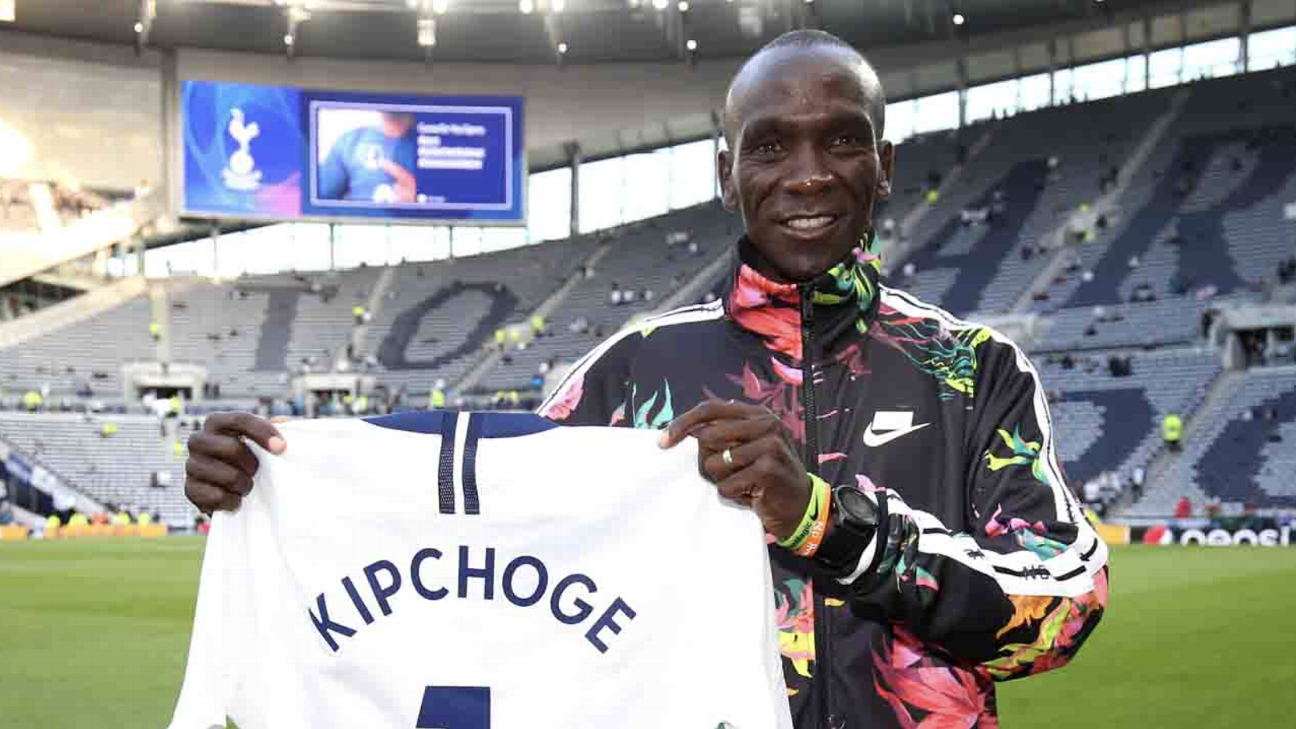
CAPE TOWN - Kenya's Eliud Kipchoge, the most decorated marathoner of all-time, told ESPN that he is more than a little concerned about Tottenham Hotspur's potential relegation from the Premier League, having supported the London club for years.

Kipchoge also paid tribute to compatriot and friend Victor Wanyama following the former Tottenham star's retirement from football.

Kipchoge visited Tottenham in 2018 and 2019, when Wanyama was still at the club. However, the former marathon world record holder has remained true to his pledge to continue supporting Spurs after the midfielder's 2020 departure, despite his anxiety over their relegation battle.

"I'm still a Tottenham fan. We're having a rough time. We're ranked in the [Premier League] bottom three and I don't know whether we'll survive relegation or not," Kipchoge told ESPN.

Spurs are currently 18th in the Premier League, two points adrift of safety with six games to play.

Roberto de Zerbi recently became Tottenham's fourth head coach in the space of a year. Ange Postecoglou's shock sacking in June 2025 was followed by unsuccessful spells under Thomas Frank and Igor Tudor - leaving the UEFA Europa League holders fighting for survival.

However, Kipchoge is nicknamed 'The Philosopher' and holds a perspective on Spurs' struggles befitting of that moniker.

"All in all, it's football," he said. "We always say football is like life: we don't celebrate for 90 minutes - so, we'll see."

Former Spurs, Southampton, Celtic, Beerschot, CF Montréal and Dunfermline Athletic midfielder Wanyama announced on April 3 that he was hanging up his boots.

Kipchoge - who has won 11 major marathons and two Olympic gold medals - has paid tribute to the 64-cap former Kenya international.

"We are real friends. Victor is a huge footballer in Kenya. I visited him when he was at Tottenham twice. The second time, he was playing against Ajax... I believe that [in his post-playing career], he's going to promote football in Kenya and bring a lot more knowledge on football to the next generation," Kipchoge added.

Concerned as he may be over Spurs' future, Kipchoge has no such worries for Wanyama's. As Wanyama works towards finishing his UEFA A License, Kipchoge believes his friend will continue to impact lives beyond football, just as he himself aims to through the Eliud Kipchoge Foundation.

Now 41 years old, Kipchoge is turning his attention to a two-year tour of the world in which he will run marathons in seven continents. His journey will kick off at the Cape Town Marathon on May 24 before stops in Porto Alegre (July 12) and Melbourne (October 11). He aims to raise awareness and funds for conservation and education initiatives.

None of the three confirmed stops on his tour are Abbott World Marathon Majors, although Kipchoge aims to help the Cape Town Marathon become one. This therefore marks a new chapter for an athlete whose career in recent years has largely centred around established majors.

Kipchoge's marathon world record was broken by the late Kelvin Kiptum in October 2023, when he ran 2:00:35 at the Chicago Marathon four months before dying in a car crash.

However, Kipchoge remains the most successful marathoner of all-time in terms of titles and the only human being to have ever completed a marathon distance in under two hours (1:59:40 in Vienna, 2019). That run, however, was not recorded for the official marathon record books, as it was a time trial in controlled settings rather than in a formal race.

Kipchoge's beloved Tottenham will continue their fight for Premier League survival at home to ninth-placed Brighton on Saturday in a 5:30 p.m. BST (6:30 p.m. CAT, 4:30 p.m. GMT) kick-off.

Source

Premier League overreactions: Arsenal, Spurs collapsing

Submitted by daniel on
Picture
Remote Image
Premier League overreactions: Arsenal, Spurs collapsing - ESPN
Description

The most recent Premier League matchday saw -- to paraphrase Arsenal coach Mikel Arteta -- several teams punched in the face. Arsenal's grip on the title is slipping with Manchester City clawing them back. The race for the UEFA Champions League places is heating up, while Tottenham Hotspur are teetering on the trapdoor at the foot of the table.

There are plenty of takes around after the weekend, and ahead of the next batch of fixtures -- like we've done with NFL and rugby union -- we look at some snap judgements before weighing up whether they are overreactions or legit takes.

Let's start with Arsenal, and whether nerves are getting the better of them.

Jump to:

Arsenal's title hopes are going down the drain?

De Zerbi can't save Spurs from relegation?

Ngumoha ready to replace Salah?

Chelsea won't qualify for Champions League?

Brentford's Andrews is coach of the year?

Arsenal's title hopes are slipping away

When Arsenal scored that late winner against Everton back in mid-March and Manchester City were held at West Ham United, the title looked to be heading to the Emirates Stadium. Arsenal had a nine-point lead. Job done? Well, not quite. A month later, and after a week in which Southampton knocked Arsenal out of the FA Cup and Bournemouth won Saturday, Arsenal are stalling. This title race is now a flip of a coin between Mikel Arteta's side and Pep Guardiola's.

Verdict: NOT AN OVERREACTION

There are moments across the Premier League's 33-year history that are replayed time and time again. For every glimpse of Sergio Aguero's title-winning goal for Man City in 2012, you'd have also seen countless replays of Manchester United's goalmouth scramble and inability to score a title-clinching winner against West Ham in 1995. The series of blocks from West Ham's players, the eventual shot wide, and the forlorn look on Alex Ferguson's face is forever juxtaposed against Kenny Dalglish celebrating a title with Blackburn Rovers. It has remained an iconic snapshot encapsulating football's cruel, small margins.

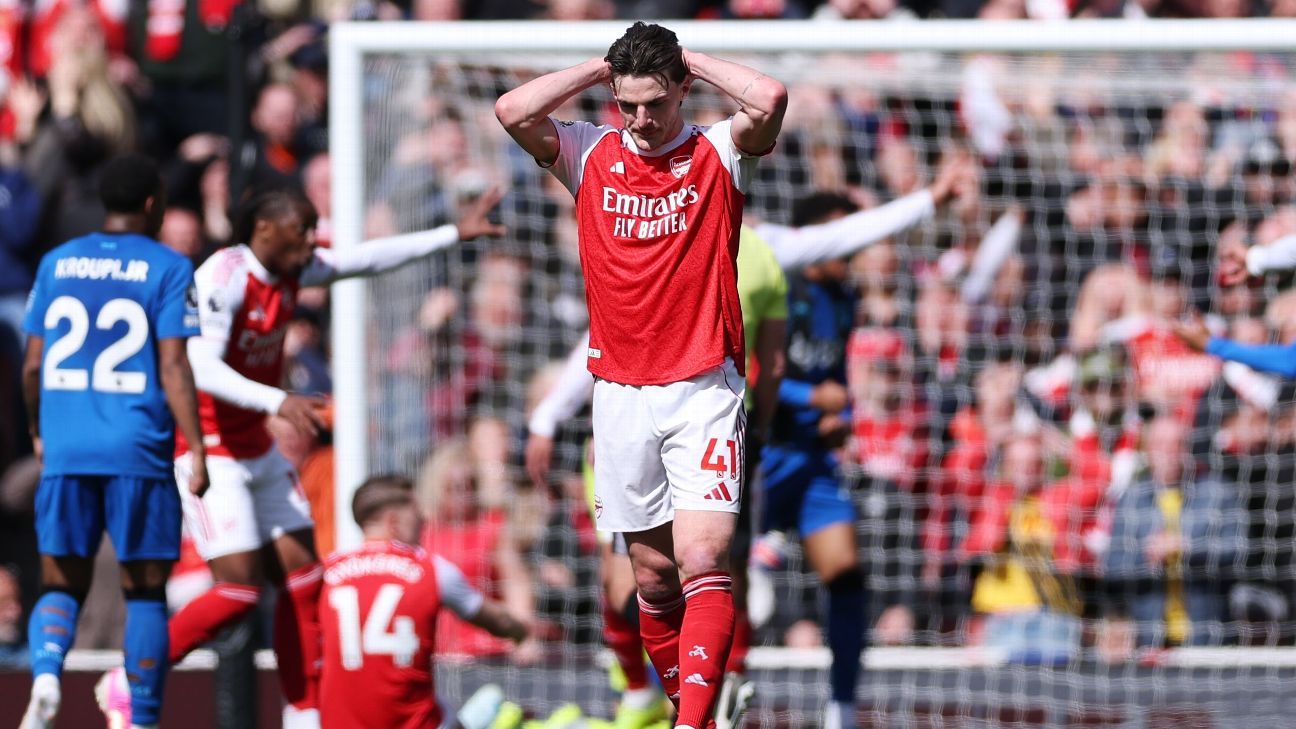
You wonder whether the sound of the Emirates Stadium booing Arsenal on Saturday, and a montage of missed opportunities like Viktor Gyökeres hooking the ball over from six yards, and Álex Jiménez's last-gasp tackle on Gabriel, will yet be immortalized as the moment where Arsenal's title hopes slipped away from them.

To reference Mike Tyson's phrase, Arsenal need to figure out whether their plan still works after having their nose bloodied, and the acid test will be how they manage the next week. First up are Sporting on Wednesday in the Champions League quarterfinals, then comes the trip to Manchester City on Sunday.

What works in Arsenal's favor is basic mathematics: If they win their remaining matches (or even get a draw at the Etihad Stadium), the title is theirs. But then you factor in the psychology of the situation. City know what it takes to win titles: they have six in the last eight years under Pep Guardiola while Arsenal have the weight of a 22-year wait.

If City ease past Arsenal at the weekend, the momentum shifts to Guardiola & Co., but this Arsenal side have depth and quality to get things across the line. They can win at Manchester City on Sunday if they find a way to rise above the noise, and trust in what's got them to this point. In short, this title race is going to go down to the wire.

De Zerbi doesn't have time to save Spurs from relegation

Not even the appointment of Roberto De Zerbi could halt Spurs' dismal run of form as they lost 1-0 at Sunderland on Sunday -- they have picked up only five points in the league this year. Compare that with their nearest rivals: West Ham have picked up 18 in 2026, Leeds United 16 and Nottingham Forest 15.

With West Ham and Leeds winning this past matchweek and Forest getting a point, Spurs are now the favorites to join Burnley and Wolverhampton Wanderers in getting relegated. They're two points behind West Ham (and safety) with six games to play.

Verdict: NOT AN OVERREACTION

Spurs' players are scared of the specter of relegation. De Zerbi has only been in the job a fortnight or so, but he is fully aware that the fear of the drop has taken hold of his players.

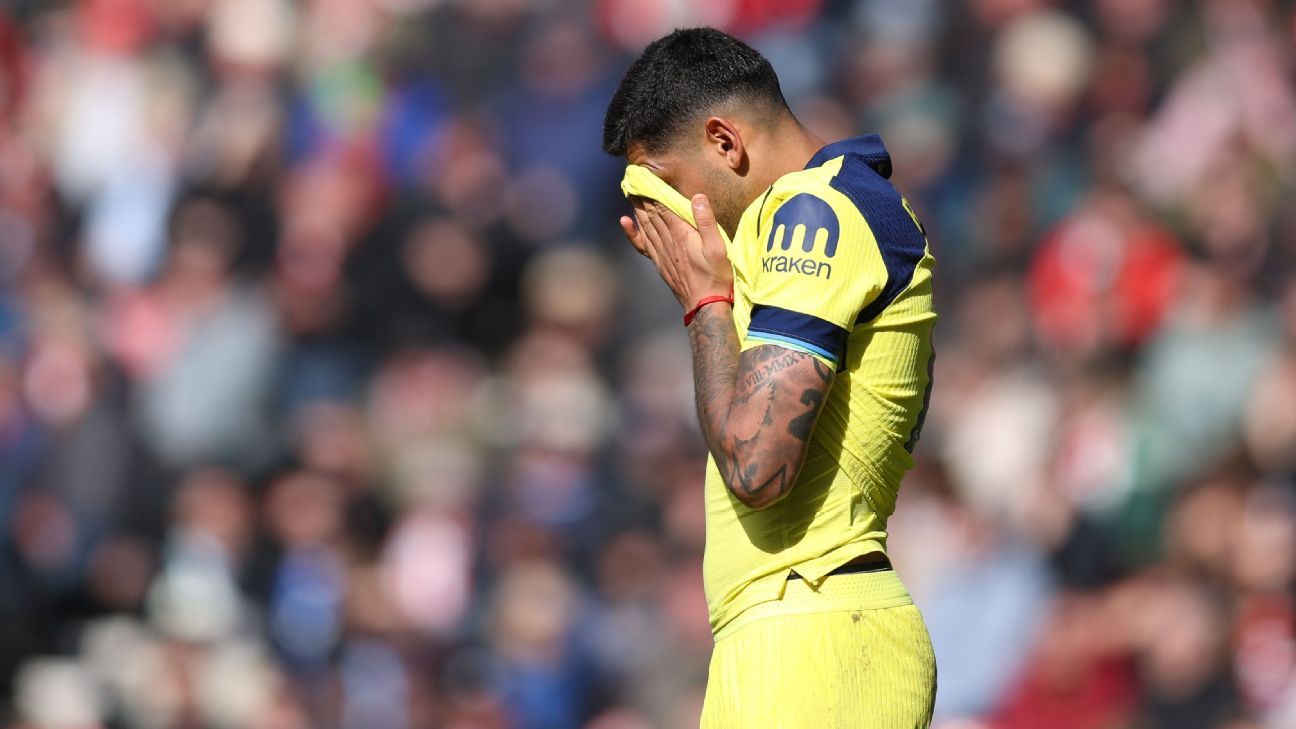
West Ham, Leeds and Forest are used to scrapping their way out of relegation battles. Spurs' players aren't -- where's the leadership? Well, the sight of injured captain Cristian Romero leaving the pitch in tears 70 minutes into their eventual 1-0 defeat to Sunderland sums up Spurs' predicament. The fact he's out for the rest of the season only deepens the gloom. The team is falling apart.

De Zerbi says they just need one win to change the mood -- perhaps that will come against Brighton on Saturday. But that win has been elusive for so much of this year. While their nearest rivals are finding ways to pick up points, Spurs are just falling short, paying for years of poor transfer business, uncertainty behind the scenes and misjudged managerial appointments. They have six games left; win a couple of those and life will be looking rosy again. But it's all far easier said than done.

Liverpool's Mo Salah replacement is already at the club

This is the season of bright young talents. Max Dowman, 16, has announced himself at Arsenal, while Rio Ngumoha put on another impressive showing for Liverpool on Saturday, getting on the scoresheet in a 2-0 win over Fulham. His first Anfield goal, in his second Premier League start, was brilliant, and it made him become Liverpool's youngest-ever league goal scorer at home. He turned and twisted Timothy Castagne and then planted a perfect curled effort into the far corner of Bernd Leno's goal.

As Liverpool plot life post-Salah, it's time to back Ngumoha and invest elsewhere. He's ready to fill Salah's vast shoes.

Verdict: OVERREACTION

Ngumoha is a rare player. In what's been a tricky season with plenty of unanswered questions for Liverpool, Ngumoha's breakthrough has been a wonderful positive. The sight of him scoring Liverpool's opener against Fulham on Saturday and being on the same scoresheet as Salah offers the delightful juxtaposition of the future and past of the club.

Liverpool need to judge this summer's transfer window carefully. After their vast expenditure last year, any recruitment needs to point toward evolution over revolution. But one position you expect them to strengthen is on the flank, as they look for someone to replace Salah.

Ngumoha's goal was a magical moment, and further evidence of his astonishing ability and boundless potential. But Liverpool still need to add to their squad this summer -- it's too soon to rely on Ngumoha. He's happiest off the left, so he'd hardly be a like-for-like Salah replacement. But imagine a forward line up with him on one flank, and RB Leipzig's Yan Diomande on the other. It's a partnership that could last a decade.

Spare him the comparisons with departing Liverpool legends, though. Let him develop at his own pace.

Chelsea's hopes of Champions League qualification are evaporating

Liam Rosenior's side collapsed to a 3-0 defeat to Man City on Sunday. They now lie seven points off Villa in fourth, and four off Liverpool in fifth. That deficit is too much for them to make up.

Verdict: NOT AN OVERREACTION

Chelsea's form isn't great. They lost to City on Sunday, fell to Everton by the same 3-0 margin on Mar. 21 and slumped at Newcastle, 1-0, on Mar. 14. Throw in the trouncing they received from PSG, and this is a team that's losing form at the wrong time. Their Premier League run-in is tricky, too -- they have Man United (home), Brighton (away), Nottingham Forest (home), Liverpool (away), Tottenham (home) and Sunderland (away). That's two teams in the mix for the top four, and two scrapping against relegation. And they've recently suspended their own captain Enzo Fernández for their past two matches. In short, it's far from ideal.

This has been another bonkers year at Stamford Bridge: more mass recruitment, former coach Enzo Maresca's departure and then the appointment of Rosenior. But so much of this isn't Rosenior's fault. He has inherited an unbalanced squad in terms of experience; it's a team built for the future, not for the present. They badly need Reece James back fit, and they've also had to endure unfortunate injury setbacks elsewhere, with first-choice center backs Trevoh Chalobah and Levi Colwill sidelined.

There are just so many off-field moving parts for Rosenior to navigate, let alone tackling their on-field inconsistency. But ultimately, their form and the fixture list suggests their chances of crashing the top five are slipping away by the match.

Brentford's Keith Andrews deserves to be Manager of the Year

Eyebrows were raised when Brentford confirmed their set piece coach Keith Andrews as the man to replace Thomas Frank last summer. But having steered the Bees to seventh in the Premier League, Andrews should be nailed on as coach of the year. This is his first managerial job, and he has barely blinked.

Verdict: OVERREACTION (for now)

Hear me out: Andrews deserves to be in the mix for boss of the year. Brentford are unfortunately accustomed to summers of upheaval. They've seen some of their best players leave previously, and last summer was no different with Bryan Mbeumo heading to Manchester United, Yoane Wissa joining Newcastle, Christian Norgaard moving to Arsenal, first-choice goalkeeper Mark Flekken signing for Bayer Leverkusen and manager Frank taking charge of Spurs.

Given that, few would've had Brentford sitting comfortably in the top half of the table with a handful of matches left in the season. Brentford's recruitment is the envy of most of Europe, and it has worked yet again, while Andrews has slotted seamlessly into the void left by Frank. If anything, the team has evolved.

Other managers will have a say in this. If Arsenal do win the league, Arteta will likely scoop Manager of the Year. But Sunderland's Regis Le Bris deserves a mention too, as does David Moyes at Everton. That's why we've marked this down as an overreaction. It's too early to hand out this award, but Andrews deserves all the praise in the world for the work he has done in west London.

Source

Mohammed Kudus at the heart of both Tottenham's and Ghana's parallel crises

Submitted by daniel on
Picture
Remote Image
Mohammed Kudus at the heart of both Tottenham's and Ghana's parallel crises - ESPN
Description

There's a cruel symmetry to two unravelling crises thousands of kilometres apart, where Accra and London are bound by instability, underachievement and despair.

In Ghana, the Black Stars are trying to drag themselves out of one of the bleakest spells in recent memory, while in England, Tottenham Hotspur are staring into a season that has veered from dysfunction to impending disaster.

Both have sacked their coaches -- two in Spurs' case; both have invested resources only to lurch from tactical confusion to emotional drift and back again, and both of these fabled institutions, these fallen giants, are clinging to the idea that a reset can save them.

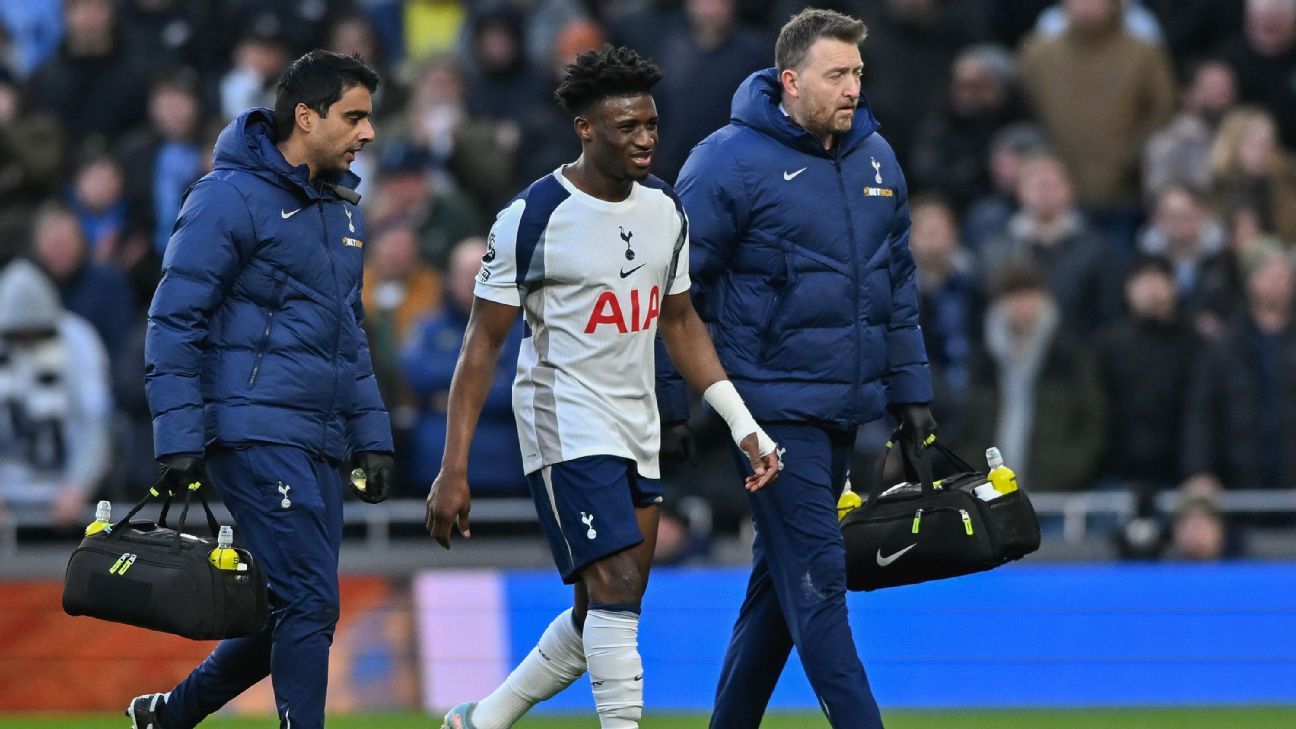
For both, this rebooting will be taking place without the injured Mohammed Kudus.

Losing Kudus to a 'significant quad injury' stretches beyond the absence of one more name on the teamsheet. His loss will have a decisive, significant impact on both FIFA World Cup dreams and English Premier League survival hopes.

For Spurs, he proved -- at least on occasion under Thomas Frank -- that he was that rare attacker who could conjure chaos from nothing.

Without Dejan Kulusevski and James Maddison, both yet to feature this season, he was increasingly invaluable, with individual displays of excellence against Burnley and Leeds United in the first half of the campaign encouraging Tottenham fans to believe that they were primed for a push for Champions League qualification.

For Ghana, he's been the difference-maker, a rare touch of quality in this demoralising cycle, where the four-time African champions have found themselves shorn of the individual excellence and strength in depth of squads gone by.

The parallels between these two decrepit edifices are striking.

Ghana's recent collapse has been marked, because of both the results and the fashion in which they've arrived. Qualification for the Qatar World Cup papered over the cracks that had been increasingly evident, while ultimate failure to qualify for the bloated 24-team 2025 Africa Cup of Nations was a national embarrassment.

Otto Addo's exit felt inevitable, but hasn't erased the damage of the previous spell. It arguably came too late, and surely has come too close to the World Cup for Carlos Queiroz to succeed to the best of his abilities.

Similarly, for Tottenham, Igor Tudor's dismissal felt inevitable, but the board's decision to cut with him has not solved the damage done during those miserable 44 days. Last year's Europa League success under Ange Postecoglou partly papered over the cracks of Spurs' structural decline, but there's been nowhere to hide this season.

Roberto De Zerbi's arrival has surely come too late, and surely too close to an increasingly inevitable relegation for the Italian to succeed to the best of his abilities.

Their appointments have reflected their institutions' desire to recruit specialists in order to pull them out of the mire in which they find themselves.

Queiroz will offer Ghana the experience that was so often questioned under his predecessor Addo, even if his tournament record isn't particularly stellar, while De Zerbi is meant to bring boldness, a front-foot playing style and vitality back to Spurs.

Both men surely need time, however, to implement their visions and establish their standards, although given the impending World Cup and Spurs' plight, it's a luxury that neither possesses.

That's why the loss of Kudus becomes such an acute agony.

He's more than just a talented attacker, he's a talismanic figure of hope, with his flamboyance, his invention, his fine delivery from open play or set pieces, and his ability to receive possession while under pressure.

He can stretch the play, forge openings, trouble opponents with his tenacity and pace, change the tempo and dynamic of a match with his dribbling, and transform his side's fortunes with an effort from range.

In various different modes of play, each of these teams would be markedly strong with Kudus present, whether it's in build-up, transition, taking chances... he's an irreplaceable loss, whether against weaker or stronger opponents.

On one hand, Spurs have stronger options - on paper - than Ghana, so could better absorb his loss, but by the same token, the Lilywhites have also been dealing with a devastating injury record this season, making Kudus's setback all the more painful.

Given the club's misery with injuries this term -- at times, over a dozen players have been sidelined -- one could forgive a certain suspicion on the part of the GFA that Spurs sought to rush back Kudus too quickly following the hamstring injury he suffered in the winter.

Given the incoming De Zerbi's desire to have him available, and Tottenham's crisis situation, a certain urgency on their part could have been forgiven, but given their medical team's catastrophic recent record, and the impending World Cup, it looks to have been a disastrous determination from Ghana's point of view.

Given the club's extensive investment in recovery science, risk prevention and load monitoring, given Spurs' facilities, there must be an enquiry into how another superstar has been lost for the run-in.

There are consequences for all parties.

Kudus is a man for moments. Spurs need as many of those match-defining moments as they can muster in their remaining six fixtures of the season. Without Kudus, it's hard to see where this magic comes from.

Ghana face a similar dilemma, albeit in a different context. Queiroz's likely approach at the World Cup is well established, and we can see the blueprint in his previous campaigns - notably with the Iran national team.

Expect compact distances, disciplined defensive structure, measured possession and carefully chosen moments to attack. Ghana may be a little more expansive against Panama, but against England and Croatia, we can already see how they'll set up.

Queiroz, unlike De Zerbi, is no purist. He wants control, certainly, but he knows that there are different ways to navigate tournament football, not all of which involve controlling the ball.

Typically, the Mozambique-born head coach's international teams play narrow, with a midblock, close out the central zones of the pitch, and prefer to deal with threats out wide. He likes his fullbacks to progress the ball, his midfielders control territory, and forwards' ability to forge openings (and take them) are favoured.

Kudus would have been a huge asset, given his ability to improvise, to both create and take chances.

If Ghana are being outplayed, are short of possession -- as they'll expect to be against their two European opponents -- Kudus could have been the antidote. He could absorb pressure, drag markers, roll opposition, and give Ghana a dimension the other way as well.

Without him, where does the Black Stars' main threat come from? Antoine Semenyo surely steps into a more prominent role without his compatriot.

The Manchester City man is enjoying a strong end to the season under Pep Guardiola -- he was magnificent in the recent 4-0 demolition of Liverpool -- and while the prospect of him and Kudus dovetailing together at the grandest stage, he could slip comfortably into a role on the right flank should Queiroz not desire him in a more central role.

A front three of Semenyo, Jordan Ayew and Adul Fatawu would suit Queiroz, while Prince Kwabena Adu -- who featured in both of Addo's last two matches, having made his debut in November -- may retain his central role under the new coach, as the main direct beneficiary of Kudus's injury.

While the Czechia-based new boy is an intriguing arrival in the camp, two more familiar faces could also take more prominent roles at the World Cup in light of Kudus's absence.

Kamaldeen Sulemana has struggled to impress since arriving at Atalanta, with only three goal contributions in Serie A so far this term, but his ability to play out wide or through the middle makes him a versatile addition for Queiroz. He also has that rare dribbling ability to beat a man, stretch play, and give opponents something to think about in behind.

Could Ernest Nuamah also be the unlikeliest of beneficiaries? The speedster hasn't been seen since April 2025 after being sidelined for a year with a knee injury. He's recently returned to training, and while normally, has probably left it too late to force his way back into contention, could see his stock rise if he can return to action and prove his sharpness with Olympique Lyonnais.

He's another who would relish one-on-one combat, and could be a valuable squad addition who could facilitate the kind of absorb-pressure, stay structured, counter-attack-with-speed-and-efficiency approach that Queiroz is expected to favour.

While there's no doubting that Ghana and Tottenham are comfortably better with Kudus, the Black Stars do have options and do have players who can offer some, if not all, of the qualities that the stricken midfielder could bring to the table.

Perhaps Queiroz has the wiles to turn the setback into a strength; without Kudus's individualism, perhaps he will more readily be able to forge a more compact, cohesive, conservative unit. At least the Black Stars don't have things quite as bad as Spurs.

These two fallen giants begin again; old wounds, new coaches, both seeking redemption, one in the shadow of disaster, the other with disaster looming large before them.

Both have talent enough to recover, although both will recognise that when you lose the player who makes the impossible feel possible, then salvation risks slipping out of reach.
Source

Relegation-threatened Tottenham 'a concoction of misfits' - Gary Neville

Submitted by daniel on
Picture
Remote Image
Relegation-threatened Tottenham 'a concoction of misfits' - Gary Neville - ESPN
Description

Tottenham look like a "concoction of misfits" with "a set of ingredients that don't go together" compared to other teams fighting for Premier League survival, according to pundit Gary Neville.

Leeds battled to a 2-1 win over 10-man Manchester United at Old Trafford on Monday night to move six points clear of Spurs, who sit 18th.

West Ham had thumped bottom club Wolves 4-0 on Friday night to haul themselves out of the bottom three, with Nottingham Forest drawing 1-1 with Champions League chasing Aston Villa on Sunday as Spurs slumped to a 1-0 defeat at Sunderland in their first game under new boss Roberto De Zerbi.

Former United and England defender Neville believes the way Leeds set about delivering a first Premier League win at Old Trafford showed just how far away Spurs are from putting together a team which can secure top-flight survival.

"In the first half, they [Leeds] were absolutely wonderful. That is a performance I don't think Tottenham are capable of -- and that is the scary thing for Tottenham," Neville said on his podcast for Sky Sports.

"Not the six points by the way that Leeds have gone clear of them, but the actual performance levels they put in. They [Tottenham] are nowhere near that.

"You watch Spurs against Sunderland and it is a set of ingredients that don't go together, a concoction of misfits, yet you watch Leeds and there is a balance and a flow."

Tottenham -- who are two points below West Ham -- must now regroup for Saturday's visit of Brighton, when they are expected to be without captain Cristian Romero.

Argentina defender fought back tears as he hobbled off at the Stadium of Light having been injured in a collision with goalkeeper Antonín Kinsky.

- Are Tottenham going to be relegated from the Premier League? What stats, charts say

- How bad analytics built a Tottenham team that might get relegated

- Sunderland condemn racist abuse aimed at Brian Brobbey on social media

Romero -- who was pictured on social media walking through London with a bandage around his right knee -- is set to miss the rest of the season, sources told ESPN Argentina.

De Zerbi said after the Sunderland game that the extent of Romero's injury would need to be properly assessed, acknowledging he was a "crucial player for us".

Tottenham have yet to comment on the reports over a timescale for Romero's recovery.

Press Association contributed to this report.

Source

How bad analytics built a Tottenham team that might get relegated

Submitted by daniel on
Picture
Remote Image
How bad analytics built a Tottenham team that might get relegated - ESPN
Description

There's a funny, instructive little story in Michael Lewis' "Moneyball" that no one remembers because it doesn't involve Billy Beane and therefore was never recreated on a movie screen by Brad Pitt.

In the late 1970s or early 80s, the Houston Astros commissioned a study about what might happen to their team's performance if they moved the outfield fences closer to home plate. They wanted to move the fences in because they figured it would lead to more home runs, and because fans love home runs, they figured they'd sell more tickets. Except, given the types of hitters and pitchers on Houston's roster, the study's authors found, moving the fences in would actually lead to more losses for the Astros.

So, Houston's decision-makers looked at the data, and they decided ... to order that the study never be made public. They'd already made the decision to move the fences in and only wanted data that would support their choice.

I was told a similar story about a professional soccer club by someone who has been working in the industry for more than a decade. The team commissioned him to work up scouting reports for three different players. He broke down each player in detail, and his conclusion for each one was the same: You do not want to sign any of these players. The club responded by asking him if he was able to send over positive scouting reports for each player; they'd already committed to signing all of them.

In both stories, the organizations wanted to use data, but not to make better decisions. They wanted it to justify the decisions they had already made.

• Why missing the Champions League might boost PL teams

• Premier League without set-piece goals: What would the table look like?

• 2026 World Cup squads ranked: All 48 national teams

Now these might sound like stories from a simpler time. Almost every baseball team is being run with way more advanced analytical models than the public can access. And soccer data is everywhere now; Amazon is powering Bundesliga broadcasts and "expected goals" have become part of the common language for virtually every English-language broadcaster.

Yet, while baseball teams have mostly moved beyond using numbers to reiterate and justify their own ingrained biases, soccer clubs have not. They're still not even close. Don't believe me? All you have to do is take a look at the team that, reportedly, was considering telling its own fans that it had "redefined what a modern football club can be."

In other words, all you have to do is look at Tottenham Hotspur.

What we know about how soccer works

Perhaps the core insight of soccer's analytics movement is something that everyone already knows: The best team doesn't always win.

This is essentially what expected goals tells us. At almost any point in a given season, a team's expected-goal differential is a better predictor of future performance than any other top-level number like shots, goals or points. If the best team always won, then past wins would immediately tell us who the best teams are, and then those past wins would predict the future.

Instead, it would appear that the best teams are the teams that accrue the greatest proportion of expected goals in their matches. If we simplify that idea down beyond the abstraction of an ever-updating algorithm that awards every attempt in a given match a specific conversion probability, then the best teams are simply the teams that create better chances than their opponents.

This is something that anyone who has played or watched the sport for long enough really does understand on a deep level -- whether or not they're willing to admit it. But by acknowledging this, we're accepting that there's a large amount of randomness inherent to the outcome of a given soccer match, because there's a large amount of randomness inherent to kicking a bouncing ball, with a misshapen foot, past the one guy on the field who is allowed to use his hands.

Now, the Premier League season isn't that long, and each season consists of something like 20 different team-level experiments. So over a decade, we get 200 different little experiments. And over these 200 different seasons, we'd expect there to be a couple of examples where the randomness boosts, or punishes, a team for an entire season.

That is exactly what we see. Here's every Premier League season since 2010, arranged by how much a team underperformed or overperformed its xG differential:

That team all the way to the right is Tottenham in 2016-17. And if you had to pick anyone to occupy the far-left spot, Tottenham in 2025-26 would seem like a pretty good choice, right? For one of the 10 richest teams in the world to be in a relegation battle with six games left to go in the season, surely "historically bad luck" would have to play a role?

Nope. That's Sheffield United in 2023-24.

This season, Tottenham aren't an outlier at all. Their goal differential (minus-11) is actually slightly better than their xG differential (minus-15.13), but not that much.

How, then, does a team with what's estimated to be the ninth-most valuable roster in the world actually become one of the worst teams in the Premier League? One possibility: You measure the things that you think matter -- and not the things that actually do matter.

Tottenham's major issue: They can't pass

Usually, soccer is a complex, dynamic game where individual qualities are impossible to extract from the interdependencies of roster construction, managerial instructions and on-field interactions. But sometimes you get a team like Tottenham, where the diagnosis is pretty simple: These guys can't pass.

At Gradient Sports, there is a team of people who watch every Premier League game and grade every pass a player makes on a minus-2 to plus-2 scale. Here's how they describe the process:

For example, consider a centre-back passing the ball on the halfway line. A routine, unpressured pass to an open teammate would receive a 0, as this meets the expectation of our expert Grading team. A precise, line-breaking pass under pressure would receive a positive grade. Conversely, an underhit pass to a teammate -- even if completed -- would receive a negative grade if it falls below the expected standard. This reflects our focus on evaluating performance rather than just outcomes.

The grading process is guided by detailed frameworks designed to minimise subjectivity and ensure consistency. Once raw grades are collected, they undergo multiple layers of quality control, including senior review of flagged actions, consistency checks, ongoing analysis, and dedicated quality assurance processes.

Based on this process of evaluating passing, here's where Tottenham's five best passers rank in the Premier League season:

Passing is the fundamental skill in this sport. The average Premier League team attempts 450 passes per game. Nothing else comes close: in a single game, the average team attempts eight shots, crosses the ball 18 times, tries to dribble past defenders 18 times, attempts 16 tackles, and makes eight interceptions. If you can't pass the ball, then nothing else matters. It's the force at the heart of the game that gives everything else meaning.

So, how the heck does one of the richest teams in the world -- one that purports to be the modern example of what a soccer club is -- build a team with only two of the 150 best passers in its own league?

The rise of the wrong analytics

Over the past few years, a new set of numbers has emerged in the soccer world. Rather than quantifying the things that lead to winning, they quantify the things that scouts and coaches have always seemed to value: Who is big and who is fast? Who looks good? Who would be unstoppable if I could teach him how to play?

A number of companies, like Gradient and SkillCorner, now offer a spate of physical metrics that show how often a player is running -- in and out of possession, at top speed, at high speed, etc. I don't fault any of the companies for doing this; it's good that these datasets exist. One of the things that's been missing from soccer data since the start is anything that tells us what everyone else is doing off the ball. The average player has possession of the ball, at most, only for a couple minutes per game, and most soccer data is only quantifying that tiny snapshot of time. It doesn't come close to telling us everything, but it is telling us the most important things.

Used properly, this off-ball, physical data can be incredibly powerful. If you're running a team and you can figure out how to combine these physical metrics with what drives winning and scoring goals, then you've created a new, much more holistic understanding of player value, and you'll have a leg up on anyone who is only using passing and shots to quantify performance. But that's really hard, and since it's really hard, it's not really happening.

Instead, as a source who has worked with a number of Champions League clubs put it to me, the physical metrics are allowing clubs just to confirm their own biases -- the same biases we've been talking about in this battle between scouts and stats since "Moneyball" was written. Except, now we have new stats that say the scouts were right.

How else to explain what happened with Spurs?

What Tottenham have is a roster filled with explosive athletes who can run. Using their physical metrics, Gradient created an "athleticism" score that's a combo of endurance, explosiveness and speed that adjusts for position and size. It's on a 1-100 scale. Tottenham have seven players at a 90 or above and five of them -- Wilson Odobert, Lucas Bergvall, Archie Gray, Dominic Solanke, Conor Gallagher -- were signed after Johan Lange became the club's technical director in October 2023. The first four were the four outfield players signed during Lange's first summer in charge.

You can't build a roster that can't pass unless you're systematically focused on a set of alternative player attributes that creates an institutional blind spot. Given that Romero -- by far their best passer -- was signed in 2021, and James Maddison, who has been injured all season but is easily their other best passer and was signed in the summer of 2023, the ignorance of what actually matters becomes even more stark.

One of the more memorable stories from "Moneyball" is the one where Billy Beane is arguing with his scouts, who are obsessing over how big a guy's butt is, what kind of face he has, or if his girlfriend is attractive. Beane keeps coming back to the question, "But can he hit?" Eventually he becomes enraged, and yells to everyone in the room, "I repeat: We're not selling jeans here."

I've heard it suggested that having someone who understands data and giving them an actual voice in your club is valuable simply because of all the things they'll keep you from doing, by reminding you to keep the main thing, the main thing. But can he hit? At Spurs, though, it seems like a new set of numbers might've blinded the club into thinking that they actually were in the business of selling jeans. What they really needed -- and what would've saved them from relegation -- was someone who kept asking a simple question:

But can he pass?

Source

Tottenham's relegation looks increasingly inevitable after loss at Sunderland

Submitted by daniel on
Picture
Remote Image
Tottenham's relegation looks increasingly inevitable after loss at Sunderland - ESPN
Description

SUNDERLAND, England -- Relegation has never felt more real than this for Tottenham Hotspur. The optimism of appointing a new manager as lauded as Roberto De Zerbi is now set against the dawning realization that one of the Premier League's traditional powerhouses might actually go down.

Sunday's 1-0 defeat at Sunderland means they will end a weekend in the relegation zone for the first time this season with just six matches to play. It is the first time they have been in the bottom three this late in the season in Premier League history.

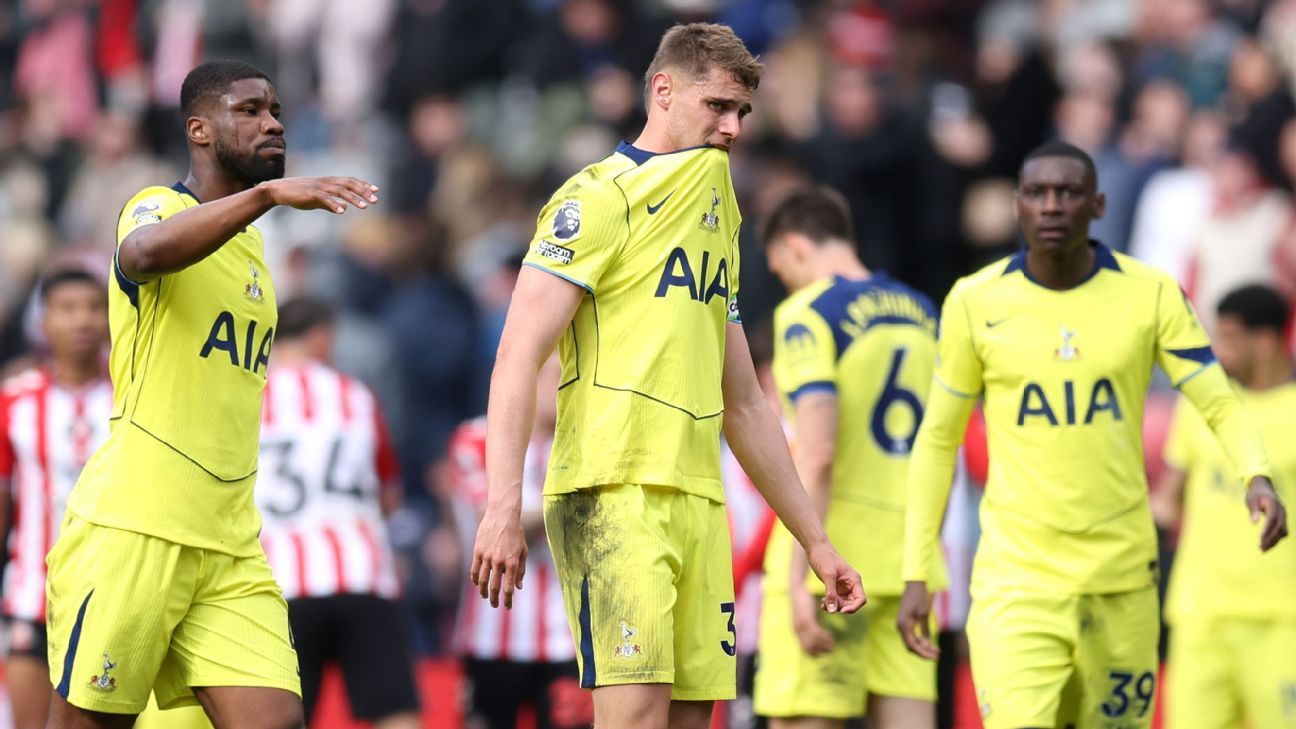
Their captain, Cristian Romero, left the field in tears, and several players including Micky van de Ven looked stunned at the final whistle. Welcome to Spurs, Roberto.

- Why did Spurs hire De Zerbi? Are his tactics right for relegation fight?

- How players really approach a battle against Premier League relegation

- How did Spurs go from Europa League champions to facing the drop?

Faced with staring into the abyss, is the fear itself of relegation the problem?

"I think so," said De Zerbi in response postmatch. "If you ask me, I am 46 years old. I have much [more] experience than the players, and I am positive absolutely because I know them as guys and players and for that I am positive, not because we are Tottenham or because I have to do positive [things].

"They have the quality to win one game and the target now ... is to win one game. Because if we win a game, we can see everything in a different way."

Winning one game is easier said than done. Spurs have now gone 105 days without winning a league game. Fourteen matches without victory is their longest such run since 1935 -- and they went down that year, too.

De Zerbi is a talented head coach, but he is not a magician. He talked before the game about hoping Spurs could invoke the spirit of their attacking, dynamic best under Ange Postecoglou.

On one hand, it was an effort to draw on recent inspiration, reminding a palpably deflated squad of the quality they possess. But on the other, it was also an indication of the dangerous cycle Spurs are in.

After all, the negative aspects of Postecoglou's high-risk football are in part what set Tottenham on their present trajectory. UEFA Europa League winners, yes, but 17th place in the league last season and 18th now.

De Zerbi wanted Spurs to think like the big club they are. Randal Kolo Muani, Dominic Solanke and Richarlison all started a Spurs game together for the first time. Where De Zerbi's predecessor Igor Tudor went for pragmatism, the former Brighton & Hove Albion boss wanted bravery, at least in his team selection.

When referencing the best of Postecoglou's style, De Zerbi mentioned Pedro Porro and Destiny Udogie by name. So it followed that Tottenham's fullbacks often inverted and pushed on as was a feature of "Angeball."

The midfield pairing of Conor Gallagher and Archie Gray was also a throwback to Thomas Frank's spell in charge this season, a choice he adopted initially after Gallagher's January arrival before scrapping that plan. And so it is the story of Tottenham's season so far: managers trying ideas to extract more from a group of players who continue to deliver a performance level alarmingly removed from their reputational level.

Nordi Mukiele's 61st-minute goal was unfortunate in one sense -- his left-footed strike took a huge deflection off Van de Ven to give goalkeeper Antonín Kinsky no chance. It is, as the old cliché goes, the sort of luck you get at the wrong end of the table. But Mukiele was allowed to drift infield under almost no pressure to work himself into a shooting position -- precisely the sort of slack defending that has put Spurs in this position.

Kinsky, incidentally, was one of the only Tottenham players to emerge with any credit in his first appearance since his calamitous 17 minutes against Atlético Madrid a month ago, surviving a clash with Romero that led to a lengthy delay. Sunderland's Brian Brobbey pushed Romero, whose knee collided with Kinsky's face. Romero looked inconsolable as he walked off, but De Zerbi expressed his hope that it was not a serious injury, adding the Argentina international is a "big personality and we need him to finish the season."

There is no silver bullet. And in any case, De Zerbi believes now is not the time for radical change.

"We are inside a difficult moment," he said. "My job is not now to change the style of play. We did two or three things with the ball, without the ball, but the crucial part is our mentality, to be positive."

The mentality point is clear. Both Frank and Tudor expressed concerns about this squad's inability to cope with setbacks, and the statistics back that up. Spurs have now failed to win any of their last 33 league games when conceding first.

"You know me as a coach, but one very important part for my style of coaching is the mental part, to transfer the confidence of the players, to give what they need in terms of mentality and confidence," De Zerbi said.

"For that, we could play better, because during the week they play better because their heads are clean. During the game, it is different for sure. My work to help them, to show them what they do during the week during the game."

De Zerbi has only just started, but the table tells us time is already running out to get that work right.

Source

Tottenham's relegation looks increasingly inevitable after loss at Sunderland

Submitted by daniel on
Picture
Remote Image
Tottenham's relegation looks increasingly inevitable after loss at Sunderland - ESPN
Description

SUNDERLAND, England -- Relegation has never felt more real than this for Tottenham Hotspur. The optimism of appointing a new manager as lauded as Roberto De Zerbi is now set against the dawning realization that one of the Premier League's traditional powerhouses might actually go down.

Sunday's 1-0 defeat at Sunderland means they will end a weekend in the relegation zone for the first time this season with just six matches to play. It is the first time they have been in the bottom three this late in the season in Premier League history.

Their captain, Cristian Romero, left the field in tears, and several players including Micky van de Ven looked stunned at the final whistle. Welcome to Spurs, Roberto.

- Why did Spurs hire De Zerbi? Are his tactics right for relegation fight?

- How players really approach a battle against Premier League relegation

- How did Spurs go from Europa League champions to facing the drop?

Faced with staring into the abyss, is the fear itself of relegation the problem?

"I think so," said De Zerbi in response postmatch. "If you ask me, I am 46 years old. I have much [more] experience than the players, and I am positive absolutely because I know them as guys and players and for that I am positive, not because we are Tottenham or because I have to do positive [things].

"They have the quality to win one game and the target now ... is to win one game. Because if we win a game, we can see everything in a different way."

Winning one game is easier said than done. Spurs have now gone 105 days without winning a league game. Fourteen matches without victory is their longest such run since 1935 -- and they went down that year, too.

De Zerbi is a talented head coach, but he is not a magician. He talked before the game about hoping Spurs could invoke the spirit of their attacking, dynamic best under Ange Postecoglou.

On one hand, it was an effort to draw on recent inspiration, reminding a palpably deflated squad of the quality they possess. But on the other, it was also an indication of the dangerous cycle Spurs are in.

After all, the negative aspects of Postecoglou's high-risk football are in part what set Tottenham on their present trajectory. UEFA Europa League winners, yes, but 17th place in the league last season and 18th now.

De Zerbi wanted Spurs to think like the big club they are. Randal Kolo Muani, Dominic Solanke and Richarlison all started a Spurs game together for the first time. Where De Zerbi's predecessor Igor Tudor went for pragmatism, the former Brighton & Hove Albion boss wanted bravery, at least in his team selection.

When referencing the best of Postecoglou's style, De Zerbi mentioned Pedro Porro and Destiny Udogie by name. So it followed that Tottenham's fullbacks often inverted and pushed on as was a feature of "Angeball."

The midfield pairing of Conor Gallagher and Archie Gray was also a throwback to Thomas Frank's spell in charge this season, a choice he adopted initially after Gallagher's January arrival before scrapping that plan. And so it is the story of Tottenham's season so far: managers trying ideas to extract more from a group of players who continue to deliver a performance level alarmingly removed from their reputational level.

Nordi Mukiele's 61st-minute goal was unfortunate in one sense -- his left-footed strike took a huge deflection off Van de Ven to give goalkeeper Antonín Kinsky no chance. It is, as the old cliché goes, the sort of luck you get at the wrong end of the table. But Mukiele was allowed to drift infield under almost no pressure to work himself into a shooting position -- precisely the sort of slack defending that has put Spurs in this position.

Kinsky, incidentally, was one of the only Tottenham players to emerge with any credit in his first appearance since his calamitous 17 minutes against Atlético Madrid a month ago, surviving a clash with Romero that led to a lengthy delay. Sunderland's Brian Brobbey pushed Romero, whose knee collided with Kinsky's face. Romero looked inconsolable as he walked off, but De Zerbi expressed his hope that it was not a serious injury, adding the Argentina international is a "big personality and we need him to finish the season."

There is no silver bullet. And in any case, De Zerbi believes now is not the time for radical change.

"We are inside a difficult moment," he said. "My job is not now to change the style of play. We did two or three things with the ball, without the ball, but the crucial part is our mentality, to be positive."

The mentality point is clear. Both Frank and Tudor expressed concerns about this squad's inability to cope with setbacks, and the statistics back that up. Spurs have now failed to win any of their last 33 league games when conceding first.

"You know me as a coach, but one very important part for my style of coaching is the mental part, to transfer the confidence of the players, to give what they need in terms of mentality and confidence," De Zerbi said.

"For that, we could play better, because during the week they play better because their heads are clean. During the game, it is different for sure. My work to help them, to show them what they do during the week during the game."

De Zerbi has only just started, but the table tells us time is already running out to get that work right.

Source

Roberto De Zerbi: Tottenham players are scared of being relegated

Submitted by daniel on
Picture
Remote Image
Roberto De Zerbi: Tottenham players are scared of being relegated - ESPN
Description

Tottenham boss Roberto De Zerbi has admitted the fear of relegation is affecting his players after Sunday's 1-0 defeat at Sunderland.

Nordi Mukiele's deflected 61st-minute strike was enough to condemn Spurs to their 16th Premier League defeat of the season and means they will finish a weekend in the bottom three for the first time.

Spurs last suffered relegation in 1977 but they have not won a league game in 105 days and De Zerbi's arrival on a five-year contract was not enough to reverse their downward spiral in his first game in charge after another disappointing display at the Stadium of Light.

Asked if the prospect of relegation itself was the reason behind Tottenham's problems, De Zerbi said: "I think so. If you ask me, I am 46 years old. I have much [more] experience than the players and I am positive absolutely because I know them as guys and players and for that I am positive, not because we are Tottenham or because I have to do positive [things].

"They have the quality to win one game and the target now, the closest target is to win one game because if we win a game, we can see everything in a different way.

"You know me as a coach but one very important part for my style of coaching is the mental part, to transfer the confidence of the players, to give what they need in terms of mentality and confidence.

"For that, we could play better because during the week they play better because their heads are clean. During the game, it is different for sure. My work to help them, to show them what they do during the week during the game."

- Tottenham lose Roberto De Zerbi's first game vs. Sunderland, stay in drop zone

- Are Tottenham going to be relegated from the Premier League? What stats, charts say

- Which injuries could decide Premier League relegation run-in? Every team's problems explained

Captain Cristian Romero was substituted in tears following a collision with goalkeeper Antonín Kinsky.

Brian Brobbey appeared to push Romero and his knee collided with Kinsky's face.

"We have to see in the next days," De Zerbi said. "I hope for us not an important problem because he is a crucial player for us. A good guy, top player, big personality and we need him to finish the season and to achieve our goal.

"Maybe yes [it is his knee] but I don't want to say anything because I don't know."

De Zerbi insisted he was still optimistic Spurs would avoid relegation.

"We are inside a difficult moment," he said. "My job is not now to change the style of play. We did two or three things with the ball, without the ball, but the crucial part is our mentality, to be positive. We have the quality to win a game when we win a game, we change everything."

Source

0 Spurs (Apr 12, 2026) Game Analysis

Submitted by daniel on
Picture
Remote Image
Sunderland 1-0 Spurs (Apr 12, 2026) Game Analysis - ESPN
Description

Roberto De Zerbi's first game in charge of Tottenham ended in defeat after they were beaten 1-0 by Sunderland at the Stadium of Light.

The Italian took over from Igor Tudor, who left North London last month, and Spurs entered the contest in the Premier League relegation zone after West Ham beat Wolves on Friday.

An open first half saw Spurs have a penalty decision overturned in the 21st minute and both teams enjoy opportunities, with Brian Brobbey, Richarlison and Dominic Solanke all going close.

However, Sunderland took the lead 11 minutes into the second half through Nordi Mukiele's deflected strike, which proved to be enough as Regis Le Bris' side clinched back-to-back league wins.

Defeat leaves Spurs languishing two points adrift in the drop zone with six games left to play, still searching for their first Premier League win of 2026.

De Zerbi gave a start to goalkeeper Antonín Kinsky, who had not appeared since his 17-minute nightmare in the Champions League defeat to Atlético Madrid last month.

It was one of five changes the former Brighton boss made from Spurs' last outing against Nottingham Forest, but he was not able to oversee an instant improvement.

Pedro Porro's early effort was saved by Robin Roefs and Spurs threatened again when Randal Kolo Muani played Richarlison in, but the forward had his meek shot held by the Sunderland goalkeeper.

At the other end, Cristian Romero had to make an important intervention from a Sunderland attack and Granit Xhaka's in-swinging delivery was tipped over the crossbar by Kinsky from the resulting corner.

Kinsky made a brave stop to deny Brobbey after he had been found by Enzo Le Fée, and the Netherlands striker nodded over from his next opportunity.

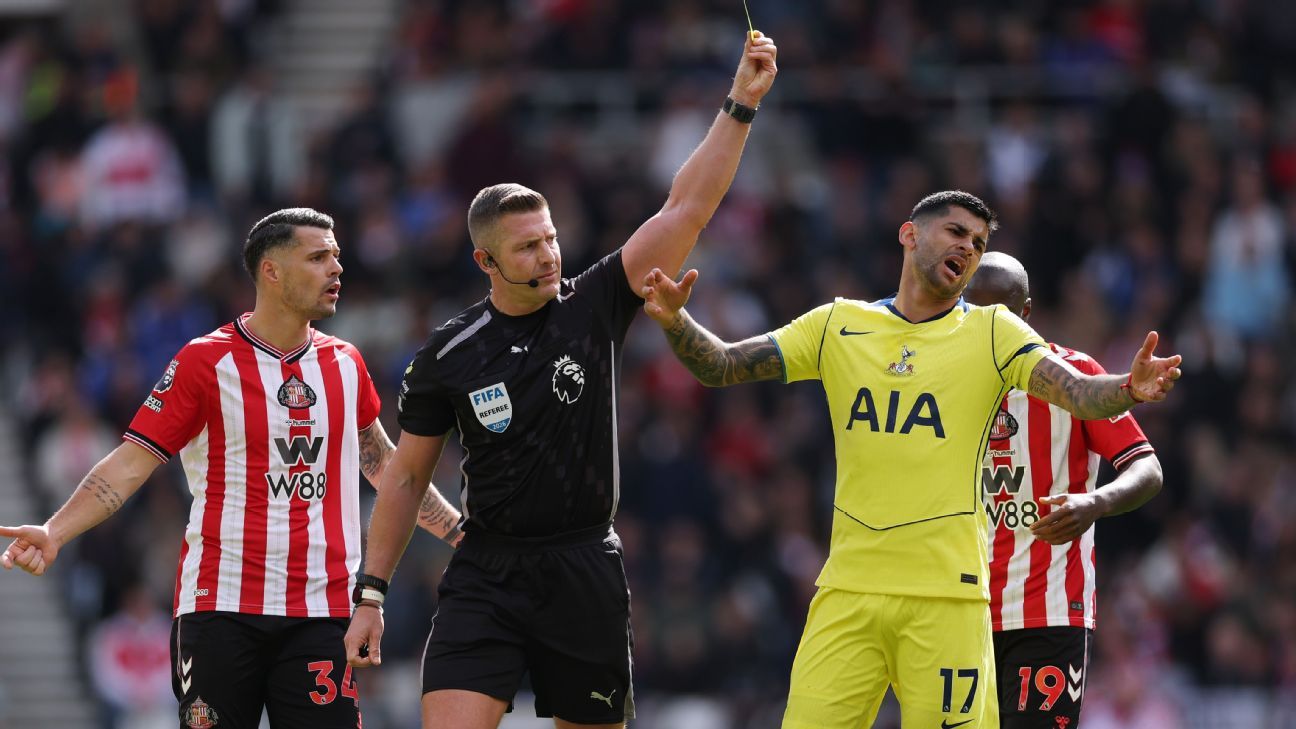
Spurs were awarded a penalty in the 21st minute when Kolo Muani was ruled to have been fouled in the area, but following a VAR consultation, referee Rob Jones overturned his original decision as Omar Alderete clearly won the ball.

The chances continued to come as Solanke's attempt was taken by Roefs before Mukiele nodded wide from a Le Fée free kick and Xhaka's vicious strike from the edge of the area whistled past the post.

In first-half stoppage time, Brobbey was denied again by a solid save from Kinsky, and Roefs made a crucial stop at the opposite end from Solanke.

Luke O'Nien made an important intervention to deny Richarlison early in the second half, and the Spurs forward then had a low effort held by Roefs.

But Sunderland opened the scoring in the 61st minute when Mukiele weaved from the right flank toward the outside of the box, and his strike deflected off Micky van de Ven's foot to leave the wrong-footed Kinsky with no chance.

De Zerbi made a triple substitution with Mathys Tel, João Palhinha and Pape Matar Sarr introduced just before a worrying moment saw Romero and Kinsky collide.

Following a lengthy stoppage, the Spurs goalkeeper had a bandage wrapped around his head and was able to continue, but a tearful Romero was replaced by Kevin Danso.

Spurs had 11 minutes of added time to salvage a point, but despite Porro being denied twice by Roefs -- having both a free kick and vicious strike pushed over the bar -- Spurs could not avoid a 16th league loss.

Source