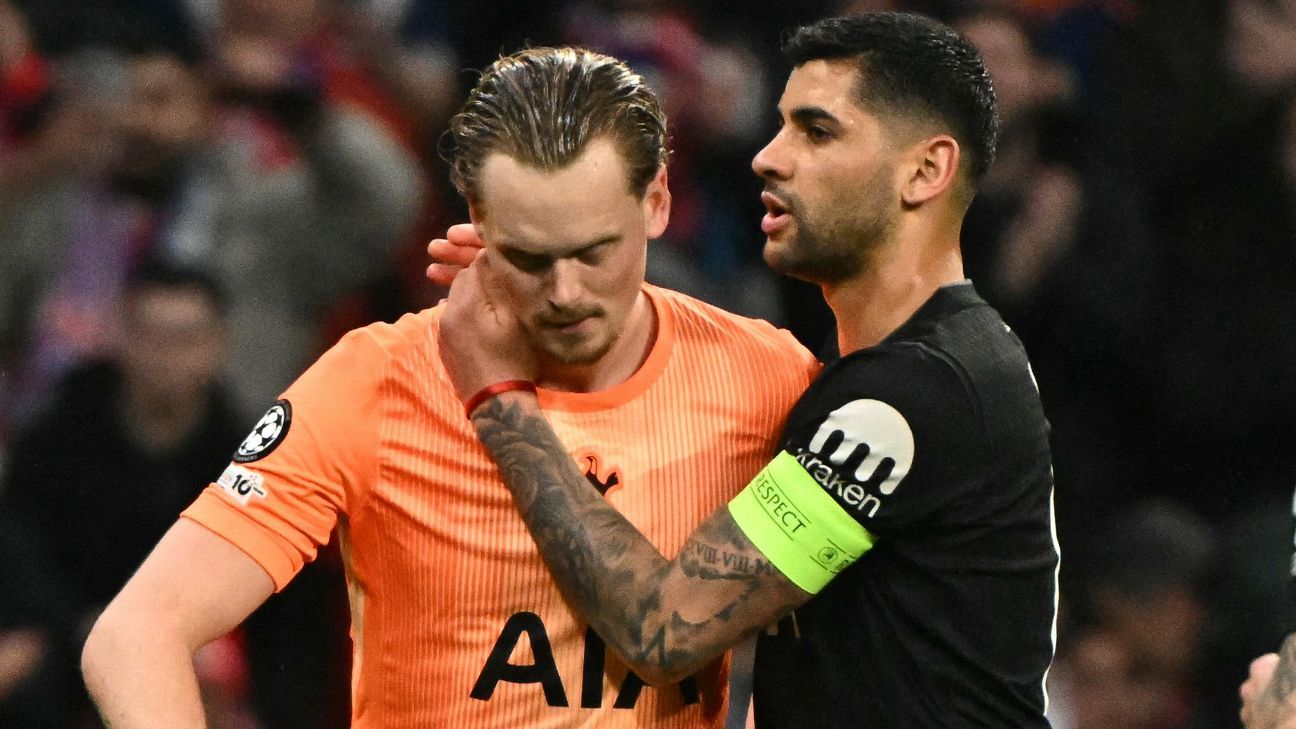
Antonín Kinsky's error-strewn performance in Tottenham Hotspur's 5-2 UEFA Champions League loss at Atlético Madrid, which ended with the goalkeeper being substituted after 17 minutes with his team already 3-0 down, makes you realize what a savage business football can be.
When the 22-year-old's name appeared on the team sheet for his European debut in Madrid, I'm sure many Spurs fans and others probably didn't think it was the worst idea given that No. 1 Guglielmo Vicario, among other senior players, hasn't necessarily been at his best in the past few months. How quickly things can change.
Kinsky's first mistake (if we want to call it that) came after six minutes when he slipped as he attempted to clear the ball, leading to Spurs immediately being punished with the opening goal. I put that caveat in because although it shouldn't have happened, it's something that could happen to any player. (Indeed, we soon saw Micky van de Ven slip, leading to Atlético's second goal, and several other players from both teams were losing their footing throughout the evening.)
- Spurs' unprecedented implosion felt like rock bottom
- The stats behind Kinsky's horrible night for Tottenham
- UCL Talking Points: Spurs terrible as all English sides lose
In that situation, you won't find many teammates who will look at you and say, Why did you do that? They're disappointed that it has affected the game, but there's not much you can say apart from, Come on, let's keep going.
But Kinsky's second mistake, when he tried and failed to play a first-time pass with his weaker left foot and allowed Julián Álvarez to walk the ball into an empty net? That's a technical error. It wasn't the pitch or the ball back to him; it's a failure of execution that led to his team being 3-0 down inside 15 minutes.
After his first mistake, Kinsky put his hands on his head. But after his second, he was face down on the pitch. I'm not even sure he was looking as the ball went into the net. That's when the human element kicks in and you think, Oh my goodness, this is a lot to be dealing with. Moments later, he was being replaced.
I can't think of a time when a goalkeeper has been substituted that early for a performance-related issue. But Spurs interim manager Igor Tudor, who made the call to put Kinsky into the team on such a big occasion, seemed to have decided that this guy's doing so poorly and is so low in confidence that he can't continue in this game. For any professional, that's a tough thing to accept.
When you make a mistake that puts the spotlight on you, you want to believe that those around you will support you by keeping playing and the manager will show faith by keeping you in there to offer something positive. One of the reasons you've made it as a professional is because at some stage, you have faced adversity and you have been able to get through it -- sometimes with flying colors. So, for your coach and maybe even some of your teammates to make the decision that you cannot deal with the adversity? I think that's one of the toughest moments you can have as a player. And as Kinsky walked down the tunnel, he must have been deeply questioning himself. It's a dark place for any professional to find themselves.
It certainly stood out that Tudor didn't even appear to acknowledge Kinsky as he passed by. But then, if I was Kinsky coming off the pitch, I don't know if I would even want the manager to take me aside and try explaining why he thinks I'm so bad that he has to replace me immediately with the player he didn't trust to start the game in the first place.
We don't see a ton of early subs in games, especially not a change between the posts. Even though it was going badly for Kinsky, this still feels unprecedented -- so much so that a manager shaking your hand is not going to make you feel any better.
The thing that makes the situation feel so different is the fact that it happened in the first half. So when the Spurs players came into the dressing room at halftime, 4-1 down by that point, there were all the emotions and anger over how poorly the team was playing and how the game was going, but then there was also a young goalkeeper sat in the corner, potentially as upset as any player you've ever seen before. But if you go and make a big deal about the goalkeeper, it's like the game doesn't matter; and if you make a big deal about the game, it's like the goalkeeper doesn't matter anymore.
Did Kinsky say anything at halftime? If so, what? It would have been the first time the manager had seen him since forcing him to take the walk of shame. Tudor might be able to talk for five minutes at halftime, at most. How much of it does he give to that one player? The players themselves are watching everything Tudor's doing, and for them, for as much as they're unsure about how to feel about that moment, they're still looking to the manager for answers about how to improve in the second half. And all the while, there's huge frustration and anger toward the nature of the performance.
I've been sent off before, and if it was definitely a red card and the team suffered as a result, you just start off by apologizing. But then it's awkward because if your teammates think it wasn't the right decision, they'll say you don't need to apologize, but the result of the game itself still needs to be addressed. Contrary to what some people think, everybody who has played professionally has shown this desire and energy to be a winner -- these people hate losing. In the aftermath of games, there are so many competing emotions that make it really difficult for players and coaches to decompress.
There is little respite for Tottenham, as they travel to Liverpool on Sunday still in desperate need of results to avoid relegation from the Premier League. If the manager picks Kinsky at Anfield, we're now looking at him and wondering (fairly or not) if he is good enough physically and strong enough mentally to recover from what happened in Madrid. However, the way football goes, especially at this stage of the season, people are ruthless. There is no sentiment allowed anywhere because when everybody is fighting for results, they'll do anything to win. And if that means pressuring Kinsky on the pitch or encouraging the crowd to get on his back every time he's got the ball at his feet, they will do it.
Does Tudor still trust him to handle possibly the most high-pressure situation Tottenham has faced in the club's recent history?
One of the best things about football is that it's great when the spotlight's on you for a positive reason. You feel invincible. However, when the spotlight is negative, there's nowhere to hide. You just have to try to step up and move forward, which is far easier said than done -- especially when you don't know if you'll get the chance to play again and make up for your mistakes.
Kinsky's teammates at Tottenham now have to decide whether to make a big show of offering their support or giving him time and space. There is no right answer because the fact is the mistake still was made. As I saw it happen, I thought that his error wasn't necessarily a representation of how good a goalkeeper he is, but it was a representation of this moment in time for both himself and Tottenham.
Nobody would want to be in his shoes in that moment, and even though the game has passed -- the second leg, in north London, is on Wednesday -- many eyes still remain on all those involved, from Kinsky to Tudor and the rest of the Tottenham team. After all, it was a moment that will live long in the memory.
Nedum Onuoha was speaking to ESPN senior editor Tony Mabert