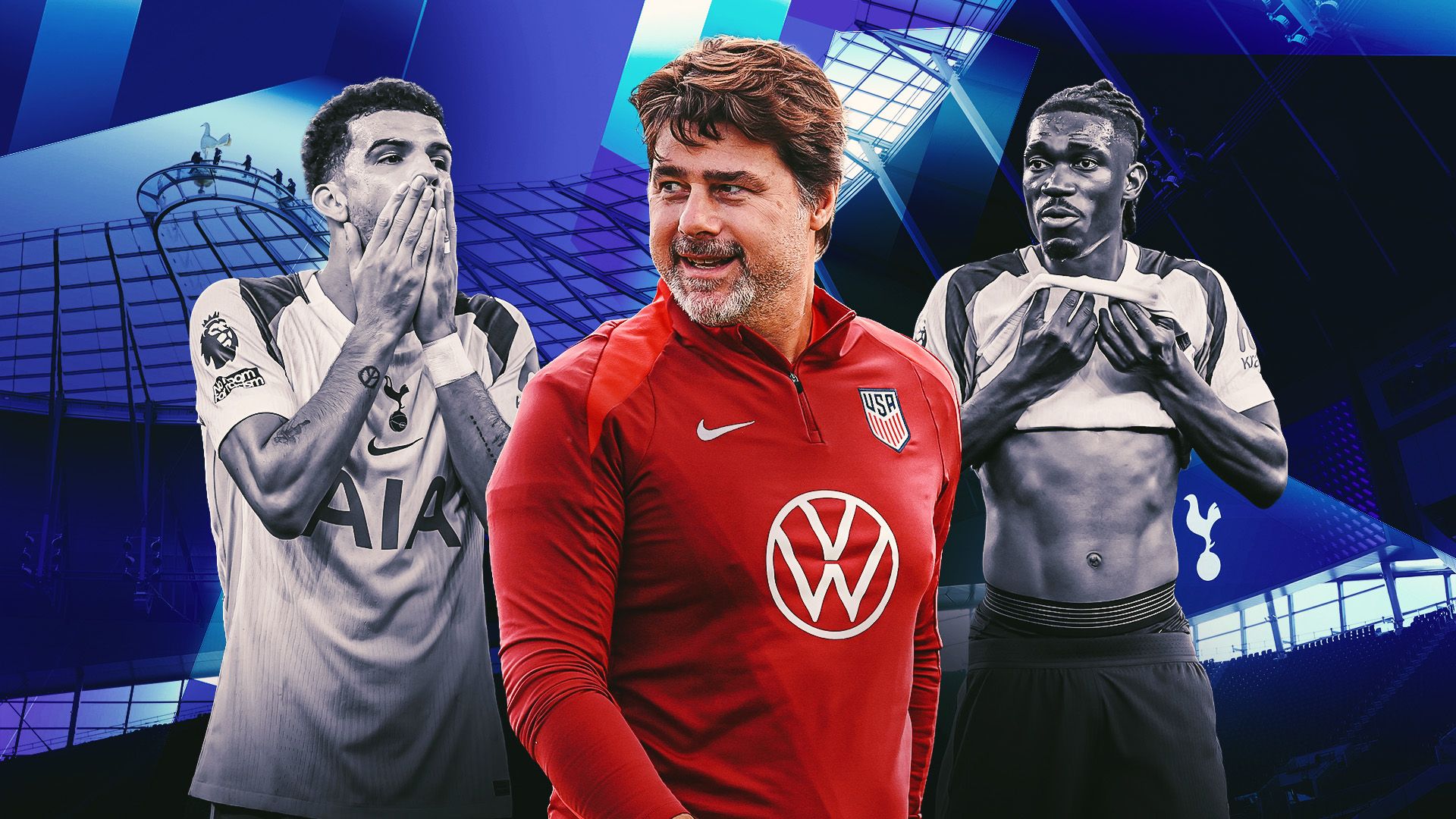
Pochettino is Tottenham's most successful manager of the modern era. Forget using silverware as a barometer of measurement and simply think about the best Spurs sides you can remember. They were all teams managed by the Argentine. Best of all to Tottenham fans, he genuinely loves the club, warts and all.
Tottenham, from the fans to the players to the board, loved Pochettino. He was a modern-thinking tactician with his pressing and playing from the back, an astute man-manager and the exact sort of character you would want as the face of your club. If there was a definitive image of Pochettino through his first three years at Spurs, it would be that with tears in his eyes as Tottenham waved goodbye to the old White Hart Lane for the final time.
Tottenham sold right-back Kyle Walker in 2017 after the defender asked to move to a team more capable of winning titles. The club had hoped a Barcelona or Bayern Munich would make a bid and they could sell abroad, but such offers were not forthcoming. Walker ended up joining Manchester City for £50 million, which at the time was a world record fee for a full-back.
That same summer, Spurs received interest from Manchester United for left-back Danny Rose and versatile defender Eric Dier. There was belief in some corners they could have commanded a combined £100m, only for both to stay put. The feeling upstairs in that moment was they didn't want to be seen as a selling club, but in hindsight it may have been better to take the money and reinvest, especially considering the effective embargo Pochettino was placed under.
After Tottenham acquired Lucas Moura from Paris Saint-Germain at the end of the January 2018 window, Spurs went 18 months without making another signing. This came despite two very public - and out of character - pleas from Pochettino to then-chairman Daniel Levy.
At the end of the 2017-18 season, the Argentine pulled no punches at his final press conference heading into the summer, saying: "If we want to be real contenders for big trophies, we need to review a little bit the thing. We need to create dreams that will be possible to achieve. Maybe we are a bit disappointed and frustrated because now we are close [to trophies].
"I think Daniel is going to listen to me, of course. You need to be brave. Being brave is the most important thing and take risks. I think it’s a moment that the club needs to take risks and tries to work, if possible, harder than the previous season to be competitive again, because every season will be more difficult."
Spurs' only sign of any activity in the summer of 2018 was a derisory bid made for Jack Grealish, offering £4m plus academy graduate Josh Onomah, believing Aston Villa were on the brink of financial disaster. In fact, the West Midlands club had just received fresh investment and laughed them out the door.
Levy and Co at the time insisted the budget was there for Tottenham to bolster the squad despite their delayed move to the new billion-pound Tottenham Hotspur Stadium, but suggested at a meeting with the supporters' trust that transfers were actually quite difficult to pull off. That was an admission of failure to Pochettino, his players and the fans. It was also the first sign that this regime was not ready to make that leap to a truly club.
Pochettino's Tottenham ran on fumes for the entire 2018-19 season having made one senior signing across their last two transfer windows, failing to add to what was an already thin squad while missing the chance to shift other players when their concentration started to wane. That's why reaching the club's first-ever Champions League final was even more of a miracle, but the circumstances around Spurs getting there left Pochettino even more drained, and he intimated he would quit if they did indeed become kings of Europe.
Shortly prior to their famous comeback against Ajax in the semi-finals, Pochettino again warned that there was no point in Spurs investing so much in a new stadium if they were going to neglect the squad again: "When you talk about Tottenham, everyone says you have an amazing house, but you need to put in the furniture. If you want to have a lovely house, maybe you need better furniture. And it depends on your budget if you are going to spend money. We need to be respectful with teams like Manchester City or Liverpool who spend a lot of money.
"We are brave, we are clever, we are creative. Now it's about creating another chapter and to have the clear idea of how we are going to build that new project. We need to rebuild. It's going to be painful."
Spurs signed Tanguy Ndombele, Giovani Lo Celso, Ryan Sessegnon and Jack Clarke during the summer of 2019, but that wasn't enough to repair the damage of the previous 18 months and they have been playing catch-up in the market ever since. Every window has proven too reactive and, at times, one window too late.
Pochettino was sacked five months after the Champions League final, with the club pivoting to a 'win-now' strategy under Jose Mourinho. It didn't go as planned.
Levy was the top dog at Tottenham on a day-to-day basis. For all his flaws, he ran Spurs in an almost exemplary manner and had earned the right to try and take them to the next level from when he took charge in 2001 to leaving White Hart Lane in 2017. He delivered the new stadium on what was sometimes described as a one-man mission, desperate to help the club find new ways to bring in revenue.
Levy's main drawback was he couldn't help but get in his own way. He was stubborn over transfer policy despite the calls from managers to spend more on wages, as most recently attested to by Ange Postecoglou and Gareth Bale on the Stick to Football podcast. He was accused of running Tottenham as a business and did little to sway that argument. He tried but often couldn't delegate power away from himself. He never seemed like a 'proper football man', in layman's terms.
Former captain Hugo Lloris claimed that the Spurs squad were rewarded for reaching the 2019 Champions League final with luxury watches as personal gifts from Levy. They were engraved with the words 'Champions League finalists'. "I would have preferred nothing to be written on it," Lloris said, only fuelling suggestions Levy lacked a winning mentality.
At his worst, Levy was a lightning rod for criticism. The Lewis family, who run the club on a broader scale but not in the same every-day way as Levy, sacked their chairman in September, briefing that they were targeting 'more wins, more often'.
Levy's responsibilities were assumed by CEO Vinai Venkatesham, with Peter Charrington becoming chairman on non-executive terms. What does any of that mean? Very little, as it turns out. There is a leadership vacuum at Tottenham that extends from the boardroom to the pitch, allowing a slide into mid-table mediocrity turn into a fight against relegation. Spurs need some sort of figurehead to represent them again.
As referenced earlier, the main reason behind Tottenham's decline has been their inability to rebuild the playing squad. There has been too much of a focus on signing either teenage prospects who aren't yet ready to play, or midfield 'duellers' who lack the technical ability to complement their team-mates.
Johan Lange joined Spurs from Aston Villa in November 2023, initially as technical director before being promoted to sporting director. He has overseen five full transfer windows, and in that time, Tottenham have gone from Champions League contenders to scrambling for survival. It was a situation that supporters were concerned with during the most recent January window, particularly with the club into a third-successive season of mass injuries, but Lange explained that he didn't want to panic.
"There was simply not many available players, across the whole marketplace, during January... There are a lot of injuries in January, and we are definitely a club that is suffering with those at the moment," he told Spurs' club channels. "During the course of the window it’s very important, even though that is highly frustrating with all the injuries, to remain disciplined because, a) the players are coming back and, b) if you then, can you say, go in and make a 'stress purchase' of any football player then yes, the immediate feeling it gives you is nice. But of course there's no point in signing players that will not help us in the short term, in the medium term or even in the long term.
"So even though that is highly frustrating with all the injuries, the majority of the players will return this season, here, hopefully a few very soon. And it is important as a club to remain disciplined and make sure to do to the best of our ability only to sign players that can generally help the team, now or in the future."
As of March 9, Spurs are still without 10 (ten) first-teamers due to injury. The recruitment team have again neglected to realise that when these fitness issues pile up, there is a knock-on effect. Players who are usually robust are run into the ground, others are played out of position to try and make ends meet.
Lange gambled on the future of Spurs. If they are indeed relegated, he would do well to work in English football ever again.
Football's modern obsession of club models where the 'manager' is merely the 'head coach' may be heading to a full-circle moment. Sporting and technical directors still exist, but they are not necessarily the lone individual responsible for recruitment.
Tottenham would be wise to take a leaf out of the books of two rivals who have breached the 'big six' over the last three years in Aston Villa and Newcastle. They have handed power, control and autonomy back over to their respective men in the dugout, Unai Emery and Eddie Howe, with every part of the project revolving around them. Such unity has been key to climbing up the table and challenging for major honours.
And it may seem hard to remember right now, but at the start of Arsenal's ascent back to title contention, they had to wrestle control back from Spurs in the north London power struggle. The Gunners, at their lowest ebb for a quarter of a century, quickly promoted Mikel Arteta from 'head coach' to 'manager' in 2020. Their fortunes got worse before better, but once Arteta had his fingerprints all over every facet of the club, that's when they started to make progress again.
The right manager can make for a unifying figure. For Tottenham, that has to be Pochettino. No other person who has stepped foot inside Hotspur Way since 2014 has understood what Spurs are and what Spurs need more than him. They went down the 'winners' route, they went down the 'we're not panicking' route, but all roads lead back to the Argentine.
Pochettino has made no secret of his desire to return to Tottenham. Earlier this year, he revealed on the High Performance Podcast that it is the one club he remains enamoured with. "Still, the people on the street, the fans of Tottenham, really show the love and the appreciation, and I think that is why it's so special," Pochettino, who still lives in London, said.
He also spoke of the lofty ambitions Spurs should have, though said this at the start of February before their current predicament settled in like mould taking over a luxury downtown abode.
"To win a Europa League, that the team won, is good, but it's not enough," Pochettino continued. "It is not enough to challenge for the Carabao Cup, or the FA Cup, or the Europa League, or the Conference League. It's a club that should be, or needs to be because the fans, what they expect is, to be in the Champions League, fighting for the Champions League, trying to believe that you can win the Champions League and also fighting for the Premier League and believing that you can win the Premier League."
Poor defending has been a problem on the pitch for Spurs over the last couple of seasons, but the real poison has been their neglect in the final third in a post-Kane world. Even in Postecoglou's second season, opposing teams became used to the way Tottenham would structure attacks and nullify their threat easily, given how stubborn the Australian was with his tactics. When Frank was appointed with a remit to make them more conservative, he sometimes removed attacking from the equation altogether - his decree that "we will 100 percent lose football matches" lingers. Under Tudor, it's Spurs' incoherence on the ball that is killing them as much as any lapses at the back.
Ambition on the pitch can sometimes reflect that off it, and the last 12 months at Tottenham are testament to that. Pochettino, though, hasn't lost any of that drive to be the best.
The Tottenham job isn't attractive anymore. Not now, not at the end of the season if they stay up, and definitely not if they go down. Since Pochettino's exit in 2019, his successors have tended to endure the lowest ebbs of their respective careers while in N17.
Spurs' under-fire owners do have some PR moves to call upon. Pochettino, who wouldn't necessarily be put off managing in the Championship with Tottenham, is not only the favourite amongst fans to reignite the fire they have for their club, but at this stage is probably the most-qualified candidate who's interested in the job. Couple this with the exits of Lange and maybe even ex-Arsenal chief Venkatesham and it would be the first sign that those running the club seriously do want the drastic change that is sorely needed.
Pochettino's return would also likely be met with more grace and patience than any other outsider. Even despite a promising performance against PSG in the UEFA Super Cup and a win away at Manchester City in his opening month, Frank's Spurs were still booed at half-time and full-time of his first defeat, a 1-0 loss at home to Bournemouth. Even then, lots of supporters weren't prepared to buy the bridge the club was trying to sell them, but most would gladly jump at the offer of a reunion with Pochettino.
Tottenham are broken and only one man is worth calling to put them back together again. There is nothing else for them to lose anymore with going back to their favourite old flame.