Of all the members of the English Premier League's so-called "Big Six" clubs, Tottenham Hotspur's inclusion has always been the most generous. Liverpool, Arsenal, and Manchester United are clearly deserving of their spots as historical powerhouses that can weather runs of bad form, even across seasons. Chelsea and Manchester City have over the past couple decades acquired the money and success to overcome their humble histories (three combined first division titles pre-2000) and achieve class ascension. But what has Tottenham done to deserve equal billing?
Since 2000, Tottenham has won two trophies: the 2008 League Cup, and last season's Europa League. Prior to 2009-10, the club hadn't finished in the league's top four spots since 1989-90. Even in this past decade and a half of relevance, Tottenham has never even come close to matching its ostensible peers' weight as measured in either silverware or sterling. Instead, Tottenham became a Big Six club more from steadiness than greatness. This made it more prone to slippage, and though it has taken quite some time, I think it's about time to remove Tottenham from that illustrious club of clubs.
Last season's Europa League win did not mask how dire the Premier League campaign went for Spurs. The club's 17th-place finish in the league could tell that story by itself, even if Tottenham was never really in danger of relegation thanks to the ineptitude of the three newly promoted sides. But what might have looked like a blip last season has now turned into something far more concerning. After firing manager Ange Postecoglou at the end of the season, in came Thomas Frank, who'd worked miracles with Brentford. Almost immediately, the Frank hire was revealed to be a complete mismatch of club and coach, and a barrage of injuries made even mediocrity, to say nothing of miracles, nearly impossible. The losses piled up, and even though Frank could point to the club's 2-0 away win at Manchester City and its surprising run in the Champions League all the way to fourth place in the league phase, Tottenham regularly looked overwhelmed no matter who the opponent was.
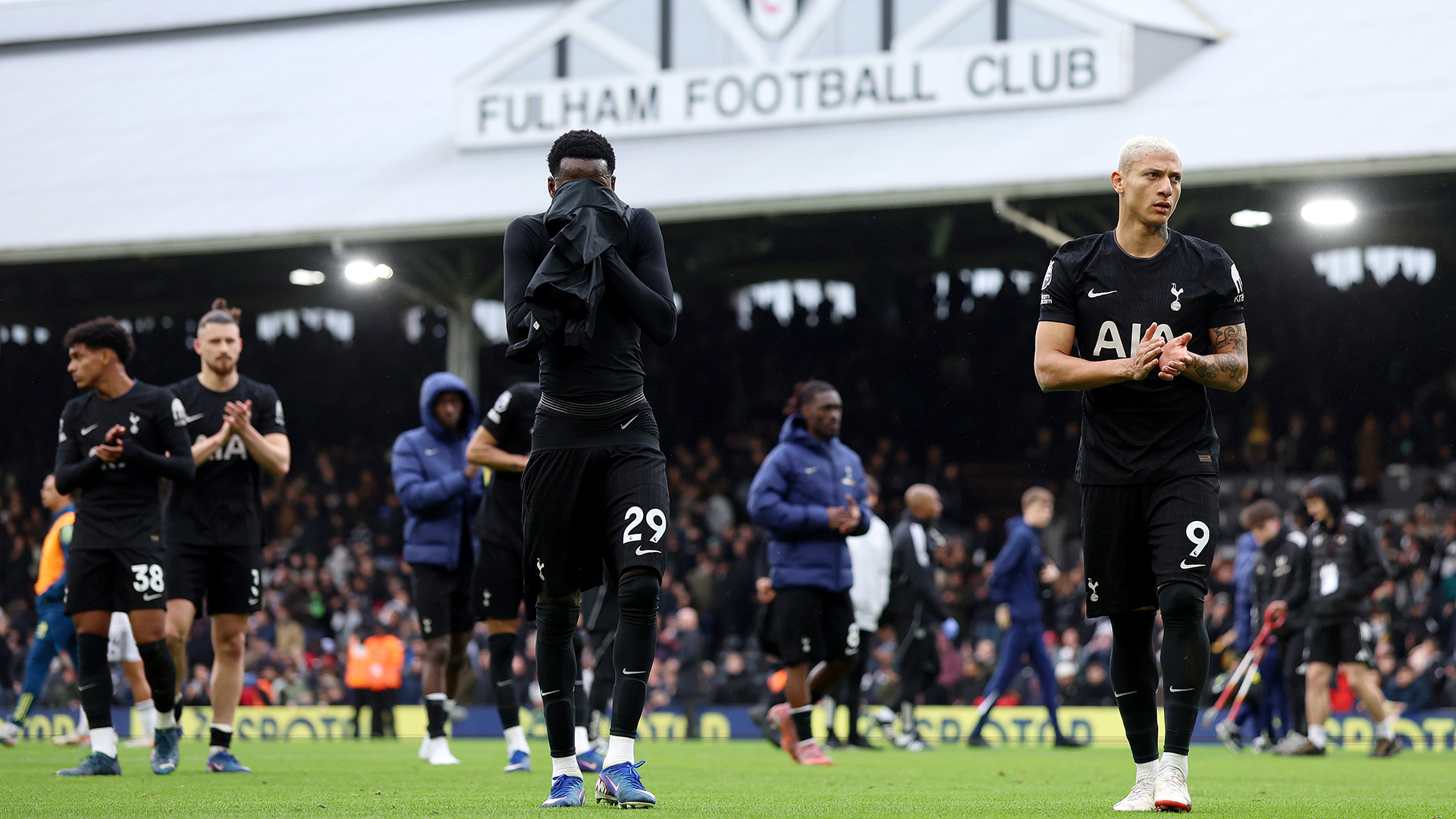
The club finally fired Frank on Feb. 11 after a 2-1 home loss to Newcastle. In came Igor Tudor, a Serie A journeyman coming off a poor stint of his own at Juventus. In Tudor's defense, his first match in charge was an impossible ask, a North London Derby against league-leading Arsenal. Tottenham's 4-1 obliteration at the hands of its hated rivals was no less painful, though, and Sunday's 2-1 defeat away at Fulham only compounded the misery.
Fulham exploited the well-trod weaknesses of a Tottenham side that simply does not have enough talent and depth to keep up. Like a skillful predator, the Cottagers attacked right down the middle of Tottenham's midfield, repeatedly bull-rushing into the attacking third with little resistance. When that wasn't working, Fulham also lobbed in crosses from the flanks to test Tottenham's shoddy defense, and both Fulham goals came from slips in play from that beleaguered backline.
On the first one, right back Kenny Tete lofted a speculative ball into the area, which bounced to former Man City youngster Oscar Bobb. He attempted to cut it back to the center, but the ball was deflected by Connor Gallagher ... directly onto the turning foot of Harry Wilson, who had no one in his face. It was a tidy finish while retreating from the goal, but with Radu Dragusin on the ground (Tottenham unsuccessfully lobbied for a foul) and captain Micky van de Ven not keeping Wilson marked, Wilson's task was easy.
The second goal was even more concerning, even if it required a bit of finishing magic. After a give-and-go between Alex Iwobi and Wilson, Iwobi had acres of space from which to drive an unexpectedly angled shot into the far post, and though the Nigerian midfielder did exceedingly well with his strike, one of Archie Gray or Xavi Simons really should have been there to close down the space Iwobi was allowed to waltz into.
It's hard to know how to evaluate Tottenham when the roster is so ravaged by injuries, so I want to cut some slack here, but a club of Tottenham's stature should never find itself this close to disaster. It's not like there aren't good (and expensive) players out there on the field even with about half of the squad on the proverbial training table. Five of the team's six players in attack and midfield on Sunday transferred to Tottenham in the last two seasons (Yves Bissouma could be considered the veteran; he was signed in 2022), and three of them (Dominic Solanke, Simons, and Gallagher) for fees of over €40 million. And yet, watching how Fulham overran the midfield and how futile Tottenham's attackers were—at least until substitute Richarlison came in and scored a hopeful goal in the 66th minute—I can't help but be sickened by the incompetence.
It's a shame, really, because Tottenham was for so long the model to follow for other Premier League teams looking to outperform their budgets. Smart recruiting, good coaching, and clutch performances—these were the things Tottenham excelled at while climbing the hierarchy of the Premier League under manager Mauricio Pochettino. If things tended to fall apart at the business end of the season, such as finishing third in a two-team battle for the 2016 title or losing the 2019 Champions League final to Liverpool, it was only because Tottenham was so well structured that it could even be disappointed by that. Even after Pochettino was fired in November of 2019, and things at the top got a lot goofier, Tottenham could still be counted on to finish in the top eight or so of the league, with respectable runs in European competitions.
The deep European runs appear, somewhat perplexingly, to still be the effect, but Spurs' domestic form has fallen off a cliff. Tottenham currently sits in 16th in the table, but unlike last season, it might have an actual relegation battle on its hands. Nottingham Forest is two points back in 17th and, crucially, West Ham is only four points back in the first relegation slot. Though the Hammers got clobbered 5-2 by Liverpool this past weekend, they have looked better than Tottenham in recent weeks; that's not particularly difficult, since Tottenham has lost four in a row, but West Ham no longer looks like the relegation shoo-in it seemed to be a couple months ago, and so Tottenham's survival can no longer be taken for granted.
Safe money would probably say that Tottenham will not get relegated; there's still too much talent there, and the schedule eases up after a particularly brutal stretch on either side of Frank's firing (three of the four losses came against top-nine opposition, and the other was against Newcastle, another tweener member of the league's fluctuating number of "big" clubs). The most likely outcome is that Tottenham finishes somewhere in the 15-to-17 range this season, but even a deeper run into the Champions League won't soften the blow of a wasted season. And if Tottenham does get relegated, it will be a disaster the likes of which the Premier League has not seen in decades.
Whatever happens, one thing is clear: Tottenham can no longer be counted on as an elite side, or even a particularly good one. Instead, the club is back to where it has been for most of its history: just another team trying to survive the grind of the Premier League and live to fight another day.