Football is a simple game. Twenty-two men chase a ball for 90 minutes and at the end, Spurs always do a nonsense.
It might be impossible to ever predict exactly what you’re going to get from Spurs, but you can be pretty certain it will involve nonsense of some sort.
And on the best days, on days like this one when the Spursy gods smile down benevolently upon us all, you get every kind of nonsense from one of the worst first-half performances ever recorded to a stirringly unlikely comeback and a point earned from a genuinely outrageous finish to secure a result the main beneficiary of which is Arsenal.
There is never a wider purpose. There is never a deeper meaning. They are just entirely ridiculous entirely all of the time, and it is all just a bunch of stuff that happens.
Over the years they’ve had good teams, they’ve had bad teams and they’ve had indifferent teams. What they’ve always had is teams capable of the utterly absurd for good, bad and both. You really do just have to try and roll with it.
We come back time and again to that infamous 4-1 defeat to Chelsea in the early days under Ange Postecoglou, and we put it to you that no other team could conjure a scenario where they lose 4-1 but appear to have the whole thing being played out on their own terms. That was a game that happened to Chelsea, even as they were scoring three unanswered goals in the second half. At no point in proceedings were Chelsea actually in control of what was going on, they were just along for the ride with the rest of us.
The time between City’s all-too-easy opening goal and all-too-easy second goal was one full of opportunities for City to score all-too-easy other goals but lacking certainty and conviction because it was all just too absurdly easy.
It felt like a scam, and City weren’t going to fall for it. Until Spurs plumbed depths so unprecedented that City had literally no choice but to do so and made the fatal mistake of scoring their second goal to apparently end a contest that hadn’t ever really started.
Throughout the first half there was a curious sense of City being deeply wary of the fact Spurs might be trying to drag them down to their level and beat them with experience.
It’s understandable, of course; there are few teams who’ve suffered more by being swept up in Spurs nonsense than Pep Guardiola’s Manchester City. This is a fixture he routinely overthinks like no other; it should be no surprise to see him do the same when all he really needed to think was ‘These are sh*t’.
City playing within themselves at 2-0 made some sense, but the failure to mount any truly compelling bid for victory at 2-2 was shameful, really. Erling Haaland and co should face tougher questions than they are likely to, which again is because this just felt like a game where, bizarrely, it was always Spurs’ level that set the tone, from the Soccer Aid first half to the Total Football of the second.
There remains no excuse for the overall paucity of their league campaign. It is still ridiculous that relegation remains a plausible outcome. It is still ridiculous that Thomas Frank is still here. It is still ridiculous that more hasn’t been done over the last month to supplement a bare-bones squad trying to play twice a week.
Yet that second-half performance was as good as it was unexpected. Several players produced the best work they’ve ever delivered in Spurs colours.
Radu Dragusin, Archie Gray, Joao Palhinha, Xavi Simons, Dominic Solanke. All exceptional in the second half, and all players who have had their doubters.
His hold-up play, the intelligence of his runs and the range of finishing he brings make Spurs a wholly different prospect than they have been without him.
For all that Spurs fans enjoyed the comeback, they will be holding their breath for a more definitive update on the late ankle injury that forced him off the field and clearly caused discomfort. They cannot afford to lose him again.
Simons nearly got the goal his performance deserved with a deflected effort superbly saved by Gianluigi Donnarumma as he became the game’s driving force in that absurd second half in which a makeshift Spurs XI looked the better side against title contenders.
It’s true and fair to say Spurs cannot use injuries and absences as an excuse for being quite so bad as they have been this season, but it would be equally wrong-headed to dismiss it out of hand.
Spurs were by the end of this game missing 12 first-team players split roughly betwee certain starters in their strongest XI – Romero, Van de Ven, Porro, Kulusevski, Maddison, Kudus – and key squad components – Bergvall, Spence, Danso, Bentancur, Richarlison, Davies.
They finished this game with a 17-year-old making his debut, midfielders at centre-back and right-back and almost none of their outfielders in the same positions as they’d started the game.
He remains a solution in their midfield rather than the solution. They still urgently need a progressive passing type in there to make them just less wretched a watch against teams who won’t allow them to play as much football as City did.
But he still brings plenty to that Spurs midfield that was sorely lacking before. There has always been drive and energy to Gallagher’s play. The lack of finesse at the end of it all can be frustrating, but in a Spurs team that can look so pedestrian so often it’s really not hard to see how he could end up a firm favourite.
Even in the first half when every other Spurs player was dropping a 2/10, Gallagher was a solid and busy 6. In the second half, he gave Simons and Solanke a run for man of the match.
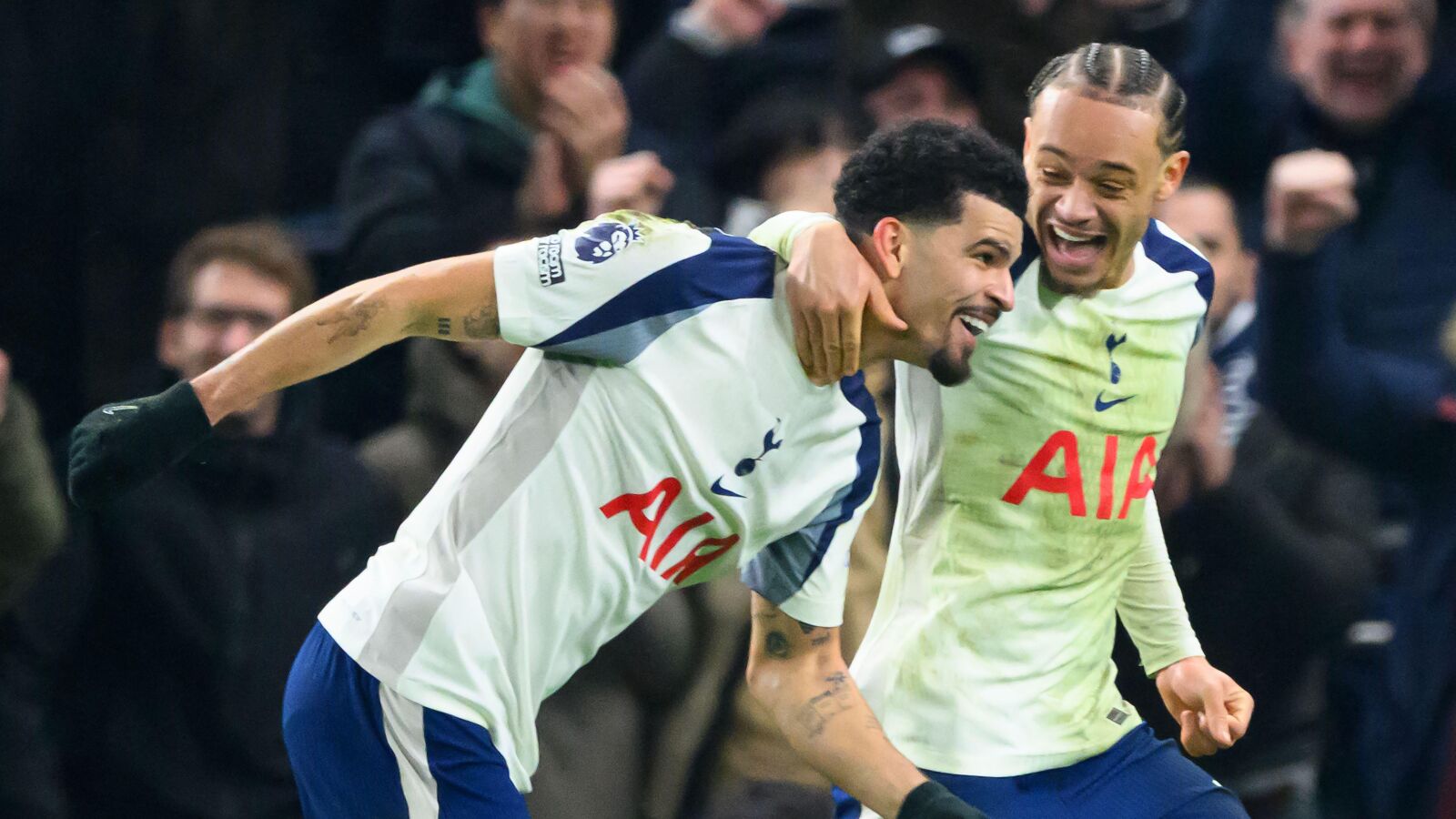
The second goal will quite rightly be remembered for Solanke’s outrageous, improvised scorpion kick finish but it simply doesn’t happen without Gallagher showing the wit and desire to win a midfield ball he had no right to and then bursting away to get the cross in.
Gallagher’s obvious and still at 25 puppy-like energy and enthusiasm for the game can often give off the appearance of a headless-chicken chaos. But he’s better than that. He reads the game smartly; the interception that led to the second Spurs goal was one of three for Gallagher in a game where no other player on either side managed more than one.
As with Simons’ contribution to the first goal, there is a clear sense here of something Spurs have lacked. Of a player doing something nobody else here would or could. And then playing in a Proper Number Nine to do likewise.
He is precisely the kind of player Spurs have lacked for so long and even out of position and facing the daunting prospect of Antoine Semenyo in full flow was rarely perturbed and only occasionally found out. Far less so than the far more experienced (albeit returning from long-term injury) centre-back Radu Dragusin to his left.
There are few players in the game who love a tackle more than Palhinha. He made six here, which was of course more than anyone else on either side (although a nod to half-time sub Sarr and his four) and extends his lead at the top of the all-comers list in the Premier League this season.
The grumblings about him earlier in the season were always misdirected. The problem was never Palhinha’s destructive No. 6 stylings, and always Frank’s insistence on pairing him with Rodrigo Bentancur in a double cement-mixer pivot.
Spurs still do lack a midfield passer, and it’s absurd they don’t seem to be showing any urgency to address that, but it doesn’t make Palhinha’s presence a problem, whether deployed in his customary position or as emergency centre-back cover.
For a club with Spurs’ historic commitment to nonsense, there’s a lot to be said for someone who is just uncomplicatedly no-nonsense.
And that’s that while yes, Spurs clearly were miles better after the break than before it to a truly staggering degree, the doubts remain about the repeatability of this.
Solanke deserves huge credit for the spectacular brilliance of his second goal and for his initial work and perseverance of the first, one which we’re just about satisfied wasn’t a foul given the touch he got on the ball before he caught Marc Guehi.
But both goals are of the buy a ticket and take your chance variety. Yes, Simons, Gallagher and Solanke get credit for buying those lottery tickets but the amount of times those finishes result in one, never mind two, goals would be staggeringly small.
Spurs’ best bet really does still remain trying to play for two halves per game instead of just the one.
But with both Micky van de Ven and Kevin Danso missing out here, the previous argument that a back three put the greatest number of Spurs’ few proficient round pegs in suitable round holes lost a lot of weight.
The post-match revelation that Cristian Romero was also struggling with illness explained a lot about why he’d been quite so far off it in a horrible first half, and why Frank opted again to try safety in numbers at the back, but the enforced switch to a back four improved Spurs markedly.
You would not, obviously, choose to lose your captain and star centre-back when you are already without two other high-class centre-backs against Man City, but the enforced return to a back four worked out wonderfully well for Spurs.
The addition of Pape Sarr to the midfield levelled up the numbers in there and massively eroded the levels of largely unencumbered influence Rodri and Bernardo Silva had enjoyed in the first half.
Semenyo put himself in direct opposition with Palhinha, who is not a centre-back, and Cherki against Dragusin, starting a Premier League game for the first time in a year.
Both scored before half-time, while Cherki was only denied a second goal by a Vicario save so improbable that none of the officials spotted what was a quite significant deflection to send the ball spinning the right side of the post from his point of view.
Yet in the second half, with a more orthodox back four and more mobile midfield with Gallagher and Sarr both in there, those channels and one-on-one contests evaporated.
It seems so churlish to criticise a team for the football that earned them a 2-0 half-time lead, and clearly we’re not pretending here that we foresaw that Spurs comeback. But City could and should have done more in that first half to truly put the game to bed given the sheer levels of generosity on offer from their hosts.
Spurs were that bad that we’re really not sure we can even say City were particularly good. They certainly weren’t ruthless, and paid a heavy price.
Neither Cherki nor Semenyo could get themselves anything like as involved in that second half, while Bernardo Silva too was less imposing, unable to recreate the bite and drive that saw him make such a fool of Yves Bissouma to create the opening goal.
The root of it all, though, seemed to be the near total loss of influence Rodri was able to exert on proceedings. It’s hard to escape the thought that he just isn’t the player he once was.
Sure, when teams give him the time and space that Spurs did in the first half he can still dictate a game with the best. But that was an alarming second half, one that ended with the indignity of Pep Guardiola forced to substitute him to save him from himself after getting away with two fouls that could have brought second yellow cards in the space of 10 seconds as the clock ticked down.
This was a player whose ability to control high-tempo, high-octane Premier League games single-handed has helped deliver multiple titles to the Etihad. His inability to do so here could be the one truly meaningful conclusion from this very daft football match.
On a day when Aston Villa also dropped points unexpectedly, the real winners are clear.
Spurs will feel far better about themselves than they did at half-time, but one point doesn’t dramatically alter the mathematics of what is still for the time being at least a relegation fight. It does far more to alter the equation at the other end of the table.
Arsenal fans have had their issues before about a lack of assistance from Spurs in a game against Man City, but they can have no such grumbles this time around. Arsenal did Spurs a massive solid on Saturday afternoon against Leeds, and that favour has been returned.