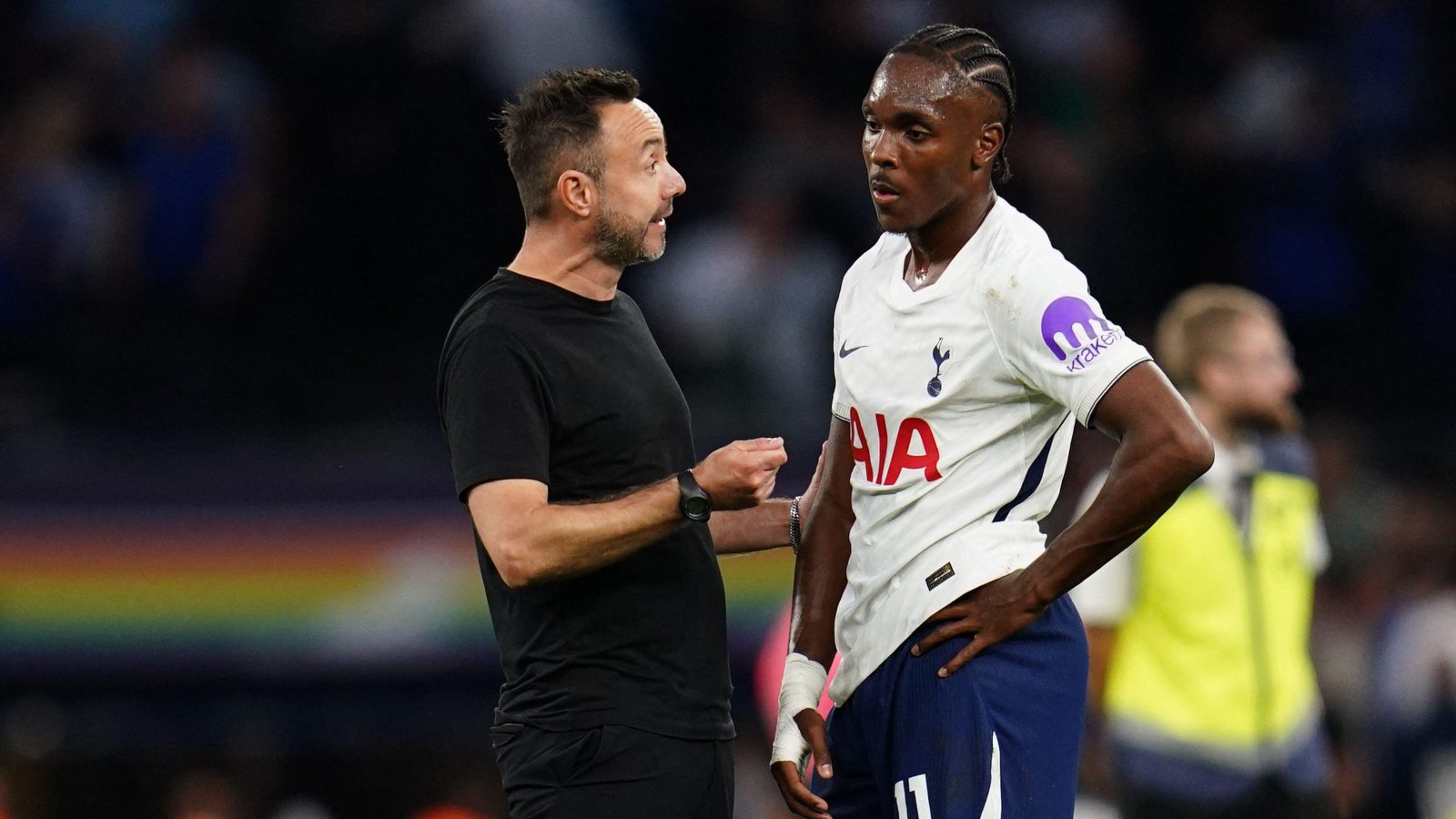
Tottenham Hotspur spent £300m in the summer to supposedly ensure they would never be in a relegation scrap again. But after four league games, they’ve scored zero goals.
Money can’t buy you love or, in Spurs’ case, goals.
Their lavish trolley dash in the summer saw them buy talents like Omar Marmoush and Savio from clubs like Manchester City, but they look just as flustered as the rest of the team in front of goal. The mood is low.
The logic in the summer was simple: buy better ready-made Premier League talent at a premium price and let Roberto De Zerbi do his thing.
It’s not worked so far but, taking a deeper look, it’s not as bad as I assumed and could certainly improve as the players gel. But as always with De Zerbi, there are drawbacks to his methods.
So, are Tottenham executing Roberto De Zerbi’s build-up? Do they have a ‘mental block’ in the penalty area, as the Italian put it? And can so many new players create chemistry while working within the constraints of the Italian’s style?
Taking one for the team, I re-watched Tottenham’s matches this season in an attempt to answer those questions…
Nice build-up, but does it end well?
De Zerbi came to the attention of tactics geeks when his methods of ‘press-baiting’ gained traction at Sassuolo and then Brighton. Particularly against Liverpool in the Carabao Cup, we saw Tottenham use this well to a degree.
It helped that Liverpool are a high-pressing team and the game was end to end, but either way, Tottenham calmly knocked the ball around the defence, waiting for Liverpool to press before finding a dropping midfielder or attacker.
This method takes out all the players up the pitch and quickly gets the ball into attack, leaving the players pressing up the pitch further away from defence.
Marmoush is particularly good at drawing two midfielders close to him, allowing gaps to open up for other midfielders like Sandro Tonali to play a quick give-and-go to gallop into space.
Against Newcastle United, we again saw signs that the players were slowly getting it. The problem isn’t getting the ball out of Tottenham’s defence; the problem occurs afterwards, when they get closer to goal.
They spurned many chances against Liverpool, and the nice positions they got into vs Newcastle United and Everton were wasted.
The tactic of dropping an attacker, fizzing it into them and using a runner to quickly receive after touching it off to them is working, but the chances created are not clear-cut because players are rushing the shot, resulting in bad decision-making.
As there are many new players, synergy is lacking in terms of knowing how another attacker moves to construct the end of an attack.
It’s been a long time since Tottenham had an in-form goalscorer, let alone a deadly attacking partnership. You can sign an exciting attacking prospect; you can’t be sure they’ll hit the ground running in a team lacking in confidence.
This was on show as the minutes ticked by vs Everton, with the tempo dropping along with the belief that Tottenham could score, resulting in less purposeful jaunts forward.
It’s why a game like Liverpool is something to take encouragement from; although it was the Carabao Cup, Tottenham never gave up, scored and should have scored more.
They just need a Premier League goal now to believe that it works.
Opposition Press
There is a permanent tactical battle in Premier League matches for space in the middle of the pitch; teams have prioritised designing defensive blocks to make it difficult for attacks to run through them.
So, when Tottenham use a dropping attacker in Marmoush or Mohammed Kudus to receive the ball, teams thus far have responded by pushing a defender up to follow them.
It stops Marmoush from turning as the defender is aggressive in his approach, but it also turns the ball over.
Eventually, against Liverpool it results in Cody Gakpo scoring, as Archie Gray initially started the move positioned high and wide, as he has been under De Zerbi.
This happened at Nottingham Forest too, as Nikola Milenkovic was not afraid to track Marmoush as the Egyptian attempted to receive in his own half.
The physicality of the league means a challenge can be put in that may be deemed a foul in other leagues such as Ligue 1 (the last league De Zerbi managed in). Or teams can commit cynical fouls, as Liverpool did, stopping the move before it becomes dangerous.
Over time, to tweak this, De Zerbi may position Tonali as the player to receive the ball and carry into space rather than relying on Marmoush or Kudus to turn his man with his back to goal, as the Italian is stronger.
Are things actually that bad?
Tottenham came away with a point at Forest (a tough place to go to) and had their chances against Newcastle.
Though they were physically overwhelmed on the opening day to Brentford, the opening half-hour vs Everton, especially with the joy Savio was getting, is something to build on.
The worry is that it may take some time for the goalscoring floodgates to open and the players to connect.
But that doesn’t mean that there haven’t been signs that they’re already at least trying to play the De Zerbi way.
The pressure of a large expenditure in the summer, as well as a diabolical 2025/26 season, looms heavily over Tottenham Hotspur, but there are finally signs that things could improve.